
Have you ever stopped mid-sentence and wondered which word fits: rather or whether? You’re not alone. These words look similar, but they serve very different purposes. One usually expresses a preference, while the other introduces uncertainty or choices. Using the wrong one can make an otherwise clear sentence confusing. It’s an easy mistake to make in emails, exams, conversations, and everyday writing. The good news is that you don’t need complicated grammar rules to tell them apart. Once you understand their basic roles, the difference becomes surprisingly simple.
This guide breaks down the difference in plain English. You’ll learn how each word works through short, natural examples. We’ll also cover useful phrases like would rather, rather than, whether to, and whether or not. Along the way, you’ll see common mistakes and simple memory tricks. By the end, choosing the right word should feel much more natural.
Rather or Whether – Quick Answer
When comparing rather or whether, the key difference is meaning and word usage. Rather usually expresses preference, while whether introduces doubt, uncertainty, or alternatives. They aren’t interchangeable words.
Think of rather when you prefer one option. Think of whether when you wonder about a possibility or need to consider options. This simple distinction works in daily communication, emails, exams, and formal writing.
Rather
Rather is an adverb that can express preference or comparison. It often appears with would rather, I’d rather, or rather than.
For example:
- I’d rather stay home tonight.
- She would rather walk than drive.
- We chose tea rather than coffee.
In these sentences, the speaker prefers one choice over another. That preference makes rather the correct word.
Conversation example:
Alex: Do you want to watch a movie?
Sam: I’d rather read a book tonight.
Whether
Whether is a conjunction. It often introduces doubt, uncertainty, alternatives, or an indirect question.
For example:
- I don’t know whether he’ll come.
- She asked whether we were ready.
- I’m not sure whether to stay or leave.
Here, the speaker isn’t expressing a preference. Instead, the sentence focuses on uncertainty or possible choices.
Conversation example:
Alex: Are you sure she’ll join us?
Sam: I’m not sure whether she’ll come.
Quick Tip
Use this easy memory trick:
Rather = prefer
Whether = wonder
If you can replace the idea with prefer, choose rather. If the sentence expresses uncertainty or asks about possibilities, choose whether.
- I would rather stay home. → I prefer staying home.
- I wonder whether she will come. → I wonder if she will come.
The difference between rather and whether becomes much easier once you focus on meaning rather than spelling.
Remember:
- Rather → preference or comparison
- Whether → doubt, uncertainty, or alternatives
- Rather than → one choice instead of another
- Whether or not → either possibility
- Whether to → uncertainty about an action
These grammar rules can help English learners form correct sentences with confidence.
The Origin of Rather or Whether
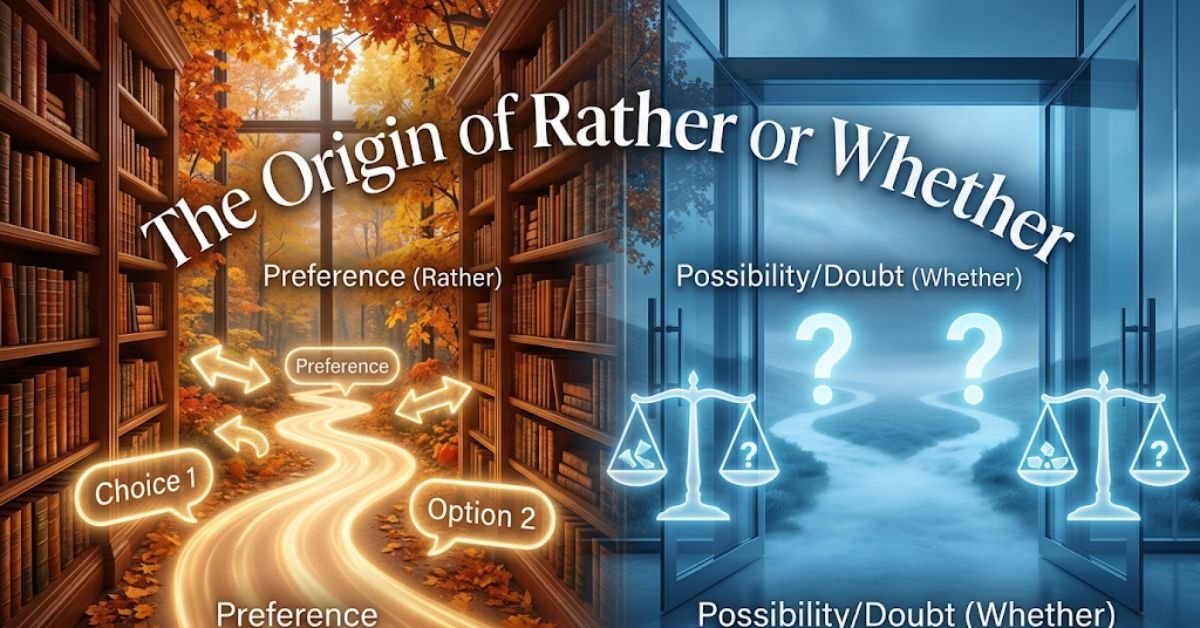
The word origin of rather or whether explains why these words developed such different meanings. Both have roots in Old English, although they followed different paths through the history of English.
Rather traces back to Old English hraðor, the comparative form related to hraðe, meaning quickly, readily, or soon. Historical usage gradually connected the word with choosing something sooner or instead. That development helped shape its modern preference meaning.
Whether comes from Old English hwæther or hwether. Its early sense referred to which of two, which fits its modern role in presenting alternatives and uncertainty.
How Their Meanings Developed
The historical difference gives you a useful way to remember their modern roles.
- Rather developed toward preference and alternatives.
- Whether developed around choices and possibilities.
- Rather can show what someone prefers.
- Whether can introduce an indirect question.
- Whether can also introduce two or more alternatives.
For example:
I’d rather take the train.
The speaker expresses a preference.
Now compare:
I don’t know whether the train has arrived.
The speaker expresses uncertainty.
Their histories aren’t just interesting facts. They also provide a useful memory aid for modern English grammar.
Conversation example:
Mia: Why does “whether” appear in questions?
Noah: Because its older meaning involved choosing between possibilities.
The exact historical meanings changed over centuries. However, the central idea of choice remains visible in modern usage.
For today’s writing, focus on meaning rather than memorizing ancient forms. The easiest rule is still simple: rather = preference, whether = uncertainty or alternatives.
British English vs American English Spelling

If you’re wondering about British English vs American English, there’s good news. Rather and whether have the same spelling in both varieties.
There are no meaningful spelling differences between US English and UK English for these two words. The same forms work in British English, American English, Commonwealth English, and global writing.
- British English: rather, whether
- American English: rather, whether
- UK English: rather, whether
- Commonwealth English: rather, whether
The bigger issue isn’t spelling. It’s word usage and sentence structure.
For example:
I’d rather stay home.
works naturally in both varieties.
Likewise:
I’m not sure whether she will come.
works in both British and American English.
Does Usage Change?
Some style preferences can differ slightly between varieties or writing settings. However, the core grammar rules remain the same.
Whether often appears in careful or formal writing when writers present alternatives or indirect questions. That doesn’t mean it belongs only to formal English.
You can use it in emails, speech, social media, academic writing, and professional writing.
Conversation example:
Emma: Is “whether” only British English?
Liam: No. American English uses “whether” too.
So, don’t choose between these words based on nationality. Choose based on the meaning you want.
For global writing, focus on the sentence’s purpose. If you’re expressing a preference, use rather. If you’re showing uncertainty or alternatives, use whether.
That simple rule works across English varieties.
Comparison Table
| Feature | Rather | Whether |
| Main meaning | Preference, comparison, or degree | Doubt, uncertainty, or alternatives |
| Word type | Adverb | Conjunction |
| Common phrase | would rather | whether or not |
| Another pattern | rather than | whether to |
| Main idea | What you prefer | What you wonder or consider |
| Example | I’d rather stay home. | I wonder whether she’ll come. |
| Choice | Shows a preferred choice | Introduces possible choices |
| Indirect questions | Not normally used for this role | Commonly used |
| Formal writing | Common | Common |
| Informal writing | Common | Common |
| British English | Rather | Whether |
| American English | Rather | Whether |
The table makes the rather vs whether distinction easy to scan. Still, context matters because rather has other uses besides preference. It can also express degree or help correct a previous statement.
For example:
It’s rather cold today.
Here, rather doesn’t show preference. It means something like “quite” or “to some degree.”
Meanwhile:
We need to decide whether to leave.
Here, whether introduces an alternative and uncertainty about an action.
Quick comparison:
- I would rather walk. → preference
- I don’t know whether to walk. → uncertainty
- I’d rather walk than drive. → preferred alternative
- I wonder whether we should walk or drive. → possible alternatives
Once you see the role each word plays, choosing the correct form becomes much easier. Practice these patterns in emails, exams, daily communication, and formal writing to make the distinction feel natural.
Which Spelling Should You Use?
Choosing between rather or whether depends on what your sentence means. These words sound similar, but they perform different jobs in English grammar.
Use rather when you express a preference. Use whether when you show doubt, uncertainty, or alternatives.
The easiest way to avoid confusion is to check the sentence’s purpose before choosing a word.
- Rather → preference or comparison
- Whether → uncertainty or alternatives
- Rather than → one option instead of another
- Whether or not → either possibility
- Whether to → uncertainty about an action
Conversation example:
Nina: Which sentence sounds right?
Omar: I’d rather stay home because you’re expressing a preference.
Nina: What about “I don’t know whether he’ll come”?
Omar: That’s correct because you’re unsure about his arrival.
Remember this simple memory trick: rather = prefer, whether = wonder. It works well for exams, emails, speech, and daily communication.
Use “Rather” When:
Use rather when your sentence shows preference. It often tells the reader which option someone favors.
The most common pattern is would rather. You can also use I’d rather in everyday speech and informal writing.
For example:
- I’d rather drink tea.
- She would rather walk home.
- We’d rather wait until tomorrow.
- He chose to stay rather than leave.
- I’d rather read than watch television.
When comparing two actions, rather than often connects the preferred option with the alternative.
Conversation example:
Jake: Do you want to take the bus?
Maya: I’d rather walk. It’s a nice evening.
Here, Maya isn’t uncertain. She has already expressed her preference.
You can also use rather without showing a direct choice. In some sentences, it means “quite” or “somewhat.”
The movie was rather interesting.
So, don’t assume rather always means preference. Context matters.
Use rather for:
- Preference
- Choosing one option
- Comparisons
- Would rather constructions
- Rather than constructions
- Degree or emphasis in certain sentences
Use “Whether” When:
Use whether when your sentence involves uncertainty, alternatives, or an indirect question.
It often appears when someone doesn’t know which possibility is true. It can also introduce a choice between alternatives.
For example:
- I don’t know whether he will come.
- She asked whether we were ready.
- I’m not sure whether to stay.
- We wonder whether the plan will work.
- Please confirm whether the meeting is today.
The pattern whether to is especially useful. It shows uncertainty about what action to take.
I can’t decide whether to call her.
You can also use whether or not when both possibilities remain open.
We’ll go whether or not it rains.
Conversation example:
Ben: Are you coming to the party?
Sara: I’m not sure whether I can come.
Sara isn’t expressing a preference. She’s uncertain about the possibility.
Use whether for:
- Doubt
- Uncertainty
- Alternatives
- Indirect questions
- Whether to
- Whether or not
- Questions involving possible outcomes
This distinction makes the rather or whether choice much easier.
Audience-Based Advice
The rules for rather or whether stay the same across major varieties of English. You don’t need a different spelling for British English or American English.
Both US English and UK English use:
- rather
- whether
The difference comes from meaning, not nationality. That makes these words easy to use in global writing.
For emails, choose the word that matches your intended meaning. The same applies to professional writing and academic writing.
In informal writing, contractions such as I’d rather sound natural.
For formal writing, you can still use rather and whether without changing their basic grammar.
Conversation example:
Student: Should I use “whether” in an American English essay?
Teacher: Yes. American English uses “whether” normally.
Student: What about “rather”?
Teacher: It works too when you’re expressing preference or another valid meaning.
For English learners, the safest approach is to focus on sentence structure.
- Rather → What does someone prefer?
- Whether → What possibility is uncertain?
- Rather than → Which option does someone choose instead?
- Whether to → Which action is someone unsure about?
These writing tips work across the United States, United Kingdom, Commonwealth English, and global communication.
Common Mistakes with Rather or Whether
Many English learners confuse rather or whether because the words look and sound somewhat alike. Their meanings, however, are quite different.
The biggest problem usually appears when writers choose a word by sound instead of meaning.
Rather commonly expresses preference. Whether commonly introduces uncertainty or alternatives.
Watch for these common mistakes:
- Using rather after “I don’t know”
- Using whether after “would”
- Confusing rather than with whether or not
- Using the wrong word in indirect questions
- Treating the two as interchangeable words
Conversation example:
Ali: I don’t know rather she’ll come.
Mina: Use whether there because you’re expressing uncertainty.
Ali: Then “I’d whether stay home” is correct?
Mina: No. Use rather because you’re expressing a preference.
A useful test can help. Ask yourself what the sentence communicates.
If it means prefer, think rather. If it means wonder or uncertainty, think whether.
Mistake 1: Using “rather” instead of “whether”
One common error occurs when writers use rather to introduce uncertainty.
Incorrect:
I don’t know rather he will arrive today.
Correct:
I don’t know whether he will arrive today.
The first sentence needs whether because the speaker doesn’t know what will happen.
The sentence isn’t about preference. It’s about uncertainty.
You can use whether in many similar situations:
- I don’t know whether she’s available.
- We aren’t sure whether the store is open.
- She asked whether I needed help.
- Please confirm whether the details are correct.
Conversation example:
Tom: I don’t know rather John is coming.
Lisa: Say, “I don’t know whether John is coming.”
A simple replacement test can help.
If you could say I wonder…, whether is often the right choice.
I wonder whether John is coming.
The same idea appears in indirect questions:
She asked whether John was coming.
Remember that rather doesn’t introduce this kind of uncertainty.
Mistake 2: Using “whether” for preference
Another common mistake happens when writers use whether after would to express a preference.
Incorrect:
I would whether stay home.
Correct:
I would rather stay home.
The correct pattern is would rather + base verb.
For example:
- I’d rather sleep.
- She would rather wait.
- We’d rather leave early.
- He’d rather study at home.
You can compare two choices with rather than:
I’d rather walk than drive.
Here, the speaker clearly prefers walking.
Conversation example:
Emma: Would you whether order pizza?
Noah: Say, “Would you rather order pizza?”
There’s an important distinction between these patterns.
I would rather stay.
This shows preference.
I don’t know whether to stay.
This shows uncertainty.
Both sentences discuss a possible action. Their meanings are still different.
When you see would, check whether the sentence expresses preference. If it does, rather is usually the correct choice.
Mistake 3: Mixing both incorrectly
Some sentences become confusing when writers combine rather and whether without a clear grammatical reason.
For example:
I rather don’t know whether to go.
This sentence may sound awkward because rather doesn’t belong there for the intended meaning.
A clearer version is:
I don’t know whether to go.
If the intended meaning is preference, rewrite the sentence:
I’d rather stay home.
These sentences communicate two different ideas.
- I don’t know whether to go. → uncertainty
- I’d rather stay home. → preference
- I’d rather stay than go. → preferred option
- I wonder whether I should go. → uncertainty
Conversation example:
Sam: I rather don’t know whether to call her.
Mia: Say, “I don’t know whether to call her.”
The key isn’t avoiding both words in the same sentence. Sometimes they can appear together correctly.
For example:
I’d rather know whether the plan will work.
Here, rather and whether have separate jobs. Rather relates to preference, while whether introduces uncertainty.
So, don’t treat rather or whether as interchangeable. Check each word’s role in the sentence before making a correction.
H2: Rather or Whether in Everyday Examples
H3: Emails
H3: News Writing
H3: Social Media
H3: Formal Writing
H2: Rather or Whether – Google Trends & Usage Data
H3: Why People Search This
H3: Popular Regions
H3: Usage Insight
H2: Comparison Table (Side-by-Side)
H2: FAQs About Rather or Whether
1. What is the main difference between rather and whether?
Rather shows preference or choice, while whether shows uncertainty or alternatives. Understanding rather or whether prevents common grammar mistakes.
2. Can I use rather instead of whether?
No, rather and whether have different meanings. Use rather for preference and whether for uncertainty, choices, or possibilities.
3. Is whether used in questions?
Yes, whether can introduce indirect questions about uncertainty or choices. It commonly appears with whether or not and whether to.
4. Can rather be used in formal writing?
Yes, rather is completely acceptable in formal writing. You can use it to express preference, comparison, or correction clearly.
5. Which word is more common?
Both words are common, but their usage depends on context. Rather or whether cannot be compared simply by frequency.
6. How can I remember the difference?
Remember this simple trick: rather means prefer, while whether means wonder. This makes rather or whether easier to remember.
7. Is this mistake common?
Yes, many English learners confuse rather and whether. Learning their meanings and sentence patterns helps you avoid this common mistake.
Conclusion
Choosing between rather or whether becomes easy once you know their roles. Use rather when you talk about a preference or choice you would make. Use whether when you show doubt, uncertainty, or two possible options. Remember this simple trick: rather means prefer, while whether connects to wonder. This small rule can help you avoid common grammar mistakes in daily writing.
The difference between rather or whether may seem confusing at first. However, regular practice makes it clear. Check each sentence before you use rather or whether. Ask yourself if you are showing a preference or expressing uncertainty. Use would rather and rather than for choices you prefer. Use whether to and whether or not when discussing possibilities. With these simple rules, rather or whether will become much easier to use correctly in emails, exams, conversations, and professional writing too.

Jack Harrison is a passionate writer with 4 years of experience exploring names, meanings, origins, symbolism, and cultural significance. He creates clear, engaging, and well-researched content to help readers discover the deeper meanings behind names and words.
