
One tiny letter can turn a math term into a heavenly being. That’s exactly why angel vs angle confuses so many English learners and everyday writers. These words look nearly identical, but their meanings go in completely different directions. Angle belongs to geometry, photography, direction, and viewpoints. Angel refers to a spiritual being or someone who shows great kindness.
The confusion often appears when you type quickly. You might write a 90-degree angel instead of a 90-degree angle. Or you may describe someone as an angle when you really mean angel. Since both words are correct English words, spellcheck may let the mistake slip through. Knowing the meaning behind each spelling makes the choice simple. Once you learn the difference, your school work, emails, social media posts, and everyday writing become much clearer.
Angle or Angel – Quick Answer
The angel vs angle confusion happens because these words differ by only one letter. However, their meanings have nothing in common. One relates to geometry and direction. The other refers to a spiritual being or a kind person.
Angle means the space or shape formed by two lines meeting at a point. It can also describe a direction or viewpoint.
Angel means a spiritual being or messenger in many religious traditions. People also use it for a sweet or kind person.
Quick difference
- Angle: Used in geometry, math class, photography, and direction.
- Angel: Used in religion, spiritual topics, and emotional topics.
- 90-degree angle: A right angle in geometry.
- 45-degree angle: An angle measuring 45 degrees.
- Camera angle: The position or viewpoint used to take a photo.
Conversation example:
Sam: Is this a 90-degree angel?
Mia: No, it’s a 90-degree angle. An angel is a spiritual being.
Remember the simple rule: angle relates to corners and direction, while angel relates to a spiritual being or kind person.
The Origin of Angle or Angel

The different origin of each word explains why their meanings developed separately. Although angle or angel look almost identical, they come from different ancient languages.
Angle comes from the Latin word angulus, meaning “corner.” That connection makes sense because an angle can form where lines meet.
Angel, meanwhile, comes through Greek angelos, meaning “messenger.” The word later became associated with a spiritual messenger in religious traditions.
Remember their origins
- Angle → Latin → angulus → corner
- Angel → Greek → angelos → messenger
- Angle: Connected with geometry and shape.
- Angel: Connected with religion and spiritual ideas.
Conversation example:
Teacher: What does angulus mean?
Student: It means “corner,” which connects to the word angle.
These origins also explain why the angel vs angle spelling difference matters. The words aren’t simply alternate spellings. They developed from different linguistic roots.
British English vs American English Spelling
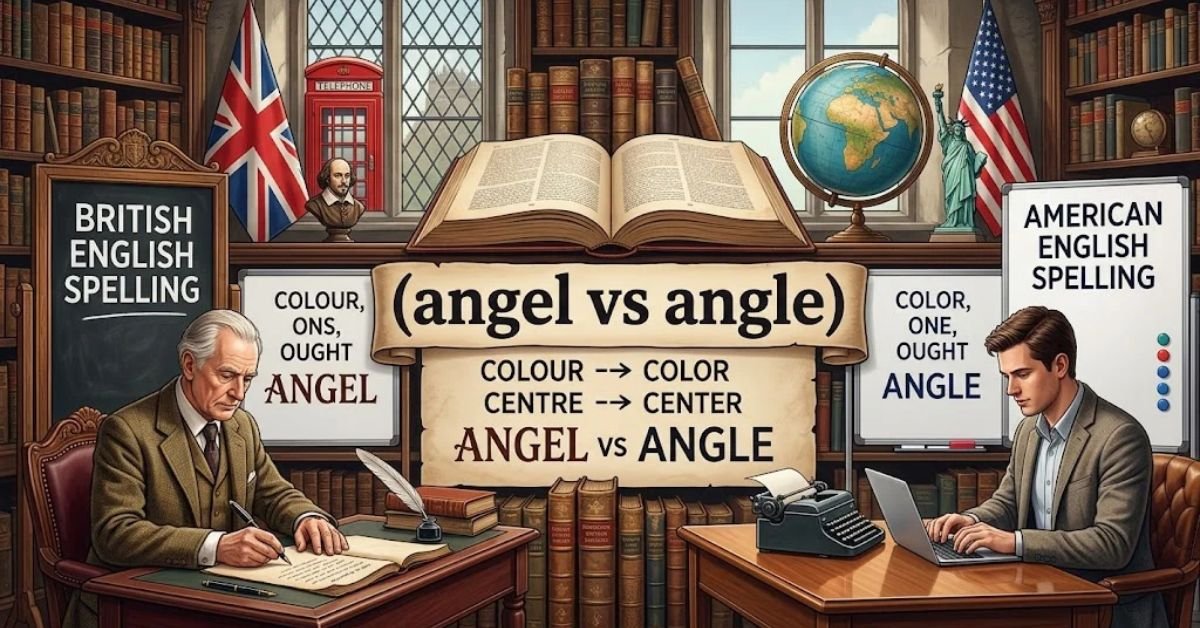
When comparing angel vs angle in British English and American English, the spelling stays exactly the same. Neither word changes based on the region.
English-speaking countries use angle for geometry, direction, and photography. They also use angel for a spiritual being or a very kind person.
| Word | British English | American English | Meaning |
| angle | angle | angle | Corner, direction, or viewpoint |
| angel | angel | angel | Spiritual being or kind person |
So, there isn’t a British spelling rule that changes either word. The same spelling works in school work, emails, social media, news, and formal writing.
Conversation example:
Alex: Should I write angle differently in American English?
Ben: No. Angle has the same spelling in both forms of English.
The main issue isn’t regional spelling. It’s choosing the correct word for your sentence.
Which Spelling Should You Use?
Choosing between angle or angel depends entirely on the meaning you want. Both are real English words, so spellcheck may not identify a typing error.
Use angle when your sentence involves geometry, direction, photography, or a viewpoint. Use angel when you mean a spiritual being, messenger, or exceptionally kind person.
Use angle for:
- A 90-degree angle or 45-degree angle
- A triangle, square, or other shape
- A corner formed by lines
- A camera angle or camera position
- A direction or viewpoint
- Rotation between two lines
Use angel for:
- A spiritual being
- A religious messenger
- Religion or religious topics
- A kind person
- A sweet person
- Emotional topics
Conversation example:
Lena: The photo looks strange.
Mark: Try changing the camera angle.
Lena: My grandmother always helps everyone.
Mark: She really is an angel.
A useful memory trick is simple: angle belongs with corners and cameras. Angel belongs with kindness and spiritual ideas.
Common Mistakes with Angle or Angel
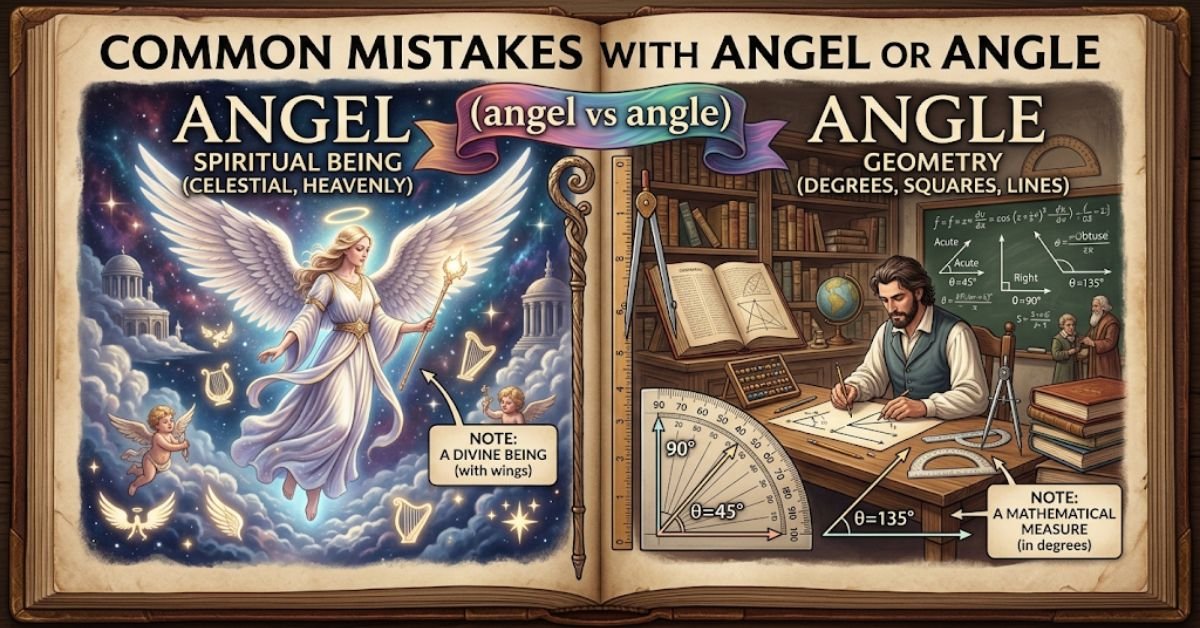
The angel vs angle spelling mistake often happens when people type quickly. Both words are real English words, so spellcheck may not flag the error.
The key is to check the meaning of your sentence. If you mean geometry or direction, choose angle. If you mean a spiritual being or kind person, choose angel.
Common mistakes
- ❌ She is such a sweet angle.
✅ She is such a sweet angel. - ❌ The triangle has three angels.
✅ The triangle has three angles. - ❌ Take the photo from a different angel.
✅ Take the photo from a different angle. - ❌ The square has four angels.
✅ The square has four angles. - ❌ We need a 45-degree angel.
✅ We need a 45-degree angle.
Conversation example:
Tom: My teacher said I used the wrong word.
Jack: Did you write angel for a geometry question?
Tom: Yes. I meant angle!
A one-letter difference can completely change your sentence. Always connect the word with its intended meaning.
Angle or Angel in Everyday Examples
The difference between angle or angel becomes easier when you see both words in everyday situations. Their meanings appear in very different settings.
You might use angle during math class, photography, or a conversation about direction. You might use angel when discussing religion or describing someone especially kind.
Everyday examples with angle
- The triangle has three different angles.
- Move the camera to get a better angle.
- The photographer used a low angle.
- The road turns at a sharp angle.
- This angle gives the photo more depth.
Everyday examples with angel
- She helped me when I needed her. She’s an angel.
- The story describes an angel as a messenger.
- Many religious traditions mention angels.
- My little sister can be a real angel.
Conversation example:
Ava: Why did you move the camera?
Noah: The first angle made the photo look flat.
Ava: Got it. And your grandmother sounds like an angel!
Once you connect angle with position and angel with kindness or spirituality, the distinction becomes much easier.
Angle or Angel – Google Trends & Usage Data
Searches for angle or angel often reflect a basic spelling question. People may know both words but still hesitate when typing a sentence.
However, Google Trends doesn’t automatically prove that users are confusing the words. Search data can include people looking for definitions, examples, pronunciation, or unrelated topics.
For that reason, usage data should provide context rather than a simple conclusion.
Search intent can include:
- Angle meaning in geometry
- Angel meaning in religion
- Angle vs angel spelling questions
- Pronunciation comparisons
- Common typing errors
- Sentence examples
- 90-degree angle or camera angle searches
Conversation example:
Maya: Why do people search for angle or angel?
Leo: They may want to check the spelling or understand the difference.
The two words also appear in very different contexts. Angle often connects with geometry, photography, and direction. Angel commonly appears in spiritual and emotional topics.
When discussing Google Trends or search data, always check the selected country, time period, and search category. Those details can change the results.
Comparison Table: Angle vs Angel
The easiest way to understand angel vs angle is to place the two words side by side. Their spelling looks similar, but their meanings and uses differ sharply.
| Feature | Angle | Angel |
| Meaning | A space, corner, direction, or viewpoint | A spiritual being or kind person |
| Main field | Geometry, photography, direction | Religion and everyday descriptions |
| Origin | Latin angulus | Greek angelos |
| Basic idea | Corner or position | Messenger or spiritual being |
| Math use | 90-degree angle, 45-degree angle | Not normally used |
| Photography | Camera angle, low angle | Not normally used |
| Religious use | Not normally used | Common |
| Example | The triangle has three angles. | She is an angel. |
| Common mistake | Writing angel for angle | Writing angle for angel |
Conversation example:
Sara: Which word belongs in this sentence: “The photographer changed the ___”?
Nina: Angle. It refers to the camera position.
A useful shortcut is to remember angle = corner or viewpoint and angel = spiritual being or kind person. That simple distinction can prevent many spelling mistakes.
FAQs
What is the difference between angel and angle?
Angel vs angle differs in meaning: an angel is spiritual, while an angle describes a corner, direction, or viewpoint.
Is angle or angel correct?
Both are correct words. Angel vs angle depends on whether you mean a spiritual being or a corner, degree, or viewpoint.
How can I remember angel vs angle?
Remember that angel vs angle has one extra e in angel, which can help you choose the correct spelling quickly.
Is angel a geometry term?
No, angel is not a geometry term. Angel vs angle matters because geometry uses angle to describe space between lines.
Can angle and angel be used in sentences?
Yes, both words are common. Angel vs angle becomes clear when you check the meaning and context before writing.
Conclusion
Choosing between angel vs angle becomes easy once you know what each word means. Angle is used for geometry, shapes, direction, and photography. You may talk about a 90-degree angle or choose the right camera angle for a photo. Angel, however, refers to a spiritual being or a very kind person. The extra e helps you remember the difference.
The mix-up between angel vs angle usually happens because both words look and sound similar. Still, their meanings are far apart. When writing, pause for a second and check the context. If you mean a corner, degree, or viewpoint, use angle. If you mean a heavenly messenger or kind person, use angel. Keep this simple rule in mind whenever angel vs angle causes confusion. It’ll help you avoid spelling mistakes in school, work, and everyday writing.

Jack Harrison is a passionate writer with 4 years of experience exploring names, meanings, origins, symbolism, and cultural significance. He creates clear, engaging, and well-researched content to help readers discover the deeper meanings behind names and words.
