Someone texts you “cmp” and you have no clue what it means. Do you reply, ask, or quietlyGoogle it? You’re not alone, and you’re not behind on online slang.Here’s the short answer to the CMP people meaning.a “CMP” has no single official meaning, and the right one depends on where you see it.
In text messages and social media apps, it most often means Check My Profile or Call Me Please. On a website, it almost always means Consent Management Platform, the toolbehind those cookie banners.
What Does CMP Mean?
Let’s clear up one thing first.
“CMP people” isn’t an established slang phrase, so most searchers just want to know what people mean when they type CMP in a chat.
Think of CMP as a three-letter container.
Different online communities pour different meanings into it, and context clues tell you which one you’re holding.
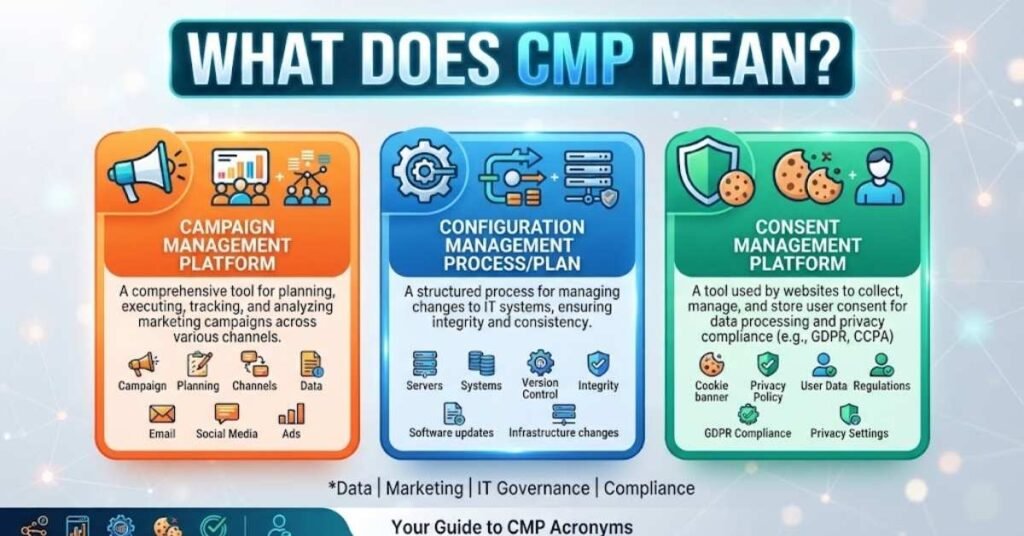
Here are the four meanings you’ll run into most often:
- Check My Profile: a nudge to look at someone’s page or bio
- Call Me Please: a polite, quick request for a phone call
- Content Marketing Plan: a work term for a content strategy
- Consent Management Platform: a privacy compliance tool used on websites
CMP Meaning on TikTok, Instagram, and Snapchat
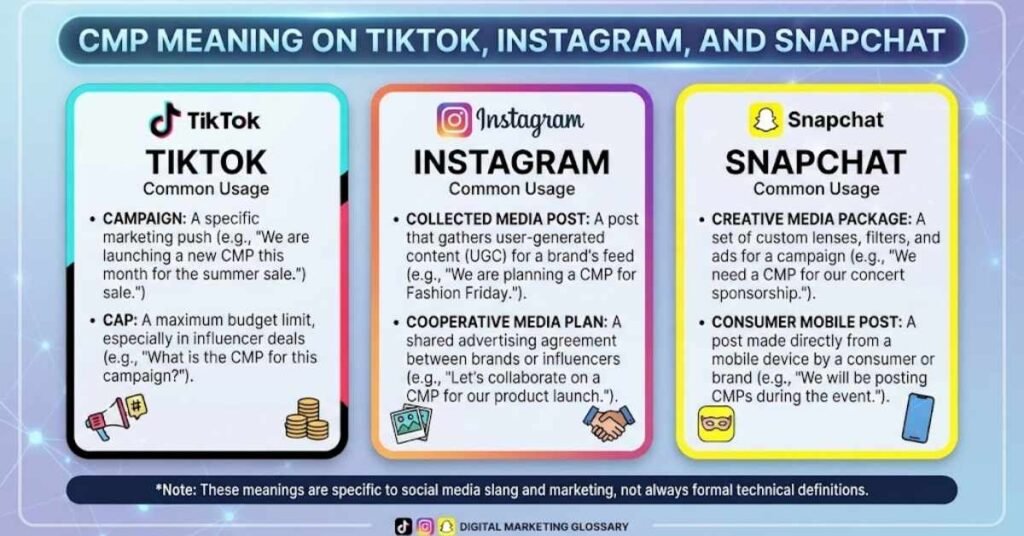
On TikTok, you’ll usually see CMP in comments or replies.
A creator might write “cmp for the full list,” which means “check my profile.”
On Instagram, it works the same way in DMs and story replies.
Someone drops it after sharing a giveaway, a link in bio, or a new post.
Snapchat is quieter, since chats vanish.
There, CMP tends to show up in quick instant messaging, often as “call me please” when a friend wants to talk right now.
Why Do People Use the Term CMP?
Speed is the main reason.
Typing three letters beats typing three words, and shorthand communication has always worked that way.
There’s also a social angle.
Slang creates an in-group feeling, and younger social media users, especially Gen Z, love a bit of cryptic communication that outsiders have to decode.
Plus, it keeps things casual.
“Cmp?” feels lighter than “Could you please check my profile?” and fits the conversational flow of group conversations and inside jokes.
Different Meanings of CMP Across Contexts
The same three letters can mean very different things.
A friend’s “cmp” in a DM and a “CMP” in your browser’s footer have nothing in common.
That’s the messy part of a fragmented internet.
Every platform and profession borrows acronyms, and they collide.
Comparison of Usage Contexts
This table shows where each meaning tends to live.
Use it as a quick decoder when you’re unsure.
| Meaning | Where you’ll see it | Typical tone | Example |
| Check My Profile | TikTok, Instagram, comment sections | Casual, promotional | “New recipe is up, cmp” |
| Call Me Please | Messaging apps, texts | Personal, a bit urgent | “Got a minute? cmp” |
| Content Marketing Plan | Emails, Slack, agency docs | Professional | “Send the CMP by Friday” |
| Consent Management Platform | Websites, legal pages, developer docs | Technical | “Our CMP handles cookie consent” |
What Is a Consent Management Platform?
Ever landed on a site and got a pop-up window asking about cookies?
That box usually comes from a Consent Management Platform, or CMP.
It’s one of the software tools sites use to collect and store user consent.
It records what each visitor chose, so the site can prove it later.
Well-known examples include OneTrust, Cookiebot, Didomi, and Usercentrics.
You don’t need to memorize them, but knowing the name helps when you read a privacy policy.
How CMP Connects to GDPR and CCPA
Why do these banners exist at all?
Mostly because of data protection regulations like the General Data Protection Regulation (GDPR), which took effect in the EU in 2018.
The California Consumer Privacy Act (CCPA) works differently.
It focuses on letting residents know what data is collected and opt out of its sale, and it’s been expanded since it began in 2020.
Both laws push sites toward privacy compliance and data transparency.
A CMP helps meet those legal requirements, though it doesn’t make a site compliant on its own.
What a CMP Does to Your Online Experience
Behind the banner, a CMP controls when website tracking tools can fire.
If you decline cookies for ads, the tool should block those scripts.
You get a few real benefits from this:
- Privacy controls you can change any time
- A clearer view of personal data being collected
- More transparent browsing and better data security habits
It isn’t perfect.
Some banners are confusing on purpose, so read the buttons before you click “Accept all.”
How to Identify the Correct Meaning
Start with where you are.
A chat app points to Check My Profile or Call Me Please, while a website footer points to the Consent Management Platform.
Next, look at who’s talking.
A friend or content creator is likely using slang, and a manager or developer is likely using a technical context term.
Then check the sentence around it:
- “Cmp for the link” means look at the profile
- “Cmp asap” means call
- “Update the CMP” at work could mean the plan or the consent tool
- “CMP settings” on a site means privacy settings management
Still unsure?
Ask. A quick “cmp as in check profile?” costs you five seconds and saves an awkward guess.
Real Chat Examples That Make It Click
Picture this.
Maya posts a thrift haul on Instagram and comments “cmp for the seller list.”
Her followers know exactly what to do.
They tap her profile, find the link, and move on.
Now a different scene.
Your cousin texts “cmp, it’s about grandma,” and you immediately dial.
Same letters, different weight.
That’s why cultural literacy online matters as much as knowing the acronym.
CMP for Creators and Brands
If you run a page, CMP slang can help.
It cuts clutter in captions and nudges user engagement, as long as your audience already understands it.
For brands, there’s another twist.
A Content Marketing Plan guides influencer marketing, posting schedules, and your overall communication strategy.
A simple rule works here.
Use slang in casual posts, and spell out the term in professional context like pitches and reports.
Common Mistakes When Reading CMP
The biggest mistake is assuming one meaning fits everywhere.
Replying “sure, calling!” to a marketing note wastes everyone’s time.
Another slip is ignoring privacy settings after a banner appears.
Clicking “Accept all” on autopilot builds a bigger digital footprint than you might want.
A third one is trusting random slang lists.
Meanings shift, and internet slang varies by region, age group, and platform.
Keeping Your Digital Footprint Safe
Since the privacy meaning of CMP affects real personal information, a few habits help.
Small steps add up over time.
- Review cookie consent choices when a banner appears
- Check privacy settings on TikTok, Instagram, and Snapchat
- Clear old cookies in your browser now and then
- Limit personal information sharing in public comments
These moves support online identity protection and secure browsing.
You don’t have to become a privacy expert, just a slightly more careful one.
FAQ’s
What is the cmp people meaning?
It usually points to people using CMP as shorthand, most often for Check My Profile or Call Me Please.
On websites, the same letters mean Consent Management Platform.
Does the cmp people meaning change?
Yes, constantly.
It shifts by platform, audience, and setting, so always read the surrounding message.
Why is the cmp people meaning important?
Misreading it can cause small but annoying mix-ups, like ignoring a call request.
Knowing the privacy meaning also helps you understand cookie banners and your data protection choices.
Is the cmp people meaning related to slang?
Partly.
Check My Profile and Call Me Please are slang, while Consent Management Platform is a formal technical term.
How to decode the cmp people meaning?
Check the platform, the sender, and the sentence around it.
If it’s still unclear, ask the sender directly.
Final Thoughts
CMP is a small acronym with a surprisingly wide range.
Once you match the meaning to the setting, it stops being confusing.Have you seen CMP used in a way that surprised you? Drop it in the comments, and share this with a friend who keeps asking what it means.
Slang and privacy rules change often. Check current platform and legal guidance before you rely on any single definition.

Jack Harrison is a passionate writer with 4 years of experience exploring names, meanings, origins, symbolism, and cultural significance. He creates clear, engaging, and well-researched content to help readers discover the deeper meanings behind names and words.
