
Have you ever paused while writing and wondered whether to use swam vs swum? You’re not alone. These two forms of swim look almost the same, but they follow different grammar rules. Choosing the wrong one can make an otherwise clear sentence sound incorrect. The good news is that the difference is much easier than it seems. Once you understand when each form belongs, you can use them with confidence.
Swim is an irregular verb with three main forms: swim, swam, and swum. Swam describes a completed action in the past, while swum usually appears with have, has, or had. For example, you can say I swam yesterday, but I have swum before. This simple pattern works in everyday conversation, school assignments, emails, and formal writing. In this guide, you’ll learn the rules, common mistakes, and easy examples that make the difference stick.
Swam or Swum – Quick Answer
When choosing swam vs swum, the key is to look at the verb tense. Both words come from swim, but they perform different jobs in English grammar.
Swam is the simple past tense of the irregular verb swim. Use it when you describe an action that happened in the past.
Swum is the past participle. It usually works with a helping verb, such as have, has, or had.
For example, you can say:
- I swam yesterday.
- She swam in the river after school.
- I have swum in the sea before.
- They had swum across the channel before sunset.
This difference stays the same in American English and British English.
Examples:
- Simple past: I swam yesterday.
- Present perfect: I have swum in the sea.
- Past perfect: They had swum across the channel.
- Past experience: She has swum competitively for years.
Conversation example:
Alex: Did you swim yesterday?
Sam: Yes, I swam after school.
Alex: Have you ever swum in the sea?
Sam: Yes, I have swum in the sea several times.
Simple rule to remember:
Think of the three main verb forms this way:
- swim → present tense
- swam → simple past tense
- swum → past participle
A useful shortcut is:
Past action by itself → swam
Have, has, or had + action → swum
So, I swam yesterday is correct. However, I have swum before is correct.
This simple pattern helps English learners avoid common mistakes, especially in school assignments, exams, emails, and formal writing.
Understanding Past Tense vs Past Participle (Simple Explanation)
The difference between swam vs swum becomes much easier once you understand past tense and past participle.
The simple past tense tells you that an action happened before now. It can stand on its own.
For example:
- I swam yesterday.
- She swam after school.
- We swam in the river last summer.
The past participle works differently. It usually needs a helping verb, especially have, has, or had.
For example:
- I have swum before.
- He has swum competitively.
- They had swum across the channel.
This pattern appears with many irregular verbs. English doesn’t always use an “-ed” ending for past forms.
Compare:
- sing → sang → sung
- drink → drank → drunk
- begin → began → begun
- swim → swam → swum
These changes come from older strong verb patterns and include a vowel change.
For English learners, the easiest approach is to memorize the complete verb conjugation:
swim → swam → swum
Once you know which form belongs to each situation, the grammar rules become much easier.
The same principle also helps with forms such as ran, eaten, gone, driven, and ride, ridden, rode. These irregular verbs can seem confusing at first, but regular practice reduces second guessing.
Quick conversation example:
Mia: Have you ever swum in the ocean?
Jake: Yes, I have. I swam there last summer.
That small exchange shows the difference naturally. Swam describes a finished past event, while swum follows have to form the perfect tense.
The Origin of Swam or Swum
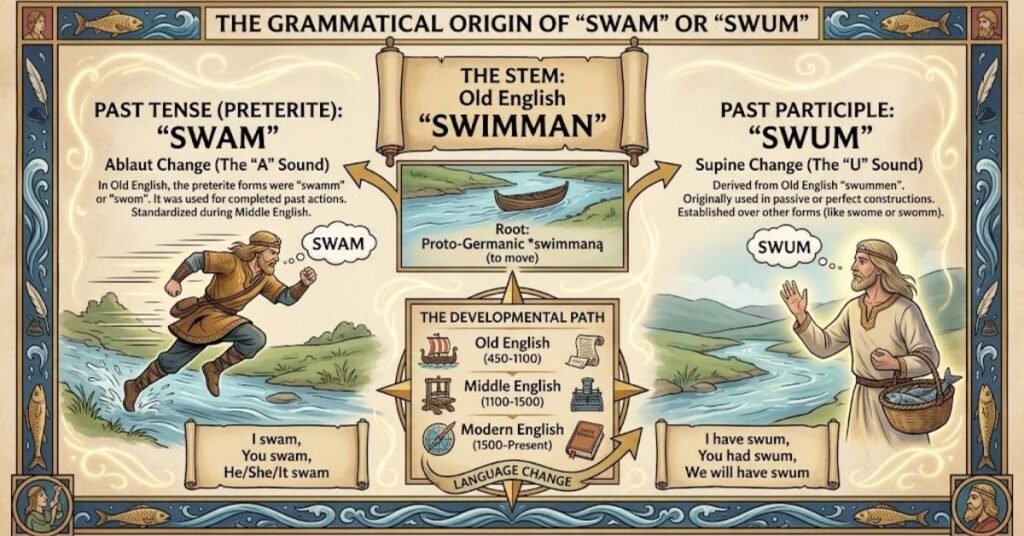
The story behind swam vs swum goes back hundreds of years. Both forms come from the verb swim, which has ancient roots in English.
The word swim comes from Old English swimman. It belonged to a group of verbs known as strong verbs.
Instead of adding an “-ed” ending, strong verbs often changed their vowel to show a different verb tense.
That pattern still appears in modern English grammar today. You can see it clearly in swim → swam → swum.
Other familiar examples include:
- sing → sang → sung
- drink → drank → drunk
- begin → began → begun
These forms may seem unusual to modern English learners. However, they reflect older patterns of verb conjugation that English has preserved.
The vowel change helps distinguish the three main forms. Once you memorize them together, choosing between swam and swum becomes much easier.
Verb forms:
The three main forms of this irregular verb work in different situations:
- Swim → present tense
- Swam → simple past tense
- Swum → past participle
For example:
Tom: Do you swim often?
Jake: Yes, I swim every weekend.
Tom: Did you swim yesterday?
Jake: Yes, I swam yesterday.
Tom: Have you ever swum in the sea?
Jake: Yes, I’ve swum in the sea several times.
This pattern explains the basic swam vs swum difference. The forms aren’t interchangeable, even though they come from the same verb.
British English vs American English Usage
When it comes to swam vs swum, there isn’t a major difference between British English and American English.
Speakers in both varieties use swam as the simple past tense. They also use swum as the past participle.
For example:
- American English: I swam yesterday.
- British English: I swam yesterday.
- American English: I have swum before.
- British English: I have swum before.
The same grammar rules apply to both forms. Regional differences may affect pronunciation, vocabulary, or style, but they don’t normally change this verb pattern.
You’ll find the same distinction in formal writing, school assignments, exams, emails, and everyday conversation.
British speaker: Have you ever swum in the sea?
American speaker: Yes, I swam there last summer.
Both sentences follow standard English grammar.
So, whether you’re writing for the United States, United Kingdom, or global readers, the basic rule remains the same.
Which One Should You Use?
Choosing between swam vs swum becomes simple when you look at the sentence structure.
Use swam when you need the simple past tense. Use swum when the sentence requires a past participle.
A quick checklist can help:
- Use swam for a completed past action.
- Use swum after have, has, or had in perfect constructions.
- Don’t use swam after have or has.
- Remember that swum normally needs a helping verb.
- Check the entire sentence rather than choosing by sound.
For example, I swam yesterday works because swam stands as the main past-tense verb.
However, I have swum before works because swum follows the helping verb have.
Conversation example:
Emma: Did you swim after work?
Liam: Yes, I swam for an hour.
Emma: Have you swum there before?
Liam: Yes, I’ve swum there many times.
This simple pattern can prevent many common grammar errors.
Examples:
Here are some everyday examples to make the difference clearer:
- I swam yesterday.
- She swam after school.
- We swam in the river.
- He has swum in the sea.
- They had swum across the channel.
- She has swum competitively for years.
- I swam my first mile last summer.
Remember this easy formula:
swim = now
swam = past
swum = with a helping verb
Once you learn that pattern, swam vs swum stops feeling like a guessing game.
Common Mistakes with Swam or Swum
The most common mistakes with swam vs swum happen when writers confuse the simple past with the past participle.
Many people choose the form that sounds natural in casual speech. However, standard English grammar follows specific tense rules.
For example, swam works as the simple past form. Swum works as the past participle and usually follows have, has, or had.
Common grammar errors
- ❌ I have swam before.
- ✅ I have swum before.
- ❌ They had swam all morning.
- ✅ They had swum all morning.
- ❌ He has swam very fast.
- ✅ He has swum very fast.
Another mistake involves using swum without a suitable helping verb.
- ❌ I swum yesterday.
- ✅ I swam yesterday.
Spellcheck may not always explain why the sentence sounds wrong. Therefore, check the verb structure yourself.
Conversation example:
Nora: Have you swam there before?
Ella: Almost. The correct form is, “Have you swum there before?”
Remember the basic pattern: swim → swam → swum. Learning these verb forms together makes swam vs swum much easier.
Swam or Swum in Everyday Examples
You can see the swam vs swum difference in many everyday situations. The context doesn’t change the basic grammar rules.
Whether you’re writing an email, posting on social media, or speaking with friends, the verb form depends on the sentence structure.
Use swam for a simple past event:
- I swam yesterday.
- She swam after school.
- We swam in the river last weekend.
Use swum with a perfect construction:
- I have swum in the sea.
- She has swum competitively.
- They had swum across the channel.
The surrounding words often give you the answer.
Friend 1: Did you swim this morning?
Friend 2: Yes, I swam for thirty minutes.
Friend 1: Have you swum in that pool before?
Friend 2: Yes, several times.
The setting may change, but the tense rules stay consistent.
Emails
Emails often mix casual language with formal writing. The correct form still depends on the verb tense.
For a finished past event, use swam:
I swam after work yesterday.
When describing previous experience, use swum:
I have swum in that pool several times.
News
News writing often reports completed events or previous achievements.
For a specific past event:
The athlete swam across the river yesterday.
For an achievement connected to the present:
The athlete has swum across the channel twice.
Social Media
Social media often uses short, informal sentences. Even casual posts benefit from correct grammar.
You might write:
- Swam my first mile today!
- I swam with friends yesterday.
- I’ve swum in this lake before.
The first example uses an implied subject. That’s common in social media posts.
Formal Writing
Formal writing requires careful attention to grammar. School assignments and professional documents should use the correct verb forms.
For example:
The participants swam for two hours yesterday.
Or:
The participants had swum for two hours before the event ended.
Formal writing leaves less room for grammar errors, so check your helping verbs carefully.
Conversation
Everyday conversation often makes the distinction easy to hear.
Maya: Did you swim yesterday?
Ryan: Yes, I swam at the local pool.
Maya: Have you ever swum in the ocean?
Ryan: Yes, I’ve swum in the ocean several times.
Casual speech can sometimes contain mistakes. However, standard grammar still uses swam and swum according to their grammatical roles.
Swam or Swum – Usage Trends
People search for swam vs swum because the two forms look and sound closely related. The confusion often appears during English grammar lessons, writing practice, and exam preparation.
Search interest can also vary throughout the year. Students may look up irregular verbs more often during school terms or exam seasons.
Searchers can come from many English-speaking and English-learning regions, including:
- United States
- United Kingdom
- India
- Australia
However, search interest doesn’t change the actual grammar rules. A higher number of searches doesn’t create a new verb form.
The same basic distinction remains useful for English learners, students, teachers, and native speakers.
It’s also worth separating usage trends from grammar facts. Online searches may reveal confusion, but they don’t determine what’s grammatically standard.
For global readers, the safest approach is simple: learn the standard forms and use them according to their grammatical function.
Swam vs Swum: Side-by-Side Comparison
A quick swam vs swum comparison makes the difference easy to remember.
| Word | Verb form | Main use | Example |
| swim | Present tense | Current or regular action | I swim every week. |
| swam | Simple past tense | Completed past action | I swam yesterday. |
| swum | Past participle | Perfect constructions | I have swum before. |
The easiest memory trick is to connect each form with its role.
- Swim → present
- Swam → simple past
- Swum → past participle
- Have/has/had + swum → perfect construction
Conversation example:
Jack: Do you swim often?
Ben: Yes, I swim every weekend.
Jack: Did you swim yesterday?
Ben: Yes, I swam yesterday.
Jack: Have you swum in the sea?
Ben: Yes, I’ve swum in the sea before.
So, when you’re unsure, don’t rely only on what sounds right. Look at the sentence around the verb.
That quick check will help you choose the correct form in conversation, formal writing, exams, emails, and everyday English.
FAQs About Swam or Swum
Is I have swam correct?
No, I have swam is incorrect in standard English grammar. Use swum after have because swum functions as the past participle.
What is the difference between swam and swum?
Swam is the simple past tense, while swum is the past participle. This distinction explains most swam vs swum questions.
Is swim, swam, swum correct?
Yes, swim is the present form, swam is the simple past, and swum is the past participle of this irregular verb.
Can I use swum by itself?
Usually, no. Swum needs a helping verb such as have, has, or had in standard perfect-tense sentences.
Should I say I swam yesterday or I swum yesterday?
Say I swam yesterday because the sentence describes a completed past action and needs the simple past tense.
Conclusion
Understanding swam vs swum becomes easy once you know their roles. Swam is the simple past tense of the irregular verb swim. Use it for a completed action in the past. For example, you can say, I swam yesterday. You can also say, She swam after school. Swum is the past participle. It usually appears with helping verbs such as have, has, or had. For example, I have swum before. This basic pattern solves most swam vs swum questions. It also helps you avoid common grammar errors in everyday writing and speech.
When choosing swam vs swum, look at the words around the verb. Use swam for a simple past action. Use swum with a perfect tense construction. Remember the full pattern: swim, swam, swum. Once this pattern becomes familiar, swam vs swum won’t feel confusing. These simple grammar rules work in both American English and British English. Keep practicing, and you’ll choose the correct form with confidence.

Jack Harrison is a passionate writer with 4 years of experience exploring names, meanings, origins, symbolism, and cultural significance. He creates clear, engaging, and well-researched content to help readers discover the deeper meanings behind names and words.
