
Ever tried naming a science word that starts with X and drawn a total blank? You’re not alone. Most of the alphabet gives us dozens of options, but X feels like it’s hiding from us.That’s exactly what this guide fixes. From xenon floating in the atmosphere to X-ray crystallography mapping out molecules, these words carry real weight across biology, chemistry, physics, and beyond.
Stick around and you’ll walk away with a list you can actually use, whether you’re studying for an exam, writing a quiz, or just curious.
Science words that start with X
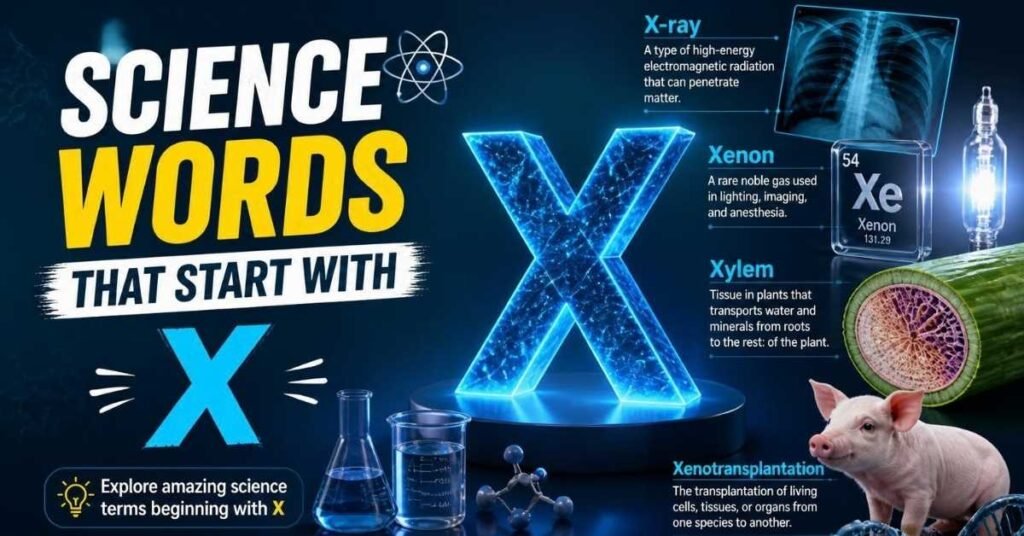
The letter X doesn’t show up often in scientific terms, but when it does, it usually means something interesting is going on. Many of these words come from Greek roots like “xeno” (foreign or strange) or “xero” (dry), which explains why so many X words describe things that are unusual, foreign, or adapted to tough conditions.
You’ll find X words scattered across nearly every research field. Biology, chemistry, physics, astronomy, and geology all have their own X terms worth knowing. Some describe elements, others describe entire branches of study.
What ties them together is precision. Scientific vocabulary exists so researchers can describe exact processes without confusion, and X words are no exception. Let’s break down the most important ones.
Xenobiology
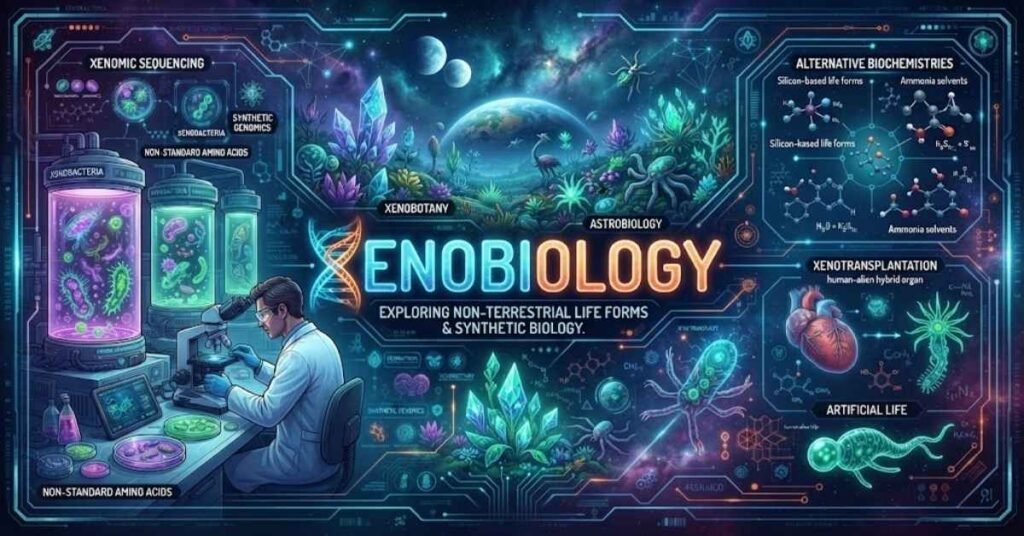
Xenobiology asks a wild question: what if life didn’t have to look like life on Earth? This field studies forms of life that use different chemistry than the DNA and proteins we’re used to, including hypothetical extraterrestrial life or lab-built organisms with swapped-out genetic parts.
Researchers in this space aren’t just dreaming. They’re building synthetic biology systems using unnatural amino acids or alternative genetic codes to see what “life” could look like under different rules. It’s part biology, part engineering.
Think of it like asking whether a car needs wheels to be a car. Xenobiology explores whether life needs our specific biochemical systems to count as life, or if nature (and human ingenuity) could build something entirely different that still grows, adapts, and reproduces.
Xenogenesis
Xenogenesis refers to the idea of an organism producing offspring that look nothing like the parent organism. It’s a term you’ll run into in older biology texts, back when scientists were trying to make sense of strange inheritance patterns before genetics was fully understood.
Today, we know most of what looked like xenogenesis was actually explained by genetic variation, hidden traits, or even mutation. But the term still shows up in discussions about heredity and how traits get passed down in unexpected ways.
It’s also used more loosely in fiction and pop science writing to describe any dramatic shift between generations. In real research, though, it’s mostly a historical stepping stone that helped scientists eventually figure out how inheritance actually works.
Xenon
Xenon is a chemical element, and it’s one of the more fascinating members of the periodic table. It’s a noble gas, meaning it barely reacts with anything else, sitting quietly with a high atomic number and low chemical reactivity.
You’ll find xenon used in specialized lighting, certain medical imaging techniques, and even in ion propulsion systems for spacecraft. Despite being rare in Earth’s atmosphere, it punches well above its weight in practical applications.
Why is xenon scientifically important?
Xenon matters because it bridges chemistry and physics in a way few elements do. Its stability makes it useful wherever a non-reactive gas is needed, from headlights to anesthesia research.
Scientists also study xenon compounds, which is surprising given how “noble” this gas is supposed to be. Under the right conditions, xenon can form real chemical bonds, which challenges older assumptions about noble gases being completely inert.
Xylose
Xylose is a pentose sugar, meaning it’s built from five carbon atoms instead of the six found in glucose. It’s classified as a monosaccharide, the simplest form of carbohydrate, and it plays a bigger role in daily life than most people realize.
You’ll find xylose in plant cell walls, tied up in hemicellulose, one of the structural components that keeps plants sturdy. Wood, straw, and corn cobs are all loaded with it.
Beyond plants, xylose has real industrial value. It’s used in biofuel production and studied for its role in metabolic pathways involving specific enzymes. Some people even know it as the sugar substitute xylitol’s close chemical relative.
X-ray Astronomy
X-ray astronomy studies celestial objects by observing the X-ray radiation they emit, something that’s invisible to regular optical telescopes. This branch of astrophysical research requires space-based observatories, since Earth’s atmosphere blocks most X-rays before they reach the ground.
Missions like Chandra, Swift, and XMM-Newton have transformed what we know about the universe. These instruments, backed by NASA and HEASARC, capture high-energy signals coming from black holes, neutron stars, and supernova remnants.
What makes this field so exciting is what it reveals about violent cosmic events. Hot gas swirling into a black hole, or an active galaxy blasting out radiation, shows up clearly in X-ray data even when it’s completely invisible in normal light.
X-ray Crystallography
X-ray crystallography is a technique used to figure out the exact atomic structure of a crystal. By firing X-rays at a crystalline sample and studying the resulting diffraction pattern, scientists can map out how atoms are arranged in three dimensions.
This method relies on serious mathematical analysis to translate raw diffraction data into a usable molecular structure. It sounds technical because it is, but the payoff has been massive for chemistry, materials science, and structural biology.
What can X-ray crystallography reveal?
This technique can expose molecular geometry, bonding relationships, and how complex biological molecules fold and function. It’s how scientists first understood the structure of DNA, and it remains central to pharmaceutical research today.
Drug developers use it constantly. Knowing the precise shape of a protein lets researchers design medications that fit into it like a key into a lock, which speeds up everything from vaccine development to cancer treatment research.
Xenopsychology
Xenopsychology is a niche but fascinating area focused on animal cognition and animal behavior, particularly behavior that seems foreign or hard for humans to interpret. It sometimes overlaps with speculative discussions about extraterrestrial intelligence, though its main use is grounded in comparing minds across species.
Researchers in this space try to understand how intelligent life, whether animal or hypothetically alien, might process information differently than we do. It’s a humbling exercise, honestly. Our own intelligence isn’t the only kind worth studying.
This field pushes scientists to drop human assumptions when studying other minds. A dolphin’s problem-solving style, for instance, doesn’t need to mirror ours to count as genuine intelligence.
Xerophyte
A xerophyte is any plant built to survive in dry habitats where water scarcity is the daily norm. Deserts, cliffs, and sandy dunes are full of them, and their survival tricks are honestly pretty clever.
These desert plants fight water loss using thick leaves, waxy surfaces, and sometimes spines instead of full leaves to cut down on evaporation. Cacti are the poster child here, but plenty of other species use the same playbook.
Common xerophyte adaptations
Deep and extensive root systems help these plants pull moisture from far below the surface. Some also develop water-storage tissues that act like an internal canteen during long dry spells.
Reduced leaf area, modified leaves, and specialized xylem structures all work together to manage drought stress. These physiological mechanisms aren’t random. Every trait exists because it improves the plant’s odds in a xeric, or extremely dry, environment.
X Chromosome
The X chromosome is one of the two sex chromosomes in humans, alongside the Y chromosome. It carries genes tied to a wide range of traits, and it plays a direct role in X-linked inheritance patterns.
Because females typically have two X chromosomes and males have one, certain conditions show up more often in one sex than the other. This is where X-linked inheritance becomes relevant in medical and genetic counseling conversations.
Beyond biology class basics, the X chromosome is central to ongoing genetic research into inherited disorders. Understanding how traits travel along it has helped researchers predict and sometimes prevent certain hereditary conditions.
Xenotransplantation
Xenotransplantation is the practice of transplanting cells, tissues, or organs from one species into another, most often from animals into humans. It exists to address one massive problem: organ shortages that leave thousands of patients waiting for transplants that may never come.
Animal organs, particularly from genetically modified pigs, are being studied as potential substitutes for human organs. This isn’t science fiction anymore. Actual xenotransplant procedures have already taken place in medical research settings.
The obstacles are real, though. Immune rejection, infection risks, and compatibility issues between species make this incredibly tricky. There are also genuine ethical questions about using genetically modified animals this way, which researchers and ethicists are still actively debating.
Xenolith
A xenolith is a rock fragment that gets trapped inside igneous rock as magma moves through the Earth. Picture a piece of older rock getting swallowed up as molten rock pushes through cracks in Earth’s crust or even from Earth’s mantle.
Once the surrounding magma cools and hardens, that trapped fragment stays locked inside, offering a rare snapshot of rock that formed somewhere else entirely. It’s basically a geological time capsule.
Why do geologists study xenoliths?
Xenoliths give geologists direct evidence about deep geological environments that are otherwise impossible to sample directly. You can’t exactly drill straight into the mantle, so these fragments are the next best thing.
By studying rock composition and how the surrounding rock formed during solidification, scientists in volcanology can reconstruct what’s happening far below the surface during magma movement. It’s one of the few direct windows we have into the planet’s interior.
Xenobiotic
A xenobiotic is any foreign chemical substance introduced into a biological organism that doesn’t naturally occur there. This covers a huge range of things, including drugs, pollutants, and industrial chemicals that enter the body through air, water, food, or medication.
Once inside, the biological system has to deal with these foreign substances somehow. That’s where the liver steps in, running metabolism processes through specific metabolic pathways and enzymes designed to break these compounds down.
Xenobiotic vs. natural compound
Natural compounds are substances the body produces or regularly encounters through diet, so it already has systems built to handle them efficiently. Synthetic compounds, by contrast, are often unfamiliar, which is exactly why fields like toxicology, pharmacology, and environmental science exist.
Understanding this difference matters because not every chemical compound gets processed the same way. Some environmental contaminants build up in the body over time precisely because we lack efficient pathways to clear them out, which is a major focus of ongoing environmental science research.
X-ray Diffraction
X-ray diffraction deserves its own spotlight since it powers so much of modern science. This technique uses controlled diffraction patterns to study crystal structures, giving researchers a way to peek at atomic structure without ever touching the sample directly.
It works because X-rays interact with the orderly rows of atoms in a crystal, scattering in predictable patterns based on that internal structure. Scientists then reverse-engineer the pattern to figure out exactly how atoms are arranged.
This isn’t just academic. Materials scientists use diffraction data to design stronger alloys, and pharmaceutical companies use it to verify that a drug’s molecular structure matches what’s intended before it ever reaches a patient.
Final words
X might be the trickiest letter in the alphabet when it comes to science vocabulary, but as you can see, it’s far from empty. From tiny sugar molecules like xylose to entire fields like xenobiology, these words touch nearly every branch of research out there.
Next time you spot one of these terms in an article, a textbook, or even a crossword puzzle, you’ll actually know what it means. That’s a pretty solid payoff for just one letter of the alphabet.Got a favorite X word we missed, or one you want explained in more detail? Drop a comment below and share this with anyone who loves oddly specific science trivia as much as you do.
FAQs
What is the most common science word that starts with X?
Xenon is probably the most recognized, thanks to its use in lighting and medical applications.
Is xylem the same as xylose?
No. Xylem is plant tissue that transports water, while xylose is a sugar molecule found within plant cell walls.
Why do so many X science words relate to “foreign” things?
Many stem from the Greek root “xeno,” meaning foreign or strange, which explains terms like xenobiotic and xenotransplantation.
Can X-ray crystallography study living cells?
Not directly. It requires a crystallized sample, so researchers typically crystallize purified proteins or molecules first.
Are xerophytes only found in deserts?
Mostly, but they also grow in other dry environments like sandy coastlines, rocky cliffs, and even some cold, dry regions.

Jack Harrison is a passionate writer with 4 years of experience exploring names, meanings, origins, symbolism, and cultural significance. He creates clear, engaging, and well-researched content to help readers discover the deeper meanings behind names and words.
