One tiny space can make a big difference in your writing! Many people type goodmorning when greeting friends, sending emails, or posting on social media. But is it correct, or should you write good morning instead? This common spelling confusion is easy to fix once you know the rule. Using the right form helps your messages look clear, natural, and polished.
In this guide, you’ll learn why good morning is written as two separate words and how to use it correctly. You’ll also see the difference between good night and goodnight, with simple examples to make things clear. From professional emails to casual text messages, you’ll learn which form works best in each situation. Plus, you’ll get easy memory tricks and practical tips to avoid common mistakes. By the end, you’ll feel more confident using this everyday greeting.
Goodmorning or Good Morning: The Correct Answer
The correct spelling in standard English is good morning, written as two separate words. Although many people type goodmorning as one word, this form is considered a spelling mistake in regular writing.
You can use good morning to greet someone at the start of the day. It works well in emails, text messages, social media posts, and everyday conversations.
For example:
- Correct: Good morning, Sarah! How are you today?
- Incorrect: Goodmorning, Sarah! How are you today?
The phrase contains two words: good, an adjective, and morning, a noun. Together, they form a friendly salutation that expresses politeness and positive intent.
You might also see the abbreviation gm in casual chats or #Goodmorning in social media captions. However, these informal forms don’t change the standard spelling.
Remember, when you want to write a polished message, choose good morning. This small detail helps keep your English clear and professional.
Why “Good Morning” Is Two Words
The phrase good morning contains an adjective and a noun. The word good describes the morning, while morning refers to the early part of the day.
English often keeps these words separate when they work together in a phrase. This is known as an open compound or an open compound expression.
For example, you write strong coffee, bright day, and cold weather as two words. The same pattern appears in good morning.
However, the adjective + noun rule isn’t universal. Some combinations become compound words over time, so you should check each expression separately.
Here are a few helpful points:
- Good describes the quality or feeling of the morning.
- Morning identifies the time of day.
- Good morning is the standard spelling in modern English.
- Goodmorning isn’t the accepted spelling for this greeting.
Correct spacing supports proper English usage. It also helps your writing look clear in academic writing, business emails, and everyday communication.
Simple Examples That Follow the Same Rule

Looking at similar phrases can help you understand why good morning stays as two words. English uses many adjective-and-noun combinations in everyday speech and writing.
Consider these common examples:
- Strong coffee: The adjective strong describes the coffee.
- Bright day: The adjective bright describes the day.
- Cold weather: The adjective cold describes the weather.
- Good afternoon: The word good describes the afternoon.
- Good evening: The word good describes the evening.
You can use these phrases naturally in conversations, emails, and social media posts. They follow familiar spelling patterns, even though each expression has its own meaning and usage.
For example:
Alex: Good morning! Did you sleep well?
Mia: Yes, thanks! It’s going to be a bright day.
In this conversation, both good morning and bright day contain separate words. Their spacing makes each phrase easy to read.
Keep in mind that English spelling depends on established usage, not just grammar rules. When you’re unsure, check a reliable dictionary.
The Exception That Trips People Up: Goodnight vs Good Night
Many people confuse good morning with goodnight because they assume both greetings follow the same spelling pattern. However, English uses good morning as two words, while goodnight can appear as one word in certain contexts.
The phrase good night is also commonly written as two words, especially when you say goodbye before going to bed. For example, you might tell a friend, Good night! Sleep well.
The one-word form goodnight can appear in some uses, including as a noun or adjective. Its acceptability may depend on the sentence and the dictionary or style guide you follow.
Here is the key difference:
- Good morning: The standard greeting used in the morning.
- Good night: A common two-word farewell.
- Goodnight: A recognized one-word form in certain contexts.
Don’t assume that one phrase determines the spelling of another. English orthography includes exceptions and patterns that you need to learn individually.
How It Works
The spelling of good morning follows established English usage. The phrase is conventionally written as two words when you greet someone at the beginning of the day.
Good night also commonly appears as two words when you use it as a farewell. For instance, you might say it when ending a conversation or preparing to sleep.
The one-word spelling goodnight appears in other grammatical contexts. You may see it in expressions such as a goodnight kiss or in a sentence like, She gave everyone a goodnight.
The meaning and role of a word can affect its spelling. This is one reason grammar, semantics, and word usage sometimes feel confusing.
Use these examples as a quick guide:
- Morning greeting: Good morning, everyone!
- Evening farewell: Good night, everyone!
- Descriptive phrase: He gave her a goodnight kiss.
The safest approach is to learn each expression in context. Don’t apply a spelling rule too broadly just because two phrases look similar.
Examples in Real Life
Everyday conversations make these differences easier to understand. Think about how you greet someone in the morning and say goodbye at night.
Example 1: Morning greeting
Emma: Good morning, James! Are you ready for work?
James: Good morning! Yes, I’ll leave in five minutes.
Here, good morning is a polite greeting. You should keep it as two words in messages, emails, and spoken-language transcripts.
Example 2: Saying goodbye at night
Lily: I’m tired, so I’m going to bed.
Noah: Good night! Talk to you tomorrow.
In this example, good night is a two-word farewell.
Example 3: Using goodnight in a sentence
Mia: Did you see their goodnight message?
Alex: Yes, it was really sweet.
Here, goodnight works as a noun describing a message.
These examples show why context matters. When you understand the meaning and grammatical role of each expression, choosing the correct spelling becomes easier.
Why People Keep Writing “Goodmorning”
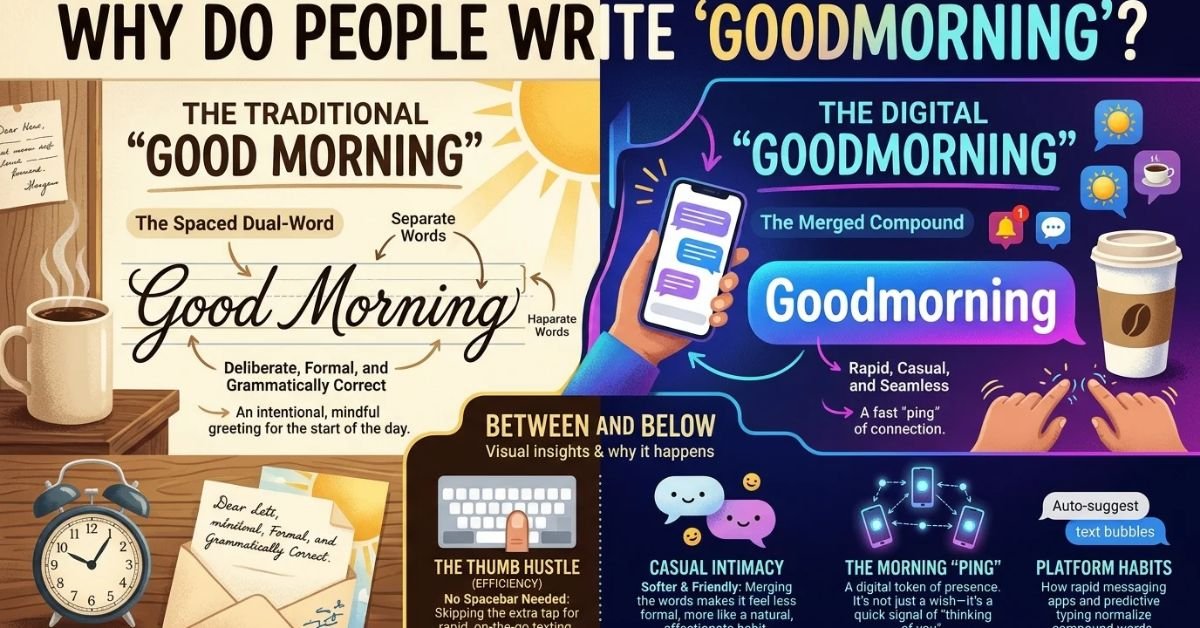
People often write goodmorning because the phrase looks simple when combined into one word. They may also type it quickly without checking the spacing.
Digital communication encourages speed. When you’re sending a quick text or replying in a busy group chat, you might focus on the message rather than its spelling.
Another reason is pattern confusion. Some people see goodnight written as one word in certain contexts and assume goodmorning should follow the same pattern.
Autocorrect doesn’t always catch every spelling mistake, either. If a keyboard doesn’t flag goodmorning, you might assume it’s correct.
Common situations include:
- Typing a quick greeting before work or school.
- Copying an incorrect spelling from another post.
- Following habits learned through texting culture.
- Forgetting that good morning is an open compound expression.
- Choosing visual simplicity over standard spelling.
The mistake is understandable, but it’s easy to fix. Once you learn the standard form, a quick proofreading check can help you avoid it in future messages.
Common Reasons People Get It Wrong
Several everyday habits can lead people to write goodmorning instead of good morning. Understanding these causes can help you correct the mistake without overthinking every message.
1. Speed typing
When you’re in a hurry, you may skip spaces or punctuation. This often happens in short text messages and casual chats.
2. Autocorrect and keyboard habits
Your phone may not flag every nonstandard spelling. As a result, you might repeat the same mistake without noticing it.
3. Pattern confusion
People sometimes compare good morning with goodnight. Because they have similar structures, they may assume both should be written as one word.
4. Visual simplicity
Goodmorning looks compact on a screen. However, a shorter-looking form isn’t necessarily the correct one.
5. Repeated exposure
If you often see an incorrect spelling online, it can start to look familiar. Familiarity doesn’t make it standard English.
To improve your writing, slow down for a moment before sending important messages. A quick check of spacing and capitalization can prevent many common mistakes.
Does It Really Matter? (Yes, More Than You Think)
Writing good morning correctly may seem like a small detail, but spelling contributes to clear communication. The phrase is short, familiar, and easy to correct, so using the standard form shows attention to detail.
A single spelling mistake doesn’t automatically make someone careless or unprofessional. Readers usually consider the whole message, its purpose, and the context in which they receive it.
Still, consistent spelling helps your writing look polished. It can also prevent a reader from pausing to question a word that should feel familiar.
Correct spelling is especially useful when writing business emails, academic assignments, reports, or client messages. In casual conversations, people may be more relaxed about minor mistakes.
Keep these points in mind:
- Use good morning in formal and informal writing.
- Check spelling before sending important emails.
- Follow a consistent style in professional documents.
- Don’t judge someone’s communication skills by one typo alone.
The goal isn’t perfect writing in every quick chat. It’s to communicate clearly and choose proper English usage when it matters.
In Professional Settings
In professional communication, a greeting often sets the tone for your message. Starting an email with Good morning, James looks clear, polite, and appropriately formatted.
Writing goodmorning as one word may distract some readers. It probably won’t determine how they view your entire message, but it can make your writing appear less polished.
This matters most when you communicate with clients, managers, colleagues, or academic staff. A thoughtful greeting shows basic courtesy and helps your message begin smoothly.
For example:
Less polished:
Goodmorning, James,
Please find the updated report attached.
Better:
Good morning, James,
Please find the updated report attached.
The second version follows standard spelling and spacing. You can also use good morning when opening a formal letter or starting a business conversation.
For professional writing, remember to:
- Capitalize the first word when it begins a sentence.
- Add a comma after the greeting when appropriate.
- Check names, spelling, and punctuation before sending.
- Keep your tone polite and suitable for the recipient.
These small editing habits help create clear, well-structured messages.
In Personal Communication
In personal communication, good morning is a friendly way to start someone’s day. You can use it with friends, family members, partners, classmates, and people you know online.
The tone can change depending on your relationship. A simple Good morning! sounds polite, while Good morning, sleepyhead! feels playful and affectionate.
You don’t need a formal sentence every time you text someone. Short messages, emojis, and casual expressions are perfectly normal in everyday chats.
For example:
Sara: Good morning! Hope you slept well.
Ali: Morning! I did. How about you?
In this conversation, Morning! works as a casual greeting. It is common in informal speech and messaging.
You might also see these variations online:
- gm: A short form often used in casual chats and online communities.
- #Goodmorning: A social media hashtag that may appear without a space because hashtags generally don’t support spaces.
- Good morning 😊: A friendly greeting with an emoji.
Even when your tone is relaxed, use good morning when writing the full phrase. Standard spelling keeps your message clear without making it feel stiff or overly formal.
Real-World Usage: Emails, Texts, and Social Media

The phrase good morning works in many types of communication. You can use it in professional emails, casual text messages, and social media posts.
The correct spelling stays the same across these situations. Write good morning as two words when using the full phrase.
Your tone can change depending on the audience. A work email may need a polite greeting, while a message to a friend can sound more relaxed.
Here are some simple ways to use it:
- Emails: Good morning, Sarah. I hope you’re doing well.
- Text messages: Good morning! How did you sleep?
- Social media: Good morning, everyone! Have a beautiful day.
- Online chats: Morning! Ready for the day?
You may also see gm in casual online conversations. The hashtag #Goodmorning is another common format because hashtags don’t allow spaces.
Remember, informal writing can be flexible, but standard spelling helps keep your messages clear.
Professional Emails
A professional email often begins with a polite greeting. Writing good morning correctly helps your message look clear and well organized.
You can use it when contacting a manager, colleague, client, teacher, or business partner. Keep the greeting simple and choose a tone that suits your relationship with the recipient.
For example, Good morning, James, sounds polite without being too formal. You can follow it with a short sentence explaining why you’re writing.
Use these tips for professional communication:
- Write good morning as two separate words.
- Capitalize Good when it starts your email.
- Add the recipient’s name when appropriate.
- Use a comma after the greeting when it fits your email format.
- Proofread the message before sending it.
Avoid writing goodmorning in a business email. Although readers may understand your meaning, the standard form looks more polished.
Example
Less polished:
Goodmorning, James,
I am sending you the updated report. Please check it when you have time.
Correct and polished:
Good morning, James,
I’m sending you the updated report. Please review it when you have time.
The second version uses the standard spelling and a natural tone. It also keeps the message direct and easy to understand.
Here’s another example:
Sarah: Good morning, Alex. Can we discuss the meeting schedule?
Alex: Good morning, Sarah. Sure, I’m available at 10 a.m.
Both colleagues use the phrase correctly. This simple greeting helps them begin their conversation politely.
Casual Text Messages
Text messages don’t always follow formal writing rules. You might use abbreviations, emojis, or short sentences when chatting with friends and family.
However, good morning remains the standard spelling when you write the complete phrase. You don’t need to combine the words just because you’re texting quickly.
For example, you can send Good morning! Hope you slept well. This sounds friendly without being overly formal.
Here are some casual options:
- Good morning! Ready for a new day?
- Good morning, bestie! What’s the plan?
- Morning! Hope your day goes smoothly.
- Good morning 😊 Did you sleep well?
You may also see gm in group chats and online communities. It’s a short form that saves time, especially in informal conversations.
Use whichever tone feels natural for your relationship. Just remember that goodmorning is not the standard spelling of the full greeting.
Example
Mia: Good morning! Are we still meeting today?
Noah: Morning! Yes, let’s meet at noon.
Mia: Perfect. See you then!
This conversation shows how naturally good morning fits into everyday texting. Noah uses Morning! as a shorter, casual greeting.
You can also make your messages more personal:
- Good morning, sunshine!
- Good morning! Have an amazing day.
- Good morning ❤️ Thinking of you today.
These expressions work well with friends, family, and partners. Emojis can add warmth, but they don’t change the spelling rule.
Social Media Posts
Social media users often share morning greetings with photos, videos, and motivational messages. You might post a sunrise picture, a coffee photo, or a positive message to start the day.
For captions, good morning is still the standard spelling when you write the complete phrase. You can keep your caption short, friendly, or creative.
Here are a few examples:
- Good morning! A fresh day begins.
- Good morning, beautiful people. Keep smiling.
- Good morning and choose positive energy.
- Good morning! Coffee first, everything else later.
- Good morning from my little corner.
You may also notice #Goodmorning on Instagram and other platforms. This format is different because hashtags cannot contain spaces. The words are joined to create one searchable tag.
For regular captions, use good morning as two words. For hashtags, use the format that works with the platform.
Pro Tip
Before publishing a post or sending a message, check how you’ve written good morning. A quick proofreading habit can help you catch spacing and capitalization mistakes.
Keep these simple rules in mind:
- Use Good morning at the beginning of a sentence.
- Use good morning in the middle of a sentence.
- Use #Goodmorning when creating a hashtag.
- Use gm when a casual abbreviation suits the conversation.
- Avoid goodmorning as the full greeting in standard writing.
For example, you could write, I sent her a good morning message before work. Here, good morning stays lowercase because it appears in the middle of the sentence.
Quick check: Is this a full greeting or a hashtag? That small question can help you choose the right format.
Memory Trick: Never Get It Wrong Again
Remembering the correct spelling of goodmorning or good morning doesn’t have to be difficult. You only need a simple mental shortcut and a little practice.
The standard greeting uses two words: good and morning. Think of them as two separate pieces that work together to express a friendly greeting.
You can connect the phrase with other familiar expressions, such as good afternoon and good evening. These greetings also use two words.
Try these memory tips:
- Picture a space between good and morning.
- Say both words slowly when proofreading.
- Compare good morning with good afternoon.
- Check your keyboard before sending important messages.
- Practice writing the phrase in a few sentences.
You don’t need to memorize complicated grammar rules to get this right. Focus on the standard spelling and use it consistently.
After some practice, writing good morning correctly should feel natural in emails, texts, and everyday conversations.
Quick Mental Shortcut
Here’s an easy memory trick: Mornings need space.
Imagine a small space between the words good and morning. Whenever you write the greeting, check that the space is there.
You can also remember the phrase by comparing it with other greetings:
- Good morning
- Good afternoon
- Good evening
- Good day
Each phrase contains two separate words. Seeing them together can help reinforce the correct spelling.
Try this quick exercise:
Question: Which spelling is correct?
- A. Goodmorning, Sarah!
- B. Good morning, Sarah!
Answer: B. Good morning, Sarah!
You can use this shortcut when writing emails, captions, or text messages. If you notice yourself typing goodmorning, pause and add the missing space.
The goal is to build a consistent writing habit. A quick mental check is often enough to catch this common spelling mistake before you send your message.
Common Mistakes to Avoid
People sometimes make small spelling mistakes when writing everyday greetings. The most common one is combining good morning into a single word.
Other mistakes include confusing good night with goodnight or using incorrect capitalization. These errors are easy to fix once you understand the standard forms.
Keep this short checklist nearby:
- Write good morning as two words.
- Use good night as a common two-word farewell.
- Recognize that goodnight can appear as one word in certain contexts.
- Capitalize the first word when the phrase begins a sentence.
- Use lowercase when the phrase appears in the middle of a sentence, unless another rule applies.
For example, Good morning, Alex! is correct at the start of a message. Meanwhile, I sent Alex a good morning message uses lowercase because the phrase appears within the sentence.
Proofreading helps you catch these issues. It also improves clarity and consistency in professional and personal writing.
Writing “Goodmorning” in Emails
One common mistake is writing goodmorning as a single word in an email. Although the recipient will probably understand the greeting, standard English uses two words.
This is especially worth checking in business emails, job applications, academic messages, and client communication. A correctly written greeting helps your message look polished from the beginning.
Compare these examples:
Incorrect: Goodmorning, Sarah. I hope you’re doing well.
Correct: Good morning, Sarah. I hope you’re doing well.
The correction is simple. You only need to add a space between good and morning.
Before sending an email, check these details:
- Is the greeting spelled correctly?
- Does the greeting suit the recipient?
- Have you capitalized the first word correctly?
- Is the recipient’s name spelled correctly?
Example conversation:
James: I noticed you wrote goodmorning in your email.
Sarah: Thanks for catching that! I’ll use good morning next time.
Small edits can improve your writing habits over time. You don’t need to worry about every tiny detail, but checking familiar phrases is an easy place to start.
Mixing “Good Night” and “Goodnight”
Another common mistake is assuming good night and goodnight always have the same spelling rules as good morning. Their uses overlap, but the forms don’t work identically in every sentence.
Good night is a common two-word farewell. You might say it when ending a conversation or telling someone you’re going to bed.
Goodnight can also appear as one word in certain contexts, including phrases such as a goodnight kiss. The correct choice depends on how the word functions in the sentence and the style guide you follow.
Examples:
- Farewell: Good night! I’ll talk to you tomorrow.
- Noun or modifier: She gave him a goodnight kiss.
- Morning greeting: Good morning! Have a great day.
Notice that good morning remains two words in its standard greeting form. Don’t change its spelling simply because you’ve seen goodnight written as one word.
When in doubt, check a reliable dictionary and look at the phrase’s role in the sentence.
Incorrect Capitalization
Capitalization is another detail to check when writing good morning. The correct choice depends on where the phrase appears in your sentence and how you format your message.
Use Good morning when the greeting begins a sentence or starts an email. Use good morning when it appears in the middle of a sentence.
For example:
- Beginning: Good morning, Sarah! How are you?
- Middle: I sent Sarah a good morning message.
- Caption: Good morning, everyone!
- Hashtag: #Goodmorning
A hashtag follows a different format because spaces aren’t allowed. Joining the words in a hashtag doesn’t mean goodmorning is the standard spelling in ordinary sentences.
Also, don’t capitalize every letter unless you’re using a deliberate style. Writing GOOD MORNING may be suitable for a poster or design, but it can feel like shouting in a casual message.
For clear writing, follow normal capitalization rules and keep your spelling consistent.
Quick Reference Table (Save This)
If you often confuse goodmorning or good morning, this quick reference table can help. It shows the standard spelling and explains when to use each form.
| Word or Phrase | Correct Usage | Example |
| Good morning | Standard two-word greeting | Good morning, Sarah! |
| Goodmorning | Nonstandard spelling | Avoid this in regular writing. |
| Good afternoon | Standard two-word greeting | Good afternoon, everyone. |
| Good evening | Standard two-word greeting | Good evening, Mr. Smith. |
| Good night | Common two-word farewell | Good night! Sleep well. |
| Goodnight | One-word form used in certain contexts | She gave him a goodnight kiss. |
| Morning | Casual greeting | Morning! How are you? |
| GM | Informal abbreviation | GM, everyone! |
| #Goodmorning | Social media hashtag | #Goodmorning #NewDay |
Keep this table handy when writing emails, text messages, or social media captions. The main rule is simple: write good morning as two words when using the full greeting.
Case Study: One Email, Two Impressions
Imagine you’re sending an email to a client named James. You want to share an updated report and ask for feedback.
Your message begins with a simple greeting. However, the way you write those first two words can affect how polished the email looks.
Compare two versions of the same message. Both communicate the same information, but one follows standard spelling and spacing.
This example shows why proofreading matters in professional communication. It doesn’t mean one small typo will ruin your reputation. It simply shows how a quick edit can improve clarity and presentation.
Let’s look at both versions and see what changes.
Version 1
Subject: Updated Report
Goodmorning, James,
I have attached the updated report for your review. Please let me know if you have any questions or suggestions.
Thank you for your time.
Best regards,
Sarah
This email communicates its purpose clearly. James can understand the message without any difficulty.
However, goodmorning is not the standard spelling of the greeting. The missing space creates a small spelling error in an otherwise professional message.
The rest of the email uses a polite tone and straightforward wording. Sarah doesn’t need to rewrite the entire message to improve it.
She only needs to correct the greeting.
This is a useful reminder that even familiar phrases deserve a quick check before you send an important email.
Version 2
Subject: Updated Report
Good morning, James,
I have attached the updated report for your review. Please let me know if you have any questions or suggestions.
Thank you for your time.
Best regards,
Sarah
This version follows standard English spelling. The greeting uses two separate words, making the opening look clean and polished.
The rest of the email remains exactly the same. Sarah hasn’t changed the meaning, tone, or purpose of her message.
This is often all you need to do when correcting a small writing mistake. A simple edit can improve presentation without making the message longer or more complicated.
The greeting also sounds natural and professional. It works well for client communication, workplace emails, and other formal settings.
Before sending a message like this, check familiar phrases, names, punctuation, and spacing. These small proofreading habits help you maintain consistent writing.
What Changed?
The main difference between the two emails is the spelling of the greeting. Version 1 uses goodmorning, while Version 2 uses good morning.
Only one space changed, but Version 2 follows standard English usage. It also looks more polished in a professional setting.
Here’s what you can learn from the comparison:
- Correct spelling: Good morning uses two words.
- Clear presentation: Proper spacing makes familiar phrases easier to read.
- Professional tone: A correctly written greeting supports a polished message.
- Simple editing: You can fix the mistake without rewriting the entire email.
Imagine James replying to Sarah:
James: Good morning, Sarah. Thanks for sending the report.
Sarah: You’re welcome, James. I look forward to your feedback.
The conversation flows naturally because both people use the standard greeting.
Remember, a typo doesn’t automatically make an email unprofessional. Still, correcting simple errors shows attention to detail and helps your writing feel complete.
A Simple Rule That Applies Beyond “Good Morning”
Learning the spelling of good morning can help you pay closer attention to other common expressions. English contains many phrases made from separate words, even when people use them together frequently.
For example, good afternoon, good evening, and good day are normally written as two words. Each expression has a familiar meaning and a standard spelling.
However, you shouldn’t assume that every adjective-and-noun combination follows the same pattern. English also contains closed compound words, such as bedroom and notebook.
The best approach is to learn common expressions individually. When you’re unsure about a word, check a reliable dictionary instead of relying only on how it looks.
This habit supports better spelling, clearer writing, and more consistent English usage.
Adjective + Noun = Separate Words
In good morning, good is an adjective and morning is a noun. The adjective describes the noun, and together they form a familiar greeting.
You can see a similar pattern in these expressions:
- Strong coffee: Strong describes the coffee.
- Bright day: Bright describes the day.
- Cold weather: Cold describes the weather.
- Good afternoon: Good describes the afternoon.
- Good evening: Good describes the evening.
These examples show why the words in good morning remain separate. However, the adjective + noun pattern isn’t a universal spelling rule.
Some word combinations eventually become compound words. For example, bedroom and notebook are written as single words.
So, don’t combine good and morning just because they appear together. Standard English usage recognizes good morning as two words.
When you need certainty, consult a dictionary or trusted style guide. Established spelling matters more than a rule that seems logical at first glance.
What About “Morning” Alone?
You don’t always need to say good morning when greeting someone. In casual conversations, morning can work as a short, friendly greeting.
People commonly use it with friends, family members, coworkers, and familiar acquaintances. It sounds relaxed and natural, especially when the situation doesn’t require formal language.
For example, you might walk into the office and say, Morning, everyone! You could also send a quick message to a friend saying, Morning! Ready for today?
The shortened greeting doesn’t change the spelling of good morning. It simply removes the word good to create a more casual expression.
Here are a few situations where morning works well:
- Greeting coworkers when you arrive.
- Saying hello to friends in a group chat.
- Sending a quick text to a family member.
- Starting an informal conversation.
For formal emails, good morning may sound more complete and courteous.
Examples
The word morning can work as a casual greeting in many everyday situations. Your choice depends on the person you’re addressing and the tone you want to create.
Here are some natural examples:
- At work: Morning, everyone! How was your weekend?
- With a friend: Morning! Did you get enough sleep?
- In a text: Morning 😊 Are we still meeting today?
- In a group chat: Morning, team! Let’s get started.
- With a family member: Morning, Mom! Would you like some tea?
You can also use morning as a noun rather than a greeting.
For example, I enjoy a quiet morning with coffee describes a time of day. In this sentence, morning is part of the main statement, not a salutation.
Compare these two examples:
Alex: Morning! How are you feeling today?
Mia: Good morning! I’m feeling great, thanks.
Both greetings are natural. Morning sounds more casual, while good morning is a complete, standard greeting that works in formal and informal settings.
Style vs Grammar: Where Lines Blur
Sometimes, people confuse writing style with grammar. Grammar helps explain how words function in a sentence, while style guides help you maintain consistency in writing.
For example, you might write Good morning in a formal email and Morning! in a text to a friend. Both can be suitable choices because the context and tone differ.
However, style doesn’t make every spelling variation correct. In standard English, goodmorning is not the accepted spelling of the full greeting.
Social media adds another layer of confusion. A hashtag such as #Goodmorning joins the words because hashtags cannot contain spaces.
That format is a platform convention, not a change to standard spelling.
To make the right choice, consider three things:
- The meaning of the phrase.
- The audience and communication setting.
- The standard spelling of the expression.
Understanding these differences helps you write naturally without sacrificing clarity.
When Style Wins
Style gives you room to adjust your wording for different readers and situations. You can choose a formal greeting for a business email or a relaxed one for a personal message.
For example, Good morning, Ms. Khan, sounds polite in professional communication. Meanwhile, Morning! feels natural in a conversation with a close friend.
Social media captions also allow creative choices. You might write GOOD MORNING in capital letters on a sunrise graphic to make the words stand out.
You can adapt your tone by using:
- Short greetings for casual chats.
- Full greetings for professional emails.
- Emojis for friendly personal messages.
- Capital letters for deliberate visual emphasis.
- Hashtags such as #Goodmorning for social media posts.
These choices affect style and presentation. They don’t change the standard spelling of the full phrase.
Choose a style that suits your audience, but keep your wording clear and consistent.
When Grammar Wins
Grammar and standard spelling matter when you need to communicate clearly. While style allows flexibility, it doesn’t mean every spelling choice is equally accepted.
For the full morning greeting, standard English uses good morning, not goodmorning. This applies to professional emails, school assignments, reports, and ordinary sentences.
Consider these examples:
- Correct: Good morning, everyone.
- Incorrect in standard usage: Goodmorning, everyone.
- Correct: I sent her a good morning message.
- Correct: Good morning! Have a wonderful day.
Capitalization also follows familiar rules. Use Good at the start of a sentence and good when the phrase appears in the middle, unless another formatting rule applies.
Remember that hashtags are different. #Goodmorning is a valid hashtag format because spaces aren’t allowed within hashtags.
When grammar and style seem confusing, identify the purpose of your writing first. Then follow standard spelling and adjust the tone to fit the situation.
Expert Insight: Why Small Errors Stand Out
Small spelling errors can stand out because readers recognize familiar expressions quickly. When they see a phrase written in an unexpected way, they may pause briefly to process it.
The spelling goodmorning can create that pause because standard English uses good morning as two words. The meaning remains understandable, but the incorrect spacing may distract from the message.
This doesn’t mean every reader will notice the error. People interpret writing differently, and context often matters more than a single typo.
Still, attention to detail can support clear and polished communication. This is especially helpful in business emails, academic writing, reports, and client messages.
Try these practical habits:
- Read your message once before sending it.
- Check common expressions and greetings.
- Use spelling tools when helpful.
- Keep your spelling consistent.
- Focus on clarity rather than perfection.
A small proofreading step can help you catch errors without spending too much time editing.
Practical Tips to Get It Right Every Time
You can avoid confusing goodmorning with good morning by building a few simple writing habits. You don’t need advanced grammar knowledge to remember this familiar phrase.
Start by learning the standard spelling. Then practice using it in sentences, emails, and casual conversations.
When you write quickly, take a moment to check spacing. This is especially useful when typing on a phone, where speed and autocorrect can lead to small mistakes.
You can also compare the phrase with good afternoon and good evening. Seeing these expressions together helps reinforce their standard two-word forms.
Try these habits:
- Practice writing good morning in a sentence each day.
- Check spelling before sending professional emails.
- Read captions aloud to spot awkward wording.
- Use a reliable dictionary when unsure.
- Keep a short proofreading checklist nearby.
With regular practice, the correct spelling becomes easier to remember.
Use These Strategies
Use these simple strategies whenever you aren’t sure whether to write goodmorning or good morning. Each one helps you catch the mistake before it reaches your reader.
1. Remember the space
Think of good and morning as two separate words. Check that a space appears between them.
2. Compare similar greetings
Remember that good afternoon and good evening are also written as two words.
3. Read your message aloud
Reading your message can help you spot awkward wording. Although you may not hear a missing space, reading slowly encourages you to check each word.
4. Proofread important messages
Before sending a business email or client message, check spelling, names, punctuation, and capitalization.
5. Use spell-check tools carefully
Your keyboard or writing app may help identify errors. However, automated tools can miss some mistakes, so review the message yourself.
6. Learn the hashtag exception
Use good morning in regular writing and #Goodmorning when creating a hashtag.
These strategies are simple enough for everyday use. The more often you practice them, the less likely you’ll be to repeat the same spelling mistake.
Quick Checklist Before You Hit Send
Before sending an email, text message, or social media post, take a few seconds to review your greeting. A short checklist can help you catch spelling and formatting errors.
Start by checking whether you’ve written good morning as two words. Then make sure the capitalization matches the phrase’s position in your sentence.
You should also consider your audience. A friendly Morning! may suit a casual chat, while Good morning, Sarah, may be better for a professional email.
Use this checklist before sending your message:
- Did I write good morning as two words?
- Did I capitalize the first word correctly?
- Did I spell the recipient’s name correctly?
- Does the greeting suit the situation?
- Have I checked punctuation and spacing?
- Did I use #Goodmorning only as a hashtag?
- Did I proofread the rest of the message?
Final reminder: The standard spelling is good morning. Keep the two words separate in ordinary writing, and use the appropriate format for your context.
This small habit helps you communicate clearly and maintain consistent writing in both personal and professional settings.
FAQs
1. Is Goodmorning or Good Morning correct?
Good morning is the correct spelling in standard English. The phrase uses two separate words, not one.
2. Why do people write Goodmorning as one word?
People often type quickly or confuse it with goodnight. However, good morning remains the standard spelling.
3. Where should I use Good Morning?
Use good morning in emails, text messages, social media posts, and everyday conversations to greet people politely.
4. Is Goodmorning ever acceptable?
Goodmorning is nonstandard in regular writing. Use good morning instead, except when reproducing a name or stylized text.
5. Why does this small detail matter?
Correct spelling makes your writing clearer and more polished. Using good morning also shows attention to detail in communication.
Conclusion,,
Choosing between goodmorning or good morning is simple once you know the correct rule. In standard English, good morning is always written as two separate words when used as a greeting. Although many people type goodmorning by mistake, this form is not standard. Using the correct spelling keeps your emails, texts, and social media posts clear and polished.
Now you know how to use goodmorning or good morning in everyday writing. Remember that good morning works for both formal and casual conversations. You can also use Morning! as a shorter, friendly greeting. Don’t confuse good morning with goodnight, which has different uses. When you’re unsure, check your spelling before sending a message. These small habits can improve your writing and help you communicate with confidence. Keep the simple rule in mind, and you’ll get it right every time.

Jack Harrison is a passionate writer with 4 years of experience exploring names, meanings, origins, symbolism, and cultural significance. He creates clear, engaging, and well-researched content to help readers discover the deeper meanings behind names and words.
