Have you ever paused while writing because two words looked almost the same? You’re not alone. English has many confusing words that can make even simple sentences tricky. One small spelling mistake can affect the clarity of your message. It can also make your writing look less polished. Knowing which word to use helps you communicate clearly and confidently.
The confusion between mistakenly and mistakingly is a good example. Both words may look correct at first glance, but one is the standard choice in modern English. Mistakenly means doing something because of an error or a wrong belief. For example, you might send an email to the wrong person or misunderstand an important detail. So, which spelling should you choose, and why? This guide explains the difference with simple examples, helpful tips, and clear answers to common questions.
Mistakingly or Mistakenly: What’s the Difference?
The correct choice in standard modern English is mistakenly. It means doing something because of an error or a wrong belief. Although mistakingly may look logical, it is not the usual form in edited English.
People often confuse these words because they look and sound similar. However, using the standard spelling helps your writing stay clear and professional.
Examples:
- Correct: I mistakenly sent the email to my teacher.
- Nonstandard: I mistakingly sent the email to my teacher.
- Correct: She mistakenly believed the shop was closed.
Conversation example:
- Alex: Should I write mistakingly in my report?
- Mia: Use mistakenly. It’s the standard form.
Remember this simple rule: when you mean doing something in error, choose mistakenly.
Is Mistakingly a Real Word?
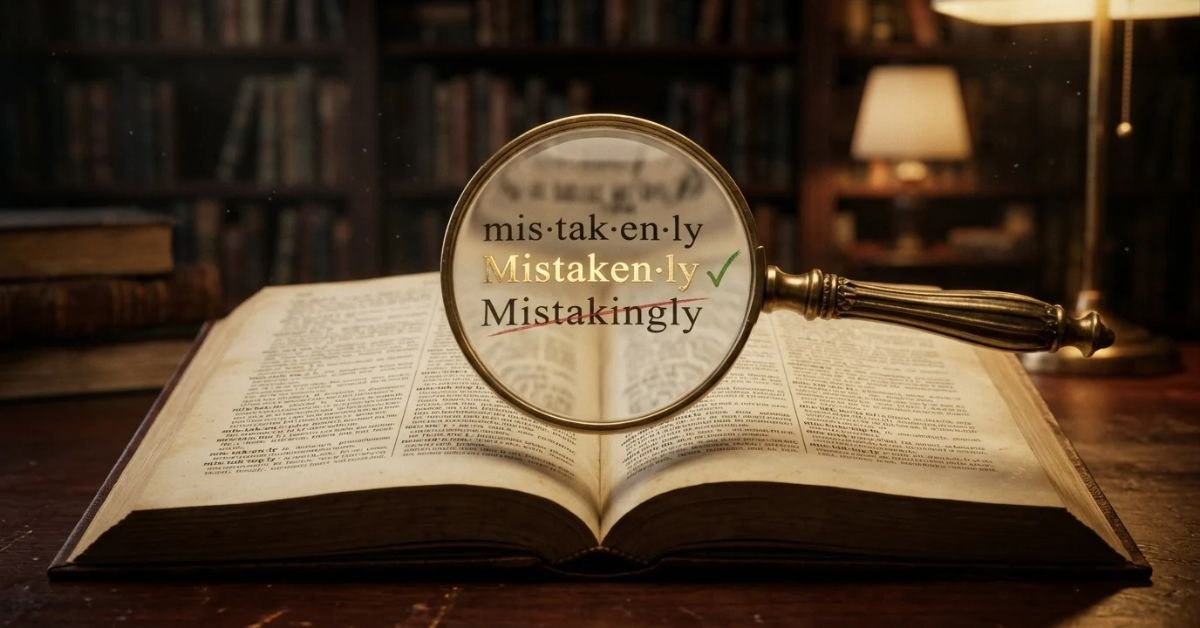
Mistakingly appears in some uses, but it is not the standard form most writers should choose today. In everyday and formal English, mistakenly is the safer and more widely accepted option.
This distinction matters because a word can appear in writing without being the best choice for modern standard English. If you’re unsure, check a reliable dictionary and look at examples from edited publications.
Keep these points in mind:
- Mistakenly is the preferred form in standard English.
- Mistakingly is uncommon and generally best avoided.
- Readers may understand mistakingly, but that doesn’t make it the recommended choice.
- English learners should focus on the form used in reliable reference sources.
Conversation example:
- Sam: I’ve seen mistakingly online. Does that mean it’s correct?
- Ella: Not necessarily. Use mistakenly in standard writing.
What professional writing favors
Professional writing favors mistakenly because it is familiar, clear, and widely accepted. Using standard spelling helps readers focus on your message instead of an unusual word choice.
This matters in business emails, reports, academic papers, customer support messages, and published articles. A small spelling issue may not change your meaning, but it can distract readers.
For example:
- Better: We mistakenly charged your account twice.
- Avoid: We mistakingly charged your account twice.
Quick tip: If you’re writing for work, school, or publication, choose mistakenly. It is the clearest option for professional communication.
Why Mistakenly Is Correct
Mistakenly is the standard adverb formed from mistaken. It describes an action that happens because someone has made an error or holds an incorrect belief.
English word formation can be tricky. Many adverbs end in -ly, but you cannot always create the correct form by attaching the suffix to any similar-looking word. Some forms develop through established patterns of usage.
Consider these examples:
- She mistakenly identified the wrong person.
- He mistakenly thought the appointment was tomorrow.
- I mistakenly deleted the important file.
In each sentence, mistakenly explains that the action resulted from an error.
Conversation example:
- Nina: Why did you write mistakenly instead of mistakingly?
- Omar: Because mistakenly is the standard form in modern English.
Learning the correct form helps you avoid word confusion and improve your writing accuracy.
What Does Mistakenly Mean?
Mistakenly means doing something because of a mistake, misunderstanding, or incorrect belief. It tells readers that an action happened in error.
You can use it when someone makes a wrong choice, misunderstands information, or performs an action based on incorrect details. The word often appears before a verb or alongside a past-tense verb phrase.
For example, someone might mistakenly send a private message to the wrong person. A worker might mistakenly enter the wrong amount on an invoice.
Common situations include:
- Making an incorrect assumption.
- Sending a message to the wrong contact.
- Entering incorrect information.
- Identifying the wrong person.
- Misunderstanding instructions.
Conversation example:
- Ava: Why did you call the wrong number?
- Ben: I mistakenly saved the wrong contact.
In simple terms, mistakenly explains that someone did something because of an error.
Example sentences
The easiest way to understand mistakenly is to see how it works in everyday sentences. It often describes actions caused by incorrect information or a wrong decision.
Here are some practical examples:
- I mistakenly attached the wrong file to my email.
- She mistakenly believed the meeting started at noon.
- The company mistakenly charged the customer twice.
- He mistakenly identified his classmate as someone else.
- We mistakenly entered the wrong delivery address.
- The employee mistakenly transferred money to another account.
Conversation example:
- Liam: Did you send the report to the wrong team?
- Zoe: Yes, I mistakenly selected the wrong email address.
Notice how mistakenly explains the error behind each action. You can use it in casual conversations, academic work, and professional writing.
Mistakenly vs Accidentally

Mistakenly and accidentally have similar meanings, but they emphasize different things. Mistakenly often highlights an error in belief, judgment, or understanding. Accidentally usually highlights an action or event that was not intended.
Sometimes, both words fit the same sentence. For example, you can say that you mistakenly deleted a file or accidentally deleted it. Both are correct, but the emphasis changes slightly.
Compare these examples:
- I mistakenly thought the store was open.
- I accidentally knocked over the cup.
- She mistakenly sent the invoice to the wrong client.
- He accidentally dropped his phone.
Conversation example:
- Mia: Did you mean to delete that document?
- Jack: No, I accidentally deleted it.
Choose the word that best matches the situation.
Key difference
The key difference is what each word emphasizes. Mistakenly often points to an error in thinking, choosing, or understanding. Accidentally usually points to something that happened unintentionally.
Use mistakenly for situations like these:
- Mistakenly assumed the deadline had changed.
- Mistakenly believed the email was genuine.
- Mistakenly identified the wrong customer.
Use accidentally for situations like these:
- Accidentally spilled water on a laptop.
- Accidentally pressed the wrong button.
- Accidentally dropped a plate.
There is some overlap. If you accidentally send a message to the wrong person, you can also say you mistakenly sent it.
Conversation example:
- Ali: Was the wrong payment intentional?
- Sara: No, we mistakenly entered the wrong account details.
Think about whether you want to emphasize an error or an unintended event.
Compare them
| Word | Main emphasis | Example |
| Mistakenly | An error or wrong belief | I mistakenly chose the wrong answer. |
| Accidentally | An unintended action or event | I accidentally spilled my drink. |
| Erroneously | Something incorrect | The report erroneously listed the date. |
| Unintentionally | Lack of intention | He unintentionally interrupted her. |
Mistakenly and accidentally can sometimes replace each other without changing the basic meaning. However, erroneously sounds more formal and often describes incorrect information or conclusions.
Conversation example:
- Eva: Should I say I mistakenly or accidentally entered the wrong date?
- Noah: Both work. Mistakenly highlights the error, while accidentally stresses that it wasn’t intentional.
Choose the word that sounds most natural for your context.
Why People Write Mistakingly
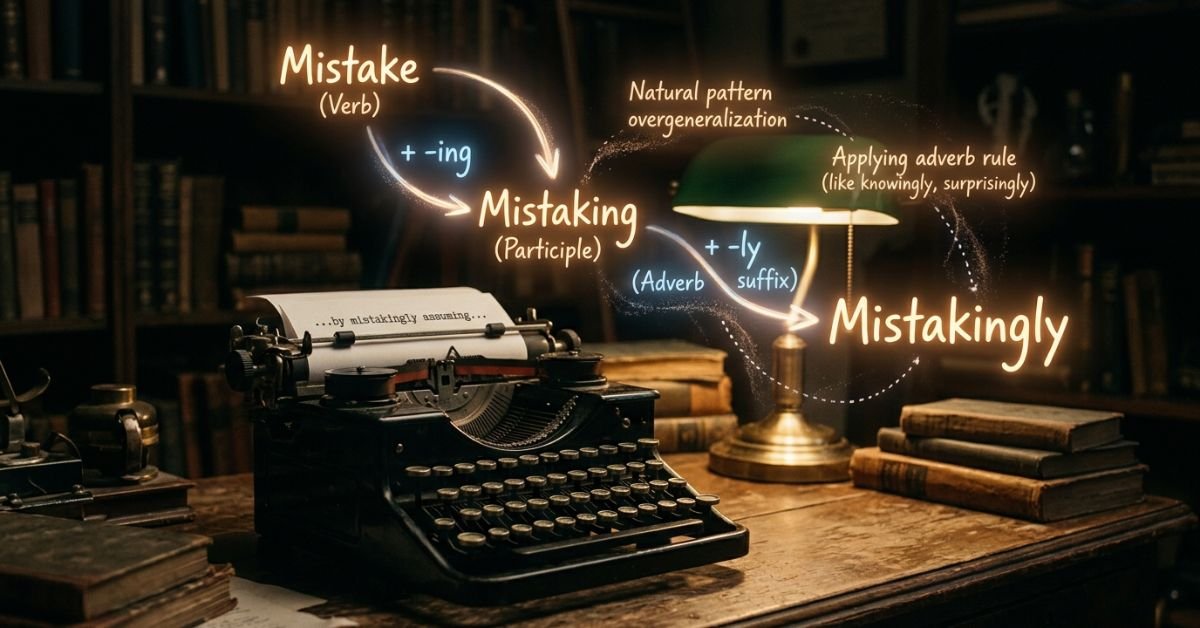
People write mistakingly because it looks like a reasonable English word. They know that many adverbs end in -ly, so they assume the same pattern applies here.
The similarity between mistaken, mistaking, and mistakenly can also cause confusion. Someone may recognize the meaning but choose the wrong form while typing quickly.
This error is common among English learners and writers who rely on spelling patterns rather than checking established usage.
Common reasons include:
- Applying a familiar spelling rule to the wrong word.
- Writing based on pronunciation.
- Typing quickly without proofreading.
- Learning a form from an unreliable online source.
Conversation example:
- Emma: I thought mistakingly was correct because it sounded right.
- Ryan: That’s understandable, but mistakenly is the standard form.
Knowing why the confusion happens makes it easier to avoid the same mistake.
False pattern matching
False pattern matching happens when you apply a familiar language rule to a word that doesn’t follow it. English has many adverbs ending in -ly, so writers may assume every similar word follows the same pattern.
For example:
- Amazing → amazingly
- Surprising → surprisingly
- Loving → lovingly
- Mistaken → mistakenly
Notice that mistakenly is the established form. Adding -ly to mistaking may seem logical, but it produces a nonstandard choice for most modern writing.
Conversation example:
- Jake: Amazing becomes amazingly, so why not mistakingly?
- Sara: English forms don’t always follow one simple pattern. The standard word is mistakenly.
The best way to avoid false pattern matching is to learn common word forms as complete words. Check a reliable dictionary when a form seems uncertain.
Sound causes confusion
Pronunciation can make mistakingly seem correct to some writers. When people speak quickly, they may not notice the difference between similar word forms. They may then spell the word based on how it sounds.
Typing habits can add to the problem. If a person has seen mistakingly online, they may remember that spelling and repeat it without checking.
To improve accuracy, pay attention to the word’s spelling rather than relying on sound alone.
Try these steps:
- Read the sentence slowly.
- Check whether the word fits the intended meaning.
- Use a trusted dictionary if you’re unsure.
- Proofread important emails and reports.
Conversation example:
- Mia: I wrote the word as I thought it sounded.
- Leo: That happens. Remember to use mistakenly in standard writing.
A quick spelling check can prevent an avoidable error.
Why English Uses Mistakenly Instead of Mistakingly
English word forms develop through patterns of grammar, history, and common usage. Not every word follows the same rule, even when two words look similar.
Mistakenly is the established adverb associated with mistaken. It describes an action performed because of an error or incorrect belief. By contrast, mistakingly is not the usual choice in standard contemporary English.
The important point is that spelling depends on accepted usage, not just on what seems logical. A word can look as if it should exist without being the preferred form.
Examples:
- She mistakenly entered the wrong date.
- He mistakenly believed the train had left.
- The office mistakenly sent the notice to the wrong address.
Conversation example:
- Alex: Why can’t I just add -ly to mistaking?
- Ella: Because mistakenly is the established form used in standard English.
When in doubt, follow reliable dictionaries and edited writing.
Common Phrases Using Mistakenly
Mistakenly often appears with verbs that describe beliefs, decisions, identification, or actions performed in error. Learning these common phrases can help you use the word naturally.
You may see it in personal messages, business communication, news reports, and formal documents.
Common combinations include:
- Mistakenly assumed
- Mistakenly believed
- Mistakenly identified
- Mistakenly accused
- Mistakenly sent
- Mistakenly deleted
- Mistakenly charged
- Mistakenly interpreted
- Mistakenly attached
- Mistakenly transferred
For example, a customer may be mistakenly charged for an order. An employee may have mistakenly attached an outdated file.
Conversation example:
- Sam: Why was the wrong invoice sent?
- Ella: It was mistakenly attached to the email.
These phrases help explain the specific error. Choose the verb that clearly describes what happened.
Everyday phrases
In daily conversations, mistakenly helps explain small errors without giving a long explanation. It can describe anything from sending a message to misunderstanding a plan.
Here are some natural examples:
- I mistakenly took your jacket.
- She mistakenly called the wrong number.
- He mistakenly deleted our conversation.
- We mistakenly arrived an hour early.
- They mistakenly believed the event was free.
You can use the word when apologizing or explaining what went wrong.
Conversation example:
- Alex: Why did you send that message to me?
- Mia: I mistakenly selected your name instead of my coworker’s.
For casual conversations, simpler alternatives like by mistake also work. For example, you can say, I sent it by mistake. Both forms communicate the error clearly.
Example in context
Imagine a customer receives a bill for a service they never purchased. After reviewing the account, the company finds that an employee entered the wrong customer number.
The company might explain the problem this way:
- We mistakenly charged your account.
- The charge resulted from an entry error.
- We have corrected the billing record.
Here, mistakenly explains how the incorrect charge happened. It also helps the company take responsibility without confusing the customer.
Conversation example:
- Customer: Why was I charged twice?
- Support agent: We mistakenly processed the payment twice. We’re reviewing the record.
The word is useful when explaining errors in a clear, professional way. Still, the full message should state what happened and what action will fix it.
Incorrect vs Correct Usage
The simplest way to learn mistakenly is to compare it with the nonstandard form. Seeing both versions makes the difference easier to remember.
| Nonstandard usage | Standard usage |
| I mistakingly sent the wrong file. | I mistakenly sent the wrong file. |
| She mistakingly believed the shop was open. | She mistakenly believed the shop was open. |
| He mistakingly identified the customer. | He mistakenly identified the customer. |
| We mistakingly charged the account. | We mistakenly charged the account. |
The second column uses the preferred form in standard English. The meaning remains clear, but the spelling is more appropriate for edited writing.
Quick proofreading tip: Search your document for mistakingly. If you mean doing something in error, replace it with mistakenly.
Conversation example:
- Editor: Please correct this word in the report.
- Writer: I’ll change mistakingly to mistakenly.
A simple check can make your writing more polished.
What Dictionaries Say
Dictionaries help explain a word’s spelling, meaning, and accepted use. When you’re unsure about a confusing word, check a reliable reference instead of relying only on how it looks or sounds.
For contemporary standard writing, mistakenly is the form to use. Dictionaries commonly define it as doing something in error or through a mistaken belief.
When checking mistakingly, pay attention to whether the dictionary lists it as a headword, provides a definition, or gives usage guidance. Don’t assume that a word is recommended just because it appears in an online text.
Helpful references include:
- Merriam-Webster
- Oxford English Dictionary or Oxford Learner’s Dictionaries
- Cambridge Dictionary
- Dictionary.com
Conversation example:
- Nina: Which spelling should I trust?
- Omar: Check a reliable dictionary and use mistakenly for standard writing.
Always consult the current entry when you need a precise dictionary-based claim.
Common dictionary treatment
For a dictionary check, search for mistakenly first. Review its definition, pronunciation, and example sentences. Then check whether mistakingly has its own entry or any usage label.
A missing entry doesn’t prove that a form has never been used. However, for everyday and professional writing, mistakenly remains the safer standard choice.
When researching dictionary guidance, consider these points:
- Is the word listed as a standard entry?
- Does the source provide a clear definition?
- Are example sentences available?
- Does the dictionary identify the form as uncommon or nonstandard?
Conversation example:
- Alex: I found mistakingly on a website.
- Sam: Check a dictionary before using it in formal writing. Mistakenly is the standard choice.
This approach helps you make accurate claims rather than relying on assumptions about dictionary entries.
Case Study: A Costly Mistakenly Error in Business Writing
Consider a fictional company that sends a customer a billing email. The message says the customer was mistakingly charged twice. The customer understands the message, but the unusual word choice makes the email look less polished.
The bigger problem is not the spelling alone. The email fails to explain what caused the extra charge or how the company will fix it. Clear wording matters most when customers need answers about money.
A stronger version would say:
- We mistakenly charged your account twice.
- We have corrected the billing error.
- Your updated statement will reflect the change.
Conversation example:
- Customer: Why was I charged twice?
- Support agent: We mistakenly processed the payment twice. We’ve corrected the error.
This fictional example shows how correct spelling and clear explanations can support trust. It is an illustration, not a report of a real company’s loss.
Mistakenly in Business Communication
Business communication often needs clear, precise wording. Mistakenly helps explain errors in invoices, emails, account records, orders, and internal reports.
Using the standard form also makes messages look more polished. This is especially important when writing to customers, managers, coworkers, or business partners.
For example:
- We mistakenly attached the wrong document.
- The payment was mistakenly transferred to another account.
- The customer was mistakenly charged twice.
- I mistakenly replied to all recipients.
When an error affects someone else, explain what happened and what you will do next.
Conversation example:
- Manager: Why did the client receive the old report?
- Employee: I mistakenly attached the previous version. I’ll send the correct file now.
Use mistakenly to describe the error, then give a clear solution. This makes business communication more useful and professional.
Common uses
In the workplace, mistakenly often describes errors that need correction. It appears in customer service, finance, human resources, information technology, and general office communication.
Common examples include:
- Mistakenly sent an email to the wrong person.
- Mistakenly deleted a shared file.
- Mistakenly entered an incorrect invoice amount.
- Mistakenly transferred a payment.
- Mistakenly revoked a user’s access.
- Mistakenly attached an outdated document.
Conversation example:
- IT worker: Why can’t Jordan access the shared folder?
- Manager: I mistakenly revoked the access permission.
In each case, mistakenly explains the action that caused the problem. Follow it with useful details, such as when the error occurred and how it will be corrected.
Mistakenly in Legal Writing
Legal writing requires careful wording because small differences can affect how readers understand a document. Mistakenly can describe an error involving a record, identity, filing, or decision.
For example, a document might state that information was mistakenly entered into a form. A report might explain that a person was mistakenly identified. The word describes the error, but it does not automatically determine legal responsibility.
Examples include:
- The clerk mistakenly entered the wrong date.
- The document was mistakenly filed under another name.
- The report mistakenly identified the wrong address.
Important: Legal documents should be reviewed by a qualified legal professional when accuracy has legal consequences. Don’t rely on spelling advice alone to resolve a legal issue.
Conversation example:
- Assistant: The case number appears incorrect.
- Lawyer: It may have been mistakenly entered. Let’s verify the original record.
Use mistakenly only when it accurately describes the facts.
Is Mistakingly Ever Acceptable?
You may encounter mistakingly in online posts, informal writing, or older texts. However, it is not the preferred form in standard contemporary English.
If you’re writing a school assignment, article, business email, or professional document, choose mistakenly. It is the more familiar and widely accepted option.
Keep these points in mind:
- Readers may understand mistakingly from context.
- Its appearance online doesn’t make it the recommended form.
- Standard writing favors mistakenly.
- Historical or quoted text may preserve an unusual form when necessary.
Conversation example:
- Mia: Someone used mistakingly in a comment. Should I correct them?
- Leo: It depends on the situation, but mistakenly is the standard spelling.
For most writing, there’s no need to take a risk. Use the established form.
American vs British English: Is There a Difference?
American and British English have several spelling differences. For example, American English generally uses color and analyze, while British English often uses colour and analyse.
However, mistakenly is the standard form in both varieties. You don’t need to change its spelling based on your audience’s location.
The important distinction is between a regional spelling difference and a nonstandard word form. Color and colour are accepted regional variants. Mistakenly is the standard choice in both American and British English.
Examples:
- US English: She mistakenly sent the wrong document.
- UK English: She mistakenly sent the wrong document.
Conversation example:
- Alex: Should British writers use mistakingly?
- Sam: No. Mistakenly is the standard choice in both varieties.
When writing for a particular audience, follow its spelling conventions for words that genuinely vary by region.
US English
In American English, mistakenly is the standard adverb for describing an action done in error. It works in casual writing, business communication, academic assignments, and published content.
Examples include:
- I mistakenly entered the wrong ZIP code.
- The company mistakenly charged my card.
- She mistakenly believed the office was closed.
American English has regional spelling preferences, such as center instead of centre. But this does not create a separate American spelling for mistakenly.
Conversation example:
- Student: Is mistakingly acceptable in my US English essay?
- Teacher: Use mistakenly for standard spelling.
If you’re following an American style guide, keep the spelling consistent and check unfamiliar word forms before submitting your work.
British English
British English also uses mistakenly as the standard form. Although British spelling differs from American spelling in some words, this is not one of those cases.
For example, British writers may use colour, organise, or centre, depending on their style guide. The spelling mistakenly stays the same.
Examples:
- She mistakenly booked the wrong train.
- He mistakenly attached the old document.
- The office mistakenly sent two invoices.
Conversation example:
- Emma: Does British English prefer mistakingly?
- Oliver: No. Mistakenly is the standard choice in British English, too.
Remember that regional differences apply only to specific words. Don’t assume every spelling changes between the United States and the United Kingdom.
Common Grammar Mistakes Related to Mistakenly
English contains many words that look or sound similar but follow different spelling rules. Learning these differences can help you avoid common errors in emails, essays, and online content.
For example, mistakenly is often confused with mistakingly. Other common mix-ups include accidently and accidentally, or definately and definitely.
Here are a few useful reminders:
- Use mistakenly, not mistakingly, in standard writing.
- Use accidentally, not accidently, in standard writing.
- Use definitely, not definately.
- Check whether a word is a noun, verb, adjective, or adverb.
Conversation example:
- Alex: I keep making spelling mistakes in my emails.
- Mia: Review commonly confused words and proofread before sending.
A little practice can improve your accuracy and confidence.
Accidently vs Accidentally
The standard spelling is accidentally. It means something happened unintentionally or by accident. Accidently is a common misspelling and should generally be avoided in formal and professional writing.
Examples:
- Correct: I accidentally deleted the photo.
- Incorrect: I accidently deleted the photo.
- Correct: She accidentally called the wrong number.
Like mistakenly, accidentally can describe an unintended action. However, the words may emphasize slightly different aspects of the situation.
Conversation example:
- Sam: Is it accidently or accidentally?
- Ella: Use accidentally. It includes the extra syllable and letters.
A simple way to remember it is to start with the correct base word accidental, then add -ly.
Definately vs Definitely
The correct spelling is definitely. The form definately is a common spelling mistake, often caused by pronunciation or confusion about the vowel pattern.
Definitely means certainly or without doubt. You can use it to express strong agreement or confidence.
Examples:
- Correct: I will definitely attend the meeting.
- Incorrect: I will definately attend the meeting.
- Correct: This is definitely the right answer.
Conversation example:
- Mia: Are you definitely coming tomorrow?
- Alex: Yes, definitely!
To remember the spelling, connect definitely with definite. The adjective helps you recall the correct vowel pattern.
Just as you should learn mistakenly as a complete word, learning definitely correctly can help prevent repeated spelling errors.
Judgement vs Judgment
Both judgment and judgement are accepted spellings, but their use varies by region and style. American English generally prefers judgment. British English commonly uses judgement, although judgment also appears in some contexts.
The word refers to an opinion, decision, or ability to make a choice. Legal writing may follow specific conventions, so check the relevant style guide.
Examples:
- US English: The judge delivered a judgment.
- UK English: She showed good judgement.
- Both forms may appear in different regional or professional contexts.
Conversation example:
- Alex: Is judgement always wrong?
- Sam: No. Unlike mistakingly, it has accepted regional and stylistic variations.
This example shows why you should check each word individually instead of assuming all spelling differences work the same way.
Mistook vs Mistaken
Mistook and mistaken are both correct forms of the verb mistake, but they serve different grammatical roles.
- Mistook is the simple past tense.
- Mistaken is the past participle, often used with have, has, or had, or as an adjective.
Examples:
- I mistook him for his brother.
- I have mistaken the date.
- She was mistaken about the time.
Conversation example:
- Mia: Should I say I mistook the address or have mistaken it?
- Leo: Use mistook for simple past and have mistaken for the present perfect.
Understanding these verb forms also helps you remember mistakenly, which is the standard adverb used to describe an action performed in error.
How to Remember the Correct Spelling
The easiest way to remember mistakenly is to learn it as a complete word rather than trying to build it from mistaking. The spelling may not follow the pattern you expect, but repeated exposure helps it become familiar.
Try writing the word in a few simple sentences. You could write, I mistakenly sent the wrong file, or She mistakenly chose the wrong answer.
Helpful habits include:
- Read examples from reliable sources.
- Add mistakenly to your personal spelling list.
- Check important writing before sending it.
- Use a dictionary when a form looks unusual.
Conversation example:
- Alex: How can I stop writing mistakingly?
- Sam: Practice the correct form and check it when proofreading.
A short daily review can help you remember the spelling without hesitation.
The easiest trick
Use this simple memory trick: mistakenly contains the word mistaken. Remember the phrase I was mistaken, so I acted mistakenly.
This connects the adjective mistaken with the standard adverb mistakenly. It also links the spelling to the meaning, making the word easier to recall.
Practice with these examples:
- I was mistaken about the meeting time.
- I mistakenly arrived an hour early.
- She was mistaken about the address.
- She mistakenly sent the package to another location.
Conversation example:
- Nina: What’s your trick for remembering the spelling?
- Omar: I remember mistaken first, then mistakenly.
Repeat the phrase a few times. With practice, the correct spelling will feel more natural.
Pattern shortcut
A useful shortcut is to remember that familiar spelling patterns do not work for every English word. Some words need to be learned through usage and examples.
For this word, connect mistakenly with mistaken, not with mistaking. Then remember that it describes an action done in error.
Try this quick practice:
- Mistaken → mistakenly
- Wrong belief → mistakenly believed
- Incorrect choice → mistakenly selected
- Sending error → mistakenly sent
Conversation example:
- Alex: Can I just add -ly to any word?
- Mia: Not always. Learn the established form, which is mistakenly here.
The shortcut is simple: remember the complete word and use it in a sentence. This is more reliable than guessing from spelling patterns alone.
Why Search Interest for Mistakingly or Mistakenly Keeps Growing
People often search for confusing word pairs when they need a quick spelling answer. The difference between mistakingly and mistakenly is easy to question because the forms look similar.
Students may check before an exam. Writers may look up the word while editing an article. Professionals may search when proofreading an email or report.
However, claims that search interest is increasing need current data from a tool such as Google Trends. Without that evidence, it’s more accurate to say the word pair can cause online confusion rather than claiming its popularity is definitely growing.
Common reasons people search include:
- Uncertainty about spelling.
- Questions about grammar and word formation.
- Spellcheck suggestions.
- English-learning needs.
Conversation example:
- Mia: Why do people search this word pair?
- Alex: They want to know which spelling is standard. The answer is mistakenly.
Spellcheck dependence
Spellcheck tools can catch many spelling errors, but they don’t always explain why one form is better than another. Some tools may miss uncommon forms or respond differently based on their dictionaries and settings.
That means you should not rely on automatic correction alone. If you’re unsure whether mistakingly is appropriate, check a reliable dictionary and review the sentence.
Helpful tips:
- Turn on spellcheck in your writing app.
- Review suggestions before accepting them.
- Check unfamiliar words manually.
- Proofread important documents after using automated tools.
Conversation example:
- Alex: My spellcheck didn’t flag the word.
- Mia: Check a dictionary, too. Mistakenly is the standard form.
Spellcheck is useful, but understanding the word helps you make the final decision.
Phonetic spelling habits
Phonetic spelling happens when someone writes a word based on how it sounds. This habit can lead to errors because English spelling doesn’t always match pronunciation exactly.
A writer might choose mistakingly because it sounds plausible. However, familiar sounds don’t always reveal the standard spelling.
To improve your spelling:
- Read the word in complete sentences.
- Notice how reliable sources spell it.
- Practice writing it correctly.
- Review your work before sending it.
Conversation example:
- Sam: I wrote it the way it sounded to me.
- Ella: That happens. In standard writing, use mistakenly.
Reading more edited English can help you recognize common word forms. Over time, the correct spelling becomes easier to remember.
Pattern assumptions
Pattern assumptions happen when writers expect a word to follow a rule because similar words do. For example, amazingly and surprisingly may encourage someone to guess the form mistakingly.
But English has exceptions and established forms that cannot always be predicted. That’s why checking actual usage matters.
Remember these points:
- Similar words may follow different patterns.
- A spelling that looks logical may still be nonstandard.
- Dictionaries can confirm established forms.
- Mistakenly is the standard choice for this meaning.
Conversation example:
- Alex: It looked like it should be mistakingly.
- Mia: I understand why, but the established form is mistakenly.
Learn common forms through reading, practice, and reliable reference sources instead of relying on guesswork.
Real-World Examples From Daily Use
Mistakenly appears in many everyday situations. You might mistakenly send a message, choose the wrong item, misunderstand a plan, or enter incorrect information.
The word helps explain that an action happened because of an error. You can use it in casual messages as well as formal writing, although simpler phrases like by mistake may sound more natural in some conversations.
Examples:
- I mistakenly took your charger.
- She mistakenly booked the wrong date.
- He mistakenly entered the wrong code.
- We mistakenly went to the wrong building.
Conversation example:
- Alex: Why did you come to the old office?
- Mia: I mistakenly saved the previous address.
These examples show how the word fits daily situations. Choose it when you want to explain the error clearly.
In emails, mistakenly can explain errors involving attachments, recipients, dates, or information. It is especially useful when you need to acknowledge a mistake politely.
Examples:
- I mistakenly attached the older version of the report.
- We mistakenly sent the invoice to the wrong address.
- I mistakenly included the wrong date in my message.
A good correction email should explain the problem and provide the right information.
Conversation example:
- Manager: Did the client receive the final report?
- Employee: Not yet. I mistakenly attached the draft, so I’ll send the final version now.
Use clear wording and avoid long explanations. Mistakenly describes what went wrong, while the rest of your email should explain how you will fix it.
Texting
In texting, mistakenly can explain why you sent the wrong message or contacted the wrong person. However, casual phrases like by mistake often sound more natural in everyday chats.
Examples:
- I mistakenly texted the wrong person.
- I sent that message by mistake.
- I mistakenly saved your old number.
Conversation example:
- Mia: Was that message meant for me?
- Alex: No, I mistakenly sent it to you. Sorry!
Both mistakenly and by mistake communicate the error. Choose the phrase that matches the tone of your conversation. In quick messages, simple language is often best.
Social Media
On social media, mistakenly may appear in captions, comments, direct messages, and explanations. Someone might mistakenly tag the wrong account, share an outdated post, or misunderstand a comment.
Examples:
- I mistakenly tagged the wrong person.
- She mistakenly shared the old photo.
- He mistakenly thought the post was about him.
Conversation example:
- Ava: Why did you tag that account?
- Noah: I mistakenly selected the wrong profile.
For casual posts, you can also say I did it by mistake. In a public correction, be clear about the error and avoid blaming others without evidence.
The main rule stays the same: use mistakenly when describing an action caused by an error.
Quote Worth Remembering
The right word makes your meaning clear; the right spelling makes your writing stronger.
Remember that mistakenly is the standard form in modern English. Although mistakingly may look reasonable, it’s best avoided in everyday, academic, and professional writing.
When you’re unsure, check a reliable dictionary instead of guessing from a spelling pattern. Practice using mistakenly in short sentences until the spelling feels natural.
Quick reminder:
- Correct standard form: mistakenly
- Meaning: doing something because of an error or wrong belief
- Similar word: accidentally
- Best practice: proofread and check unfamiliar words
A little attention to spelling can make your writing clearer, more accurate, and easier to trust.
Mistakingly or Mistakenly
Are you confused about mistakingly or mistakenly? You’re not alone. Many students, bloggers, professionals, and English learners struggle with these commonly confused words.
Mistakenly is the standard spelling in modern English. It means doing something because of an error, misunderstanding, or incorrect judgment. Although you may encounter mistakingly in some texts, it’s a nonstandard choice for everyday and formal writing.
For example:
- Correct: I mistakenly sent the wrong file.
- Nonstandard: I mistakingly sent the wrong file.
The confusion often comes from the adjective plus -ly pattern. Words like amazingly, interestingly, and surprisingly make mistakingly look reasonable. However, the established adverb comes from mistaken.
Remember this simple connection: mistaken → mistakenly. Use this spelling in academic papers, business communication, emails, and published writing. It helps maintain clarity, professionalism, and English accuracy.
Quick Rule Summary
The easiest way to remember the correct usage is to focus on the word mistakenly. It describes an action caused by an error or a wrong belief.
Use this quick comparison whenever you’re unsure:
| Word | Usage |
| Mistakenly | Standard spelling in modern English |
| Mistakingly | Nonstandard in ordinary contemporary usage |
| Accidentally | Describes an unintended action or event |
| Erroneously | Means incorrectly or based on an error |
For example, you might say, I mistakenly believed the meeting started at noon. However, you might say, I accidentally spilled coffee on my notes.
Both mistakenly and accidentally can describe unintentional events, but their meanings aren’t always identical. Mistakenly often involves an incorrect belief or judgment.
Use “mistakenly” when:
Choose mistakenly whenever you want to explain that someone acted because of an error or misunderstanding. This spelling works in casual conversations and formal writing.
Here are some common situations:
- Academic papers: She mistakenly interpreted the research findings.
- Business communication: We mistakenly charged the customer twice.
- Email: I mistakenly attached the wrong document.
- Legal writing: The witness was mistakenly identified.
- IT and tech support: The administrator mistakenly deleted the file.
- Social media: I mistakenly posted the unfinished version.
You can also use phrases like mistakenly assumed, mistakenly believed, mistakenly accused, and mistakenly transferred.
Conversation example:
Alex: Why didn’t you join the meeting yesterday?
Sam: I mistakenly believed it was scheduled for Friday.
In American English and British English, mistakenly remains the standard spelling. Use it in professional writing, standardized exams, and everyday messages to keep your writing clear and accurate.
Avoid “mistakingly” because:
Avoid mistakingly in standard contemporary writing because readers generally expect mistakenly. Although the less common form may appear in older texts or unusual contexts, it’s not the recommended choice for most modern writing.
Here are three reasons to choose the standard spelling:
- Correct usage: Teachers, editors, and professional writers generally prefer mistakenly.
- Professionalism: Standard spelling helps your emails, reports, and published writing look polished.
- Clarity: Using familiar, accepted forms reduces confusion for readers.
The mistake often happens through false pattern matching. Writers see words like lovingly and amazingly and assume that mistakingly follows the same pattern.
However, English word formation doesn’t always follow one simple rule. Spell-check software can help, but it shouldn’t replace your own judgment.
Incorrect: I mistakingly sent the invoice to the wrong client.
Correct: I mistakenly sent the invoice to the wrong client.
The second sentence follows standard usage and communicates the same idea more naturally.
Frequently Asked Questions
Is mistakingly grammatically correct?
Mistakingly appears in some sources and historical usage, but it’s nonstandard in ordinary modern English. Use mistakenly for standard writing.
What is the main difference between mistakingly and mistakenly?
Mistakenly is the standard adverb used to describe an error or incorrect judgment. Mistakingly is a nonstandard alternative that writers should generally avoid.
Is mistakenly an adverb?
Yes. Mistakenly is an adverb that describes an action performed because of an error or misunderstanding. For example, She mistakenly deleted the email.
Can I use mistakingly in formal writing?
It’s best to avoid mistakingly in formal writing. Use mistakenly in academic papers, business communication, legal documents, and professional emails.
Is mistakenly the same as accidentally?
Not always. Mistakenly often suggests a wrong belief or judgment, while accidentally emphasizes an unintended action. Their meanings sometimes overlap.
Do American and British English use different spellings?
No. Both American English and British English use mistakenly as the standard form. This isn’t a regional spelling difference like color/colour or analyze/analyse.
How can I remember the correct spelling?
Connect the adjective mistaken with its standard adverb mistakenly. Remembering this word formation pattern can help you avoid the common spelling error.
Is Mistakingly Grammatically Correct?
Mistakingly is not the standard choice in modern English. Although people may use it, mistakenly is the accepted and widely preferred form in everyday and formal writing.
The confusion often comes from the word mistaken. Writers may think they can add -ly to form mistakingly. However, English word formation doesn’t always follow one simple pattern.
Use mistakenly when you mean that someone did something because of an error or incorrect belief.
Examples:
- Correct: She mistakenly sent the email to the wrong person.
- Nonstandard: She mistakingly sent the email to the wrong person.
- Correct: I mistakenly believed the meeting was canceled.
Conversation example:
- Alex: Is mistakingly the correct spelling?
- Sam: Use mistakenly. It’s the standard form in modern English.
For clear, professional writing, choose mistakenly.
Why Do People Write Mistakingly?
People write mistakingly because it seems to follow a familiar English spelling pattern. Many adverbs form by adding -ly to an adjective. For example, amazing becomes amazingly, and surprising becomes surprisingly.
Writers may apply the same pattern to mistaken and create mistakingly. This is an understandable spelling error, especially for English learners.
Pronunciation and quick typing can also contribute to word confusion. Someone might recognize the intended meaning but choose the wrong form without checking a dictionary.
Common reasons include:
- False pattern matching: Assuming every similar-looking word follows the same rule.
- Phonetic spelling: Writing a word based on how it sounds.
- Limited exposure: Not seeing mistakenly often in published writing.
- Typing quickly: Sending a message without proofreading.
Conversation example:
- Mia: I wrote mistakingly in my report. Why is it wrong?
- Leo: It’s an understandable mix-up. Use mistakenly in standard English.
Remembering the correct form can help you avoid this common spelling mistake.
Is Mistakenly an Adverb?
Yes, mistakenly is an adverb. It describes an action that happens because of a mistake, incorrect belief, or misunderstanding.
Adverbs often explain how, when, where, or to what extent something happens. In this case, mistakenly tells readers that someone performed an action in error.
For example, in the sentence I mistakenly deleted the file, the word explains that the deletion happened by mistake.
Here are more examples:
- She mistakenly identified the wrong person.
- The company mistakenly charged the customer twice.
- He mistakenly believed the office was closed.
- I mistakenly attached the wrong document.
Compare these related forms:
| Word | Part of speech | Example |
| Mistake | Noun or verb | I made a mistake. |
| Mistaken | Adjective or past participle | I was mistaken. |
| Mistakenly | Adverb | I mistakenly replied. |
Conversation example:
- Ava: What kind of word is mistakenly?
- Noah: It’s an adverb because it describes an action done in error.
Use mistakenly when you need an adverb to explain an unintended error.
Can I Use Mistakingly in Formal Writing?
It’s best to avoid mistakingly in formal writing. Although readers may understand your meaning, mistakenly is the standard form and sounds more natural in professional English.
This matters in academic papers, business emails, legal documents, reports, and published articles. Correct word choice helps your writing appear clear, polished, and credible.
Consider these examples:
- Less suitable: The payment was mistakingly transferred to another account.
- Better: The payment was mistakenly transferred to another account.
- Less suitable: We mistakingly identified the wrong invoice.
- Better: We mistakenly identified the wrong invoice.
In professional communication, precise wording can prevent confusion. It also helps readers focus on your message instead of noticing a spelling or usage issue.
Conversation example:
- Editor: Please check this sentence before publication.
- Writer: Should I change mistakingly to mistakenly?
- Editor: Yes. Mistakenly is the standard choice.
For formal writing, choose mistakenly every time. If you’re editing an older text, preserve its original wording only when the context or editorial rules require it.
Which Word Should I Use on Exams?
Use mistakenly in English exams, grammar tests, spelling exercises, and formal assignments. It is the standard choice in contemporary English, so it is the safer answer when you must select the correct word.
Exams often test standard spelling and word usage. Writing mistakingly may be marked incorrect, even if the examiner understands what you mean.
To remember the correct form, connect mistaken with mistakenly. Avoid creating a new form by adding -ly to mistaking.
Try these examples:
- She mistakenly entered the wrong answer.
- He mistakenly thought the exam started at ten.
- The student mistakenly selected the wrong option.
Quick exam tip:
- Choose mistakenly for standard English.
- Check the spelling before submitting your answers.
- Don’t confuse it with accidentally, which has a similar meaning but a slightly different emphasis.
Conversation example:
- Teacher: Which spelling should you use in an exam?
- Student: Mistakenly, because it’s the standard form.
When you’re unsure, choose the form used in reliable dictionaries and edited writing.
Is Mistakenly the Same as Accidentally?
Mistakenly and accidentally have similar meanings, but they don’t always fit the same situations. Both can describe an action that happens unintentionally. However, mistakenly often emphasizes an incorrect belief, judgment, or decision.
Accidentally usually emphasizes that something happened unintentionally, without someone planning it.
Compare these examples:
- I mistakenly believed the store was open.
This means I had the wrong belief. - I accidentally spilled coffee on my shirt.
This means the spill was unintentional. - She mistakenly sent the invoice to the wrong client.
This highlights an error in sending it. - He accidentally broke the glass while cleaning.
This highlights an unintended event.
Sometimes, either word works:
- I mistakenly deleted the file.
- I accidentally deleted the file.
Both sentences are correct. The first emphasizes the error, while the second emphasizes that the deletion was unintentional.
Conversation example:
- Sara: I accidentally sent the message to my manager.
- Ben: You mean you sent it to the wrong person by mistake?
- Sara: Exactly. I mistakenly chose the wrong contact.
Simple rule: Use mistakenly for errors in belief or judgment. Use accidentally for unintended actions or events. When both meanings fit, either word may work.
FAQs
1. Is mistakingly correct?
Mistakingly is not the standard choice in modern English. Use mistakenly for correct spelling in everyday and formal writing.
2. What is the main difference between mistakingly and mistakenly?
Mistakenly is the standard adverb meaning doing something in error. Mistakingly is a nonstandard form best avoided.
3. Which word should I use in exams or professional writing?
Use mistakenly in exams, business emails, and formal documents. It is the accepted spelling in standard contemporary English.
4. Are both words interchangeable?
No, they aren’t equally accepted in standard English. Choose mistakenly to keep your writing clear, correct, and professional.
5. Why do people still get confused between them?
People confuse them because mistakingly seems to follow familiar spelling patterns. However, mistakenly is the standard form.
Conclusion
Choosing the right word can make your writing clear and correct. When comparing mistakenly and mistakingly, remember that mistakenly is the standard form in modern English. It means doing something because of an error or a wrong belief. You can use mistakenly in emails, school assignments, business documents, and everyday conversations. Knowing the correct spelling helps you avoid common grammar mistakes and write with more confidence.
Keep mistakenly in mind whenever you describe an action caused by a mistake. For example, you might have mistakenly sent a message, deleted a file, or misunderstood a simple instruction. Although mistakingly may look correct, mistakenly is the safer choice for standard writing. Practice using mistakenly in your own sentences to remember its spelling and meaning. With regular practice, you’ll find it easier to use mistakenly correctly and make your English clearer, more natural, and more professional.
Learn what mistakenly means, how to spell it correctly, and how to use it in sentences with simple examples and helpful tips for 2026.

Jack Harrison is a passionate writer with 4 years of experience exploring names, meanings, origins, symbolism, and cultural significance. He creates clear, engaging, and well-researched content to help readers discover the deeper meanings behind names and words.
