Have you ever paused while writing, wondering whether shinning or shining is correct? You’re not alone! These two words look almost identical, yet they describe very different things. One can bring a picture of sparkling stars or bright sunlight to mind. The other describes someone climbing a tree or pole using their arms and legs. Just one letter can change the meaning of your entire sentence.
So, how do you know which word to use? The answer becomes simple when you understand their meanings and spelling rules. Whether you’re writing a social media caption, a school assignment, or a professional email, choosing the right word makes your message clearer. In this guide, you’ll find easy explanations, everyday examples, and helpful tips to remember the difference. Let’s clear up this common spelling confusion once and for all!
Shinning vs Shining: The Quick Answer
The correct spelling depends on what you want to say. Shining usually describes something that gives off light or shows excellence. Shinning is also a real word, but it means climbing by using your arms and legs against a surface.
For example, you might write, The stars are shining brightly tonight. If someone is climbing a tree trunk, you could say, He is shinning up the tree.
Here’s a quick comparison:
- Shining: Giving off light, glowing, or showing outstanding ability.
- Shinning: Climbing a pole, tree, or similar object using your arms and legs.
- Common mistake: Writing shinning when you mean something is glowing or doing well.
Conversation example:
- Alex: Your shoes are shining!
- Sam: Thanks! I polished them this morning.
Remember, both words exist in the English language. The context tells you which spelling fits your sentence.
What Does Shining Actually Mean?
Shining is the present participle of the verb shine. It describes something that gives off light, reflects light, or appears bright. It can also describe someone who performs exceptionally well.
You can use shining when talking about sunlight, stars, polished objects, or a person’s achievements. The meaning depends on the sentence.
For example:
- The sun is shining through the window.
- Her shining eyes showed her excitement.
- He is a shining example of teamwork.
- The polished car was shining under the streetlights.
Shining can also work as an adjective. In phrases like a shining star, it describes someone or something impressive.
Conversation example:
- Mia: You did an amazing job on this project.
- Leo: Thanks! I wanted my work to shine.
The key is simple: use shining when you mean brightness, radiance, or excellence.
Common Phrases That Use Shining
The word shining appears in many everyday expressions. Some describe literal light, while others refer to success, kindness, or outstanding qualities.
Here are a few common phrases and how to use them:
- A shining example: Someone or something worth copying because of its excellent qualities.
- Knight in shining armor: A person who arrives to help someone in a difficult situation.
- Shining star: Someone who stands out because of their talent or success.
- Shining moment: A time when someone performs exceptionally well.
- Shining bright: Giving off light or doing something impressively.
- Shining eyes: Eyes that appear bright, excited, or full of emotion.
Conversation examples:
- Ava: Who helped you finish the presentation?
- Noah: My teammate was a knight in shining armor.
Another example:
- Mom: You played wonderfully today!
- Ella: That was my shining moment.
These expressions use shining, not shinning, because they describe brightness, excellence, or a helpful person. Learning these phrases can make your everyday English sound more natural.
What Does Shinning Actually Mean?
Shinning is the present participle of the verb shin, which can mean climbing by pressing your arms and legs against a surface. The word often appears when someone climbs a pole, tree trunk, or similar object without using regular climbing equipment.
Although the word contains shin, it does not simply mean that your shin bone is touching something. It describes a climbing action.
For example:
- The firefighter was shinning up the training pole.
- The boy kept shinning up the tree trunk.
- The worker practiced shinning up a tall pole.
Shinning is less common than shining in everyday writing. That’s why people often mistake it for a spelling error.
Conversation example:
- Liam: How did you get to the top of that pole?
- Ben: I practiced shinning up it during training.
Use shinning when the sentence clearly describes this type of climbing. If you mean glowing or doing well, choose shining instead.
Where You’ll Actually See Shinning
You’re most likely to encounter shinning in descriptions of climbing, physical training, or certain practical tasks. It isn’t a common word in everyday conversations, but it can be useful when describing a specific movement.
Here are some contexts where it may appear:
- Outdoor activities: Someone shinning up a tree trunk.
- Training exercises: A person practicing how to climb a pole.
- Firefighter training: Trainees climbing poles or similar structures.
- Utility work: A worker climbing a pole using appropriate equipment and safety procedures.
- Adventure stories: A character shinning up a mast or flagpole.
Conversation examples:
- Coach: What technique did you practice today?
- Athlete: We worked on shinning up a pole.
Or:
- Riley: How did the character reach the platform?
- Jordan: He was shinning up the tree trunk.
You may also see shinny in other contexts, including ice hockey. However, shinny and shinning are different words with different uses.
If you come across shinning in a blog post, story, or training guide, check whether the sentence describes climbing. The surrounding words usually provide enough context to identify the intended meaning.
Why Do People Mix Up Shinning and Shining?

People often confuse shinning or shining because the words look almost identical. Both begin with shin, and only one letter separates their spellings. However, their meanings are quite different.
The confusion also comes from English spelling rules. When you add -ing to shine, you drop the silent e to form shining. When you add -ing to shin, you double the final consonant to form shinning.
Compare these examples:
- Shine → Shining
- Shin → Shinning
- Write → Writing
- Sit → Sitting
- Hope → Hoping
- Stop → Stopping
The spelling depends on the root verb. A spellchecker might catch some mistakes, but it may not flag the wrong word if it is spelled correctly.
Conversation example:
- Emma: I wrote that the stars were shinning.
- Jack: If you mean they were glowing, write shining instead.
To avoid this word choice error, read your sentence carefully. Ask yourself whether you mean light and excellence or a climbing action
Shining vs Shinning: Side-by-Side Comparison
The words shining and shinning look almost the same, but they have different meanings. Choosing the correct spelling depends on the action you want to describe.
Shining usually refers to light, brightness, or excellence. Shinning describes climbing by using your arms and legs against a surface.
| Feature | Shining | Shinning |
| Root verb | Shine | Shin |
| Meaning | Giving off or reflecting light; showing excellence | Climbing a pole, tree, or similar object |
| Spelling rule | Drop the silent e before -ing | Double the final n before -ing |
| Example | The stars are shining. | He is shinning up the pole. |
| Common use | Everyday English and figurative expressions | Specific climbing contexts |
Conversation example:
- Mia: Why did you write shining in your caption?
- Noah: Because the sunlight is shining on the water.
Remember this simple rule: if you mean glowing or doing well, use shining. If you mean climbing in this particular way, use shinning.
Real-World Examples of Correct Usage
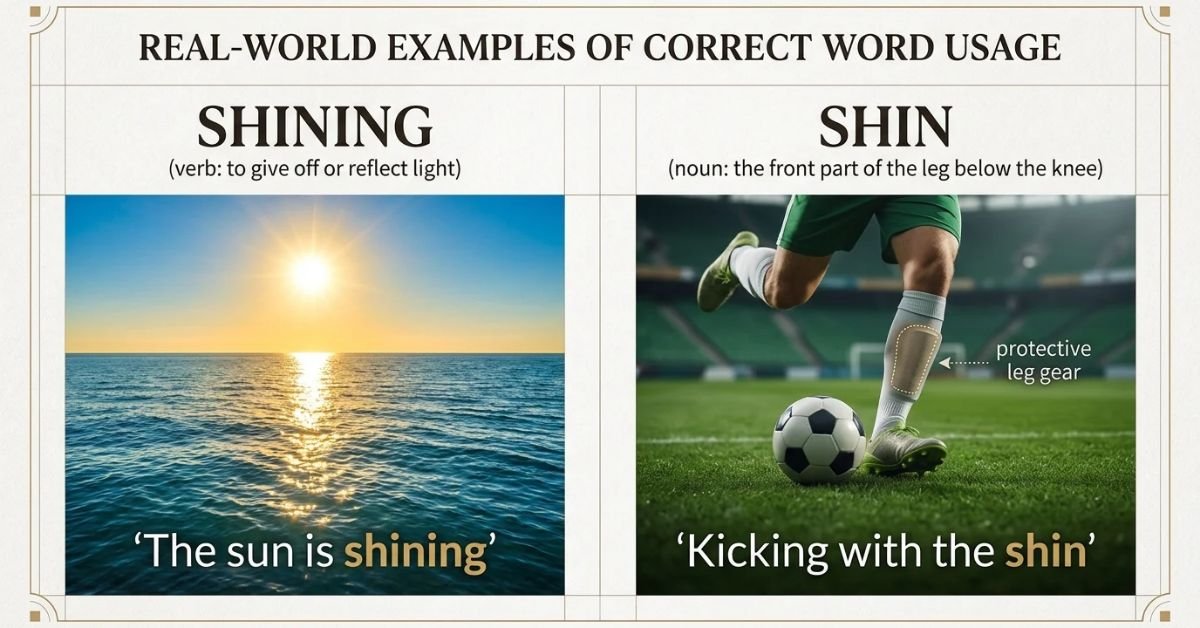
Seeing shinning or shining in complete sentences makes the difference easier to understand. The words serve different purposes, so context is your best guide.
Use shining when you describe light, reflection, or someone’s success.
- The moon is shining above the quiet lake.
- Her shining personality makes everyone feel welcome.
- The polished silver spoon was shining in the light.
- He had a shining moment during the final match.
- She is a shining example of honesty.
Use shinning when describing someone climbing by pressing their arms and legs against a surface.
- The boy was shinning up the tree trunk.
- The trainee practiced shinning up a training pole.
- In the story, the sailor was shinning up the mast.
Conversation examples:
- Ava: Why does the room look so bright?
- Liam: Sunlight is shining through the window.
- Ava: How did he reach that branch?
- Liam: He was shinning up the tree.
When proofreading, check the meaning before changing the spelling. Both words are valid, but only one will fit your sentence.
A Quick Case Study: How One Typo Changes a Sentence’s Meaning
A small spelling mistake can change the meaning of an otherwise clear sentence. Consider this example from a workplace review:
Incorrect for the intended meaning: Our new employee is shinning in her role.
Correct: Our new employee is shining in her role.
The first sentence suggests a climbing action, which doesn’t fit the workplace context. The second sentence means the employee is performing exceptionally well.
Here are two more examples:
- Incorrect for light: The stars are shinning tonight.
- Correct: The stars are shining tonight.
Now compare a sentence where shinning is appropriate:
– Correct: The firefighter was shinning up the training pole.
In this case, the sentence describes a climbing action rather than brightness.
Conversation example:
- Editor: Did you mean shinning in this paragraph?
- Writer: No, I meant the employee was doing excellent work.
This quick case study shows why spellcheckers aren’t always enough. Both words are spelled correctly, so automated tools may not identify the wrong word choice. Read the entire sentence and use context clues to confirm your meaning.
Grammar Rule Recap: Why Consonant Doubling Matters
English spelling rules explain why shining has one n, while shinning has two. The difference comes from their root verbs: shine and shin.
When you add -ing to a verb ending in a silent e, you usually drop the e. That’s why shine becomes shining, just as write becomes writing and hope becomes hoping.
When a short verb ends in a single consonant after a short vowel, you often double the final consonant before adding -ing. For example, sit becomes sitting, and stop becomes stopping.
Compare these spelling patterns:
- Shine → Shining
- Shin → Shinning
- Write → Writing
- Run → Running
- Hope → Hoping
- Sit → Sitting
Conversation example:
- Ben: Why does sitting have two ts?
- Ella: The final consonant doubles before -ing in this spelling pattern.
These rules help explain the forms, but English has exceptions. When you’re unsure, check a reliable dictionary and confirm that the word fits your intended meaning.
Other Words People Confuse With Shining
Shining isn’t the only English word that people confuse with a similar-looking word. Some pairs differ by one letter, while others sound alike but have different meanings.
Learning these commonly confused words can improve your spelling, word choice, and writing accuracy.
– Shone vs. shown: Shone is a past-tense form of shine. Shown is the past participle of show.
- Example: The sun shone brightly.
- Example: She has shown great patience.
– Shiny vs. shinny: Shiny means bright or reflective. Shinny can refer to a type of informal ice hockey or a climbing action in certain uses.
- Example: He bought shiny shoes.
- Example: They played shinny on the ice.
– Whine vs. wine: Whine means to complain in an irritating voice. Wine is an alcoholic drink.
- Example: Please don’t whine about the delay.
- Example: The restaurant serves wine.
– Sole vs. soul: Sole can mean the bottom of a foot or the only one. Soul refers to a person’s spiritual or inner self.
- Example: The sole of my shoe is worn.
- Example: Music touched her soul.
Conversation example:
- Alex: Is it shone or shown?
- Riley: Use shone when you’re talking about light in the past.
The best way to avoid these spelling mistakes is to learn each word’s meaning and review the full sentence. A quick proofreading check can make your writing clearer and more professional.
FAQs About Shinning vs Shining
1. Is Shinning a Correct Word?
Yes, shinning is a correct word that describes climbing using your arms and legs. However, shining describes brightness or excellence.
2. Which Is Correct: Shinning or Shining?
Both words are correct, but their meanings differ. Use shining for light or success, and shinning for climbing actions.
3. Why Do People Confuse Shinning and Shining?
People confuse these words because their spellings look similar. However, their meanings and spelling rules are different.
4. Can I Use Shinning in Everyday Writing?
Yes, but use shinning only when describing a climbing action. For brightness, glowing objects, or success, choose shining instead.
5. How Can I Remember the Difference Between Shinning and Shining?
Remember that shining relates to light and success, while shinning means climbing. This simple trick helps you choose correctly.
Conclusion
Understanding shinning or shining is easy once you know what each word means. Shining describes light, brightness, or success. Shinning means climbing by using your arms and legs against a surface. Both words are correct, but you cannot use them in the same way. Remember this simple difference to avoid common spelling mistakes. When talking about stars, sunlight, or someone’s achievements, choose shining. When describing a climbing action, use shinning.
The next time you wonder about shinning or shining, think about the meaning of your sentence. A quick check can help you choose the right word. Use these spelling tips in everyday conversations, schoolwork, emails, and blog posts. If you still feel unsure about shinning or shining, review the examples in this guide. With practice, you’ll remember the difference more easily. Correct word choice makes your writing clearer, more natural, and easier to understand.

Jack Harrison is a passionate writer with 4 years of experience exploring names, meanings, origins, symbolism, and cultural significance. He creates clear, engaging, and well-researched content to help readers discover the deeper meanings behind names and words.
