Quick answer first: tacet is a musical term telling a performer to stay silent for a passage. Tacit is an everyday adjective describing something understood without being said out loud. They sound almost identical, but they don’t share a job.
Mix them up in a business email or an academic essay, and you’ll confuse your reader fast. Stick around, because this spelling confusion trips up even sharp writers.
Tacet or Tacit – Quick Answer
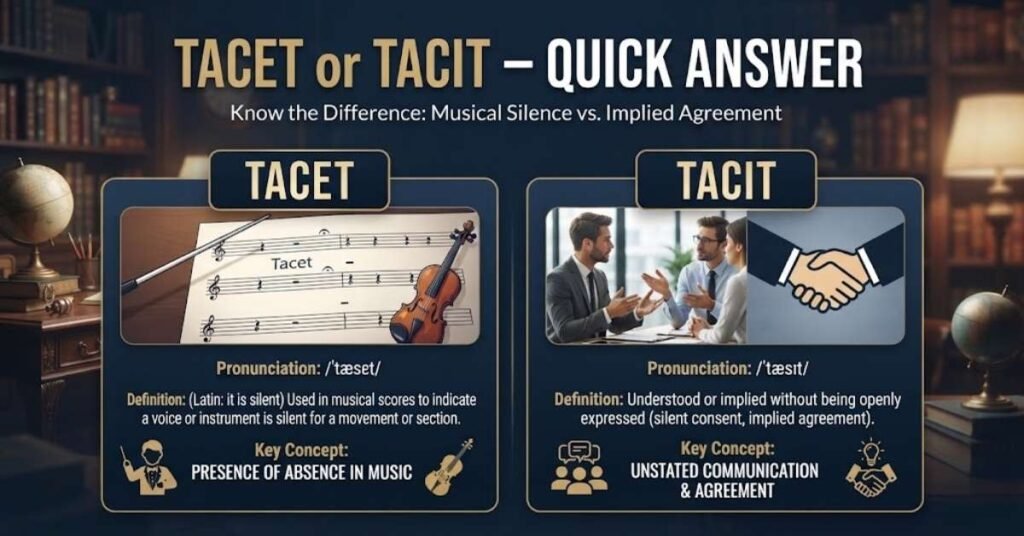
Here’s the short version you came for. Tacet shows up in sheet music. It tells a musician to stop playing for a set number of measures. Tacit shows up almost everywhere else. Think tacit agreement, tacit approval, or a tacit understanding between two people.
So if you’re writing about an orchestra, a violin part, or a musical score, you want tacet. If you’re describing an unspoken deal at work or a nod that says “we’re good,” you want tacit. One word lives in music terminology. The other lives in general English.
The Origin of Tacet or Tacit
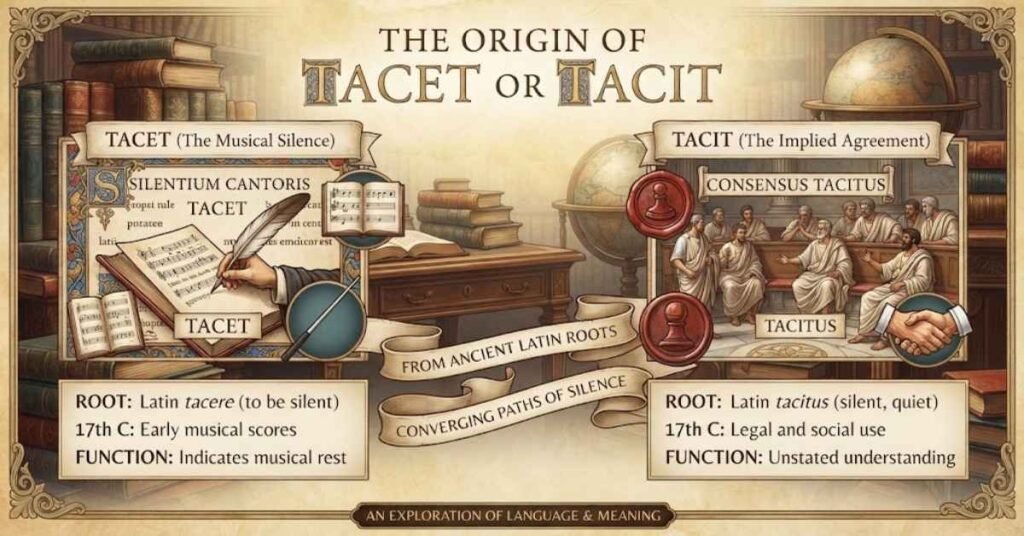
Both words trace back to the same Latin roots, which explains why they look like twins. Tacere is the Latin verb meaning “to be silent.” That single verb split into two paths over centuries.
Tacet comes straight from Latin and kept its original form. It’s literally Latin for “it is silent,” borrowed whole into music notation. Composers needed a quick way to mark rests for a whole section without writing empty staff lines. Tacet did the job, and it stuck.
Tacit took a longer road through French and into English as an adjective. It picked up a broader meaning along the way: silence as agreement, not just silence as sound. Fun fact for word nerds: the Roman historian Tacitus shares that same root, since his name basically means “the quiet one.” That’s the kind of trivia that makes etymology oddly satisfying.
British English vs American English Spelling
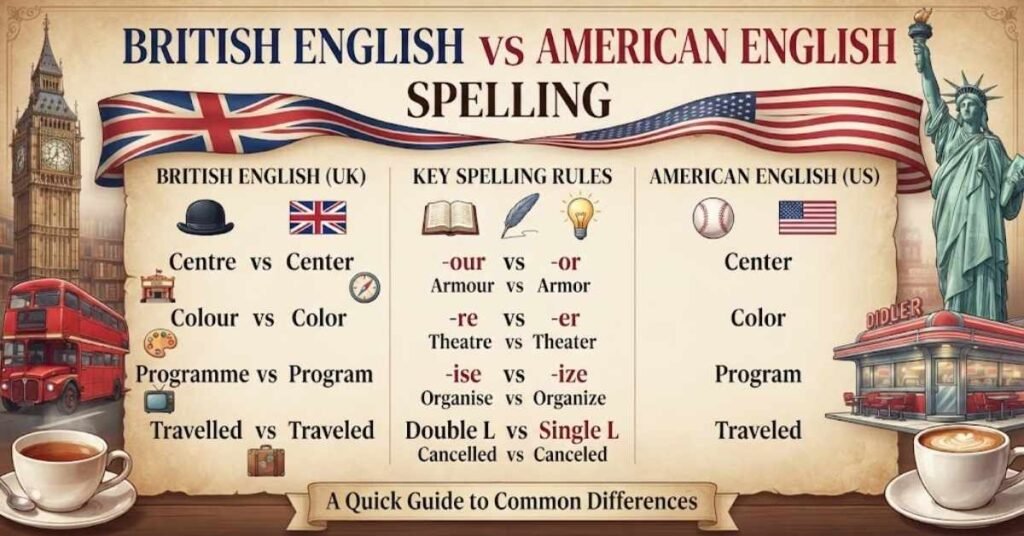
Here’s where people start second-guessing themselves. Good news: British English and American English don’t disagree on these two words.
Unlike color versus colour, or theater versus theatre, tacet and tacit spell the same way on both sides of the Atlantic. UK English, US English, and Commonwealth English all use identical spelling and identical meanings.
So if you searched this hoping for a regional spelling twist, there isn’t one. The real confusion isn’t British English vs American English. It’s the words themselves sounding alike but meaning different things.
Which Spelling Should You Use?
Ask yourself one question: are you talking about music, or are you talking about silence-as-agreement?
- Writing about a movement in a musical score? Use tacet.
- Describing an unspoken deal, a nod of approval, or an implicit agreement? Use tacit.
- Not sure? Read your sentence out loud. If it involves an instrument, a performance, or a music student’s homework, tacet fits.
Here’s a trick that helps: tacet almost never appears outside music-related texts. If your sentence has nothing to do with an instrument, a conductor, or orchestra performance, you almost certainly mean tacit.
Common Mistakes with Tacet or Tacit
Let’s talk about where writers actually mess up, because this is the part everyone searches for.
- Writing “tacet agreement” instead of tacit agreement. This is the single biggest mix-up online.
- Using “tacit” in a musical score where “tacet” belongs. Rare, but it happens with ESL learners and non-musicians writing about music.
- Autocorrect swapping one for the other, since both are short and both start with “tac.”
- Assuming they’re just alternate spellings of the same word. They’re not. They’re word comparison material, not synonyms.
I’ve seen this mistake in published content more than once, including in articles that should’ve caught it during editing. It’s a small error, but it signals sloppy proofreading to any reader who knows the difference.
Tacet or Tacit in Everyday Examples
Let’s make this real with sentences you’d actually write or read.
Tacit examples:
- “Her silence was a tacit consent to the plan.”
- “They reached a tacit agreement without ever discussing it directly.”
- “His nod was tacit approval for the new policy.”
- “There’s a tacit understanding between the two departments about deadlines.”
Tacet examples:
- “The flute has a two-measure tacet before the next entrance.”
- “Mark the violin part tacet for the entire second movement.”
- “The conductor reminded the orchestra about the tacet sections.”
Notice the pattern? Tacit connects to people and unspoken understanding. Tacet connects to instruments and printed sheet music. Keep that split in your head and you won’t mix them up again.
Tacit Agreement, Approval, and Consent: Why This Trio Matters
This deserves its own section because it’s where tacit does most of its heavy lifting in real writing.
Tacit approval shows up constantly in news reports and political writing. A lawmaker who says nothing about a controversial bill might be accused of giving tacit support to it. Policy change often moves forward this way, through silence rather than a public statement.
Tacit consent carries weight in contract law too. Sometimes a party’s inaction, not their signature, is treated as agreement. That’s a tacit agreement, and it can hold up legally depending on the situation. This is exactly why precise wording matters so much in legal texts. One wrong word changes the entire meaning of a clause.
Tacet or Tacit – Google Trends & Usage Data
Here’s something most articles on this topic skip entirely, and it’s genuinely useful.
Tacit gets searched far more often than tacet, based on general search volume patterns. That makes sense. Tacit fits into business writing, academic writing, and daily writing far more than a niche musical term ever could.
Tacet, on the other hand, spikes among music students and people reading a musical score for the first time. It’s a rare word outside that world, which is exactly why people search it instead of already knowing it.
Search intent behind each word is different too. Someone Googling “tacet” usually needs a definition fast, mid-homework or mid-rehearsal. Someone Googling “tacit” is often checking if they used it correctly in an email or an essay they’re about to send.
Comparison Table: Tacet vs Tacit
| Feature | Tacet | Tacit |
| Word type | Musical term | Adjective |
| Meaning | Stay silent (performance) | Understood without being said |
| Origin | Direct from Latin (Tacere) | Latin via French |
| Used in | Music notation, sheet music | Business emails, essays, legal texts |
| Common phrase | “Tacet for 8 measures” | “Tacit agreement“ |
| Frequency | Rare word | Common in professional writing |
| Region | Same in US English and UK English | Same in US English and UK English |
Why This Confusion Happens So Often
Both words are short, start the same way, and came from one shared Latin ancestor. That’s basically a recipe for spelling confusion, especially for English learners juggling multiple new vocabulary rules at once.
Add autocorrect into the mix, and you’ve got a word swap that survives even careful writers. Most people learn “tacit” first, in school or at work, then stumble onto “tacet” later through music class or a musical score. By then, the brain’s already primed to default to the more familiar spelling. That’s when mistakes creep in.
Tips for Writers and English Learners to Remember the Difference
A few memory tricks that actually work, tested by writers and English learners alike.
- Tacet has an “e” like “eight measures rest.” A stretch, but it sticks.
- Tacit rhymes loosely with “implicit,” and both deal with unspoken meaning.
- If your sentence mentions an instrument, a score, or a conductor, tacet is your word.
- If your sentence could work in a business email or a courtroom, tacit is your word.
Try reading your sentence back and asking, “Could this appear on a page of sheet music?” If yes, tacet. If not, you’re almost certainly reaching for tacit.
Conclusion
So here’s the whole thing in one breath: tacet silences an instrument, tacit silences a statement while still communicating something. One belongs to music terminology. The other belongs to everyday English, formal English, and everything in between.
Next time you’re drafting an email about a tacit agreement, or marking up a musical score with a tacet, you’ll know exactly which word does the job. Small distinction, but getting it right makes your writing sharper and your communication clearer.Got a sentence you’re unsure about? Drop it in the comments and let’s sort it out together.
FAQs
Is tacet a real word?
Yes. It’s a legitimate musical term used in sheet music to instruct a performer to stay silent for a section.
What does tacit mean in a sentence?
It means something is understood or agreed upon without being directly stated, like a tacit understanding between coworkers.
Can tacit and tacet be used interchangeably?
No. They mean completely different things and belong to different contexts, one musical, one general.
Is tacit approval the same as tacit consent?
They’re close cousins. Both describe agreement shown through silence rather than words, though consent often carries more legal weight.
Why do tacet and tacit look so similar?
Both trace back to the Latin verb tacere, meaning “to be silent.” They just evolved into different roles over time.
Which spelling is correct in British and American English?
Both spellings stay identical in British English and American English. There’s no regional variation here.

Jack Harrison is a passionate writer with 4 years of experience exploring names, meanings, origins, symbolism, and cultural significance. He creates clear, engaging, and well-researched content to help readers discover the deeper meanings behind names and words.
