
You just typed “I have ate breakfast” and something felt off. Was it wrong? Should it have been “eaten” instead?
Here’s the short answer. Ate stands alone as the simple past tense of eat. Eaten always needs a helping verb like has, have, or had sitting next to it. Get that one rule locked in, and most of your confusion clears up right away.
Still, the details matter, especially if you’re writing emails, school papers, or social posts where a small slip can make you look careless. So let’s break this down properly, the way a teacher would explain it over coffee, not a textbook.
Ate or Eaten – Quick Answer
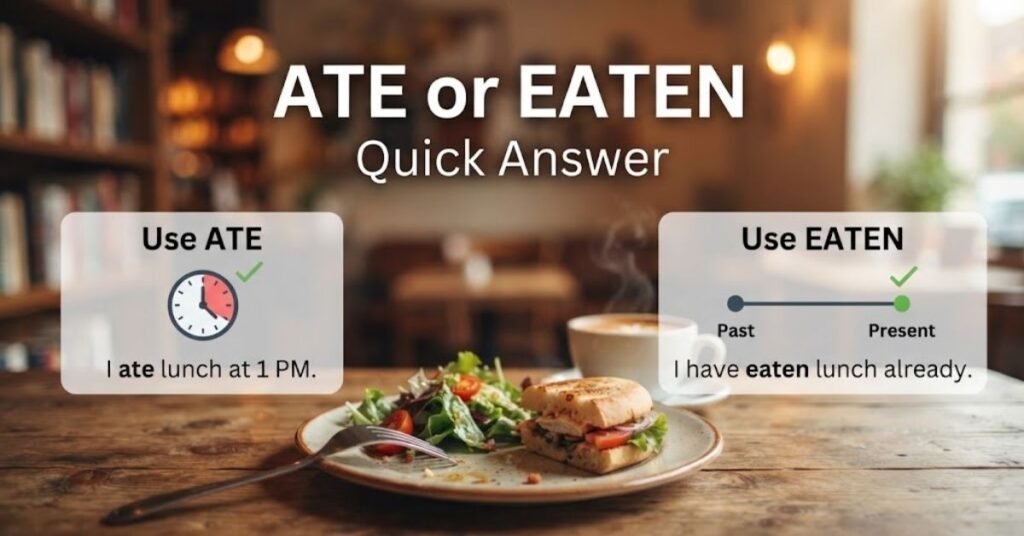
Think of eat as the root word, with three main jobs it can do. Ate is the plain past form, used by itself: “She ate lunch.” Eaten is the past participle, and it never walks alone.
You’ll spot eaten paired with words like has, have, or had almost every time. “He has eaten already” works. “He eaten already” does not. That single missing helper verb is where most grammar confusion starts.
This pattern isn’t unique to eat either. English is full of these irregular verbs, and once you understand one, the rest get easier to spot.
The Origin of Ate or Eaten
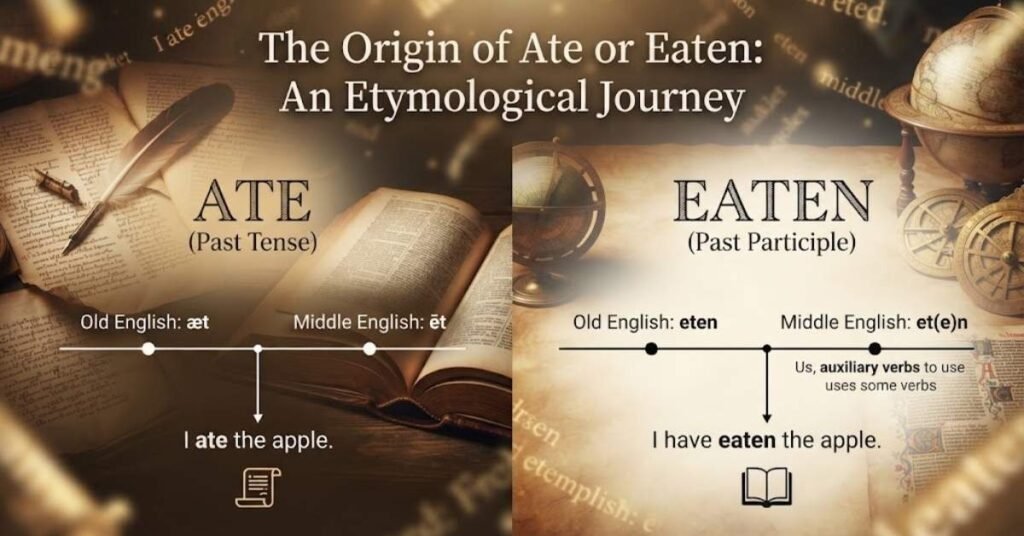
Both words trace back to Old English, from the word etan, which simply meant to consume food. Language historians note that this root has barely changed in meaning across centuries, even as spelling and pronunciation shifted.
By the time Middle English rolled around, etan had split into the forms we recognize now, ate and eaten. This kind of split happened to many verbs during that period, which explains why English has so many irregular verb patterns instead of one neat rule.
Knowing the word origin won’t fix a sentence on its own, but it helps explain why these forms don’t follow the usual “add -ed” pattern that regular verbs use.
British English vs American English Spelling
Here’s some good news. Unlike words such as colour and color, ate and eaten are spelled the same in British English and American English. No swapped letters, no regional spelling battles here.
Where things get slightly different is pronunciation. Many UK English speakers say “ate” closer to “et,” while most US English speakers say it as “ayt.” Both are accepted, so don’t let an accent throw off your confidence.
So if you’re writing for a global audience, spanning the United States, United Kingdom, India, or Pakistan, you can use either word without worrying about regional spelling rules. The grammar rule matters far more than geography here.
Which Spelling Should You Use?
This isn’t really a spelling choice, it’s a structure choice. The real question is whether your sentence has a helping verb attached. If it doesn’t, you’re reaching for ate. If it does, eaten is your word.
Let’s split this into simple use cases so it sticks.
Use ate when:
- The action is a completed action with no auxiliary verb nearby
- You’re describing a past action in a simple sentence, like “I ate dinner at 7”
- You’re speaking casually about something that already happened
Use eaten when:
- A helping verb like has, have, or had appears in the sentence
- You’re forming a present perfect tense structure: “have eaten,” “has eaten”
- You’re describing an action with a present connection, like “She has just eaten”
Audience guidance:
If you’re an English learner or a student prepping for exams, memorize this shortcut: ate never needs backup, eaten always does. This one line solves probably 80 percent of the mix-ups people run into during grammar exercises.
Common Mistakes with Ate or Eaten
The most frequent slip is “I have ate,” which mixes a helping verb with the wrong form. The correct version is “I have eaten.” This single error shows up constantly in casual texts, emails, and even resumes.
Another common one is dropping the helping verb entirely and saying “I eaten lunch.” Without has, have, or had, eaten cannot stand on its own, no matter how natural it might sound in fast speech.
These aren’t just small grammar errors either. In professional writing, a missing helping verb or mixing verb forms can make a message look rushed or careless, even if the meaning still comes through fine.
Ate or Eaten in Everyday Examples
Grammar rules feel abstract until you see them in the wild. So here’s how ate and eaten actually show up across different types of daily communication.
Emails
“I already ate lunch, so let’s push the meeting” sounds natural and direct. Compare that with “I have eaten lunch already,” which fits better in a slightly more polished, formal writing tone. Both are correct, the choice just depends on how casual your email is.
News
News writing tends to favor eaten in longer reports: “Officials confirmed the food had been eaten before the inspection.” This past participle form fits well when connecting one event to another point in time.
Social Media
Social media leans casual almost every time. “I literally ate that whole pizza” reads naturally, while “I have eaten that whole pizza” feels stiff for a caption. Context and tone decide the winner here.
Formal Writing
In formal writing, like reports or academic papers, eaten often appears alongside has or had to show a completed process: “The samples had been eaten by pests before testing began.”
School Work
Teachers commonly test this exact pair in school work and quizzes because it’s one of the most common grammar questions students get wrong. Practicing sentence pairs side by side is still the fastest way to lock it in.
Ate or Eaten – Usage Data
Why people search this keyword:
Most people search “ate or eaten” right in the middle of writing something, an email, a caption, or homework. It’s rarely idle curiosity, it’s usually a real time grammar question they need answered fast.
Popular regions:
Search interest for this exact phrase tends to cluster among English learners and students in regions like India, Pakistan, the United States, and the United Kingdom, where English is either a first or widely used second language.
Usage contexts:
The phrase shows up most in writing assistance searches, grammar checker queries, and classroom related searches, confirming this is a practical, everyday writing improvement need rather than a niche grammar debate.
Comparison Table (Keyword Variations)
| Term | Form | Needs Helping Verb | Example |
|---|---|---|---|
| Eat | Base form | No | I eat breakfast daily |
| Ate | Past tense | No | She ate an apple |
| Eaten | Past participle | Yes | They have eaten dinner |
| Eating | Continuous form | Uses is/am/are | He is eating now |
Quick Grammar Cheat Sheet
If you only remember one table from this whole guide, make it this pattern. Eat is your starting point, the base form you’d find in a dictionary. Ate handles simple past action, no extra words needed.
Eaten and eating both need a partner word. Eaten teams up with has, have, or had, while eating pairs with is, am, or are. Once you see the pattern this way, the whole verb table stops feeling random.
This same structure applies to plenty of other irregular verbs too, like go, went, gone, or see, saw, seen. Learning one pattern well genuinely speeds up how fast you pick up the rest.
Why Getting This Right Matters More Than You Think
A single wrong verb form rarely breaks communication, but it does shape how people read your writing. Recruiters skimming a cover letter, professors grading an essay, or clients reading a proposal all notice these small details, even subconsciously.
Clear verb conjugation signals attention to detail, and that matters more in professional writing than most people assume. It’s not about sounding fancy, it’s about sounding reliable.
The good news is this particular rule is one of the easier ones to fix permanently. A little practice with sentence correction exercises and you’ll stop second guessing yourself within days, not months.
Ate or Eaten Compared to Other Confusing Word Pairs
This isn’t the only pair that trips people up. Think about used or use, or figuring out whether a word is functioning as an adverb or adjective in a sentence. English has plenty of these near twins.
What connects them all is the same root issue, a small structural rule that gets skipped when we’re typing fast. Once you notice the pattern in one pair, spotting it in others becomes much quicker.
That’s actually good news for anyone doing serious language learning. Fixing one word difference builds a mental habit you can reuse across dozens of similar grammar comparison cases.
Practice Sentences to Test Yourself
Reading rules is one thing, applying them is another. Try filling in the blank before checking the answer, it’s the fastest way to build real communication skills.
- “By the time we arrived, they had already ___ (eat) dinner.” Answer: eaten
- “She ___ (eat) a burger for lunch yesterday.” Answer: ate
- “Have you ___ (eat) breakfast yet?” Answer: eaten
- “He ___ (eat) two apples this morning.” Answer: ate
If you got all four right, you’ve already mastered the core rule better than most native speakers do on their first try. If one tripped you up, just reread the cheat sheet above, it clicks fast with a little repetition.
Ate or Eaten in Casual Speech and Texting
Texting and casual chats bend grammar rules constantly, and that’s fine in low stakes settings. “Ate” alone often shows up as slang praise too, like “she ate that outfit,” meaning she looked amazing.
That slang usage has nothing to do with the grammar rule discussed here, but it does explain why some people search this exact phrase expecting a totally different answer. Context always decides meaning.
For actual grammar purposes though, stick to the helping verb rule. Save the slang version for group chats, not for essays or workplace communication where clarity matters more than trend language.
Conclusion
Ate and eaten aren’t complicated once you strip away the confusion. Ate stands alone, describing a simple past action. Eaten always needs a helping verb like has, have, or had standing beside it.
Whether you’re writing a quick text, a formal email, or a school assignment, this one rule will keep your sentences clean and confident. Practice it a few times today, and it’ll become second nature before you know it.
Got a sentence you’re still unsure about? Drop it in the comments and let’s sort it out together.
FAQs
1. What is the difference between “ate” and “eaten”?
Ate is the simple past tense used alone, while eaten is the past participle that always needs a helping verb like has, have, or had.
2. Can I say “I have ate”?
No, that’s a common grammar error. The correct phrase is “I have eaten,” pairing the helping verb with the past participle form.
3. Can I use “eaten” alone?
Not correctly. Eaten needs a helping verb attached, such as has eaten, have eaten, or had eaten, to form a complete sentence.
4. Is there a regional difference?
Spelling stays the same across British English and American English, though pronunciation can differ slightly between UK English and US English speakers.
5. Which is easier to use?
Ate is generally easier since it works alone in simple sentences, while eaten requires remembering the correct helping verb pairing.
6. Why is “eaten” used?
Eaten is used to show a completed action with a present connection, often in present perfect or past perfect sentence structures.
7. How can I remember the rule?
Remember this: ate stands alone, eaten needs backup. If you spot has, have, or had nearby, eaten is your word.

Jack Harrison is a passionate writer with 4 years of experience exploring names, meanings, origins, symbolism, and cultural significance. He creates clear, engaging, and well-researched content to help readers discover the deeper meanings behind names and words.
