Have you ever wondered whether to write skill set or skillset? These two spellings look different, but they generally share the same meaning. Both describe a combination of skills, abilities, and knowledge that helps you succeed at work or in daily life. For example, a software engineer may use programming and debugging skills, while a writer relies on research, editing, and proofreading. Each combination creates a useful set of abilities.
But which spelling is correct, and which one should you use? The answer depends on your writing style and the guidelines you follow. Skill set is a common choice in formal and professional writing, while skillset also appears in modern English. In this guide, you’ll learn the key spelling differences, grammar rules, and practical examples. You’ll also see how to use the term correctly in resumes, job descriptions, and everyday conversations.
Skillset vs Skill Set: The Quick Answer
The main difference between skill set or skillset is spelling, not meaning. Both forms refer to a collection of skills, abilities, or competencies that help you perform a task.
However, skill set is the more conventional choice in formal and professional writing. You’ll often see it in resumes, job descriptions, business writing, and career development articles.
The one-word form, skillset, also appears in everyday and professional contexts. Still, some editors and style guides prefer the two-word form.
- Skill set: The traditional open compound and widely accepted spelling.
- Skillset: A one-word alternative with the same general meaning.
- Skill sets: The plural form of the two-word version.
- Skillsets: The plural form of the one-word version.
For example:
- “My skill set includes writing and editing.”
- “The company needs a candidate with a strong technical skillset.”
Both sentences communicate the same basic idea. When in doubt, choose skill set and follow your organization’s house style.
What Does Skill Set Mean?
A skill set is a collection of skills, abilities, and competencies that someone uses to complete tasks or achieve goals. These skills can come from education, work experience, training, or personal practice.
Your skill set may include technical knowledge, communication skills, problem-solving, and teamwork. The exact combination depends on your job, interests, and experience.
For example, a software engineer may have programming, debugging, and system design skills. A marketing professional may have SEO, keyword research, and content strategy skills.
You can develop your skill set through practice, professional development, and certification programs.
Common types of skill sets include:
- Technical skill set: Programming, cybersecurity, SQL, and cloud computing.
- Soft skill set: Adaptability, teamwork, and conflict resolution.
- Leadership skill set: Delegation, coaching, and strategic planning.
- Creative skill set: Graphic design, illustration, and storytelling.
- Digital skill set: Google Analytics, email marketing, and digital tools.
Think of your skill set as a toolbox. Each skill is a tool that helps you handle different challenges.
Examples of skill set in a sentence
Seeing skill set in real sentences makes its meaning easier to understand. You can use it when discussing education, work experience, or personal development.
Here are some natural examples:
- My skill set includes writing, editing, and proofreading.
- The company needs someone with a strong technical skill set.
- She improved her skill set through regular training.
- His skill set makes him suitable for the leadership role.
- This internship helped me build a useful skill set.
- The job description lists several required skills for the position.
- My current skill set matches most of the job requirements.
- The course will expand your digital skill set.
Conversation example:
Maya: What skills do you bring to this position?
Alex: My skill set includes data analysis, communication, and project management.
Maya: Great! Those abilities match our team’s needs.
Notice how skill set refers to a combination of abilities rather than one specific skill. You can use it in resumes, cover letters, job applications, professional emails, and everyday conversations.
What Does Skillset Mean?
Skillset is the one-word spelling of skill set. It refers to the same collection of abilities, knowledge, and competencies. The main difference is its written form.
You may encounter skillset in job advertisements, online articles, company websites, and workplace conversations. Some writers use it because they prefer closed compounds, where two words combine into one.
For example, a web developer might describe their skillset as programming, database management, automated testing, and cloud deployment. A content writer might include research, SEO, editing, and storytelling.
Although the one-word form is used, skill set remains a safer choice for formal writing when you’re unsure which spelling an audience or editor expects.
Examples:
- “We’re looking for a candidate with a versatile skillset.”
- “Her digital skillset supports our marketing strategy.”
- “The training program helped him expand his professional skillset.”
Conversation example:
Sam: What kind of skillset does this role require?
Jordan: It requires communication, problem-solving, and basic data analysis.
Both speakers use the word to describe a combination of relevant abilities. If your workplace has a style guide, follow its preferred spelling.
Skill Set vs Skillset: Are They Different?
The difference between skill set or skillset is mainly orthographic. In other words, the two forms differ in spelling rather than meaning.
Skill set is an open compound, meaning it contains two separate words. Skillset is a closed compound because the words appear together as one word.
Both forms describe a collection of skills. Neither form automatically suggests better abilities, greater experience, or higher qualifications.
| Feature | Skill set | Skillset |
| Spelling | Two words | One word |
| Compound type | Open compound | Closed compound |
| Meaning | A collection of skills | A collection of skills |
| Common context | Formal and professional writing | Some modern and informal writing |
| Plural | Skill sets | Skillsets |
| Best approach | A reliable default | Use when your style guide allows it |
For example:
- “The candidate has a strong skill set.”
- “The candidate has a strong skillset.”
Both sentences express the same idea.
Your choice should depend on your audience, dictionaries, and editorial standards. Consistency matters more than switching between forms without a clear reason.
Is Skill Set One Word or Two?
The standard spelling skill set uses two words. It consists of skill, which identifies an ability, and set, which means a collection or group.
Together, these words form an open compound noun. The phrase describes several skills that someone can use in a particular role or situation.
For example, a marketing professional may have a skill set that includes content strategy, email marketing, keyword research, and Google Analytics.
The two-word form is a strong choice for formal writing, including resumes, reports, essays, articles, and professional emails.
Remember these examples:
- Correct conventional form: “She has a diverse skill set.”
- Another established form: “She has a valuable skill set.”
- Plural form: “The candidates have different skill sets.”
You can use a similar pattern with other compound expressions:
- Tool set: A collection of tools.
- Data set: A collection of data.
- Workday: A day spent working.
- Mindset: A way of thinking.
These examples show that English compounds do not all follow the same spelling pattern. When choosing between skill set and skillset, check a reliable dictionary or your preferred style guide.
Is Skillset One Word Correct?
Yes, skillset is used as a one-word spelling, and readers generally understand it to mean the same thing as skill set. However, its acceptance may depend on the dictionary, publication, or organization you follow.
English spelling changes over time. Some compounds begin as separate words, then appear with a hyphen, and may eventually become one word. Not every compound follows this path, though.
That’s why you shouldn’t assume that every familiar phrase has one universally preferred spelling.
Consider these points:
- Meaning: Skillset refers to a collection of skills.
- Clarity: Most readers can understand it from context.
- Formal writing: Skill set is the safer default if you’re unsure.
- Consistency: Avoid switching between skill set and skillset in the same document.
- Editorial standards: Follow the spelling required by your employer, teacher, or publisher.
For example, a technology company might write skillset in a recruitment post. An academic essay or corporate report may use skill set instead.
If you’re preparing a resume, cover letter, or job application, use the spelling that matches the rest of your document. The goal is clear, professional communication—not making a simple spelling choice more complicated than necessary.
Skill Set vs Skillset in US English
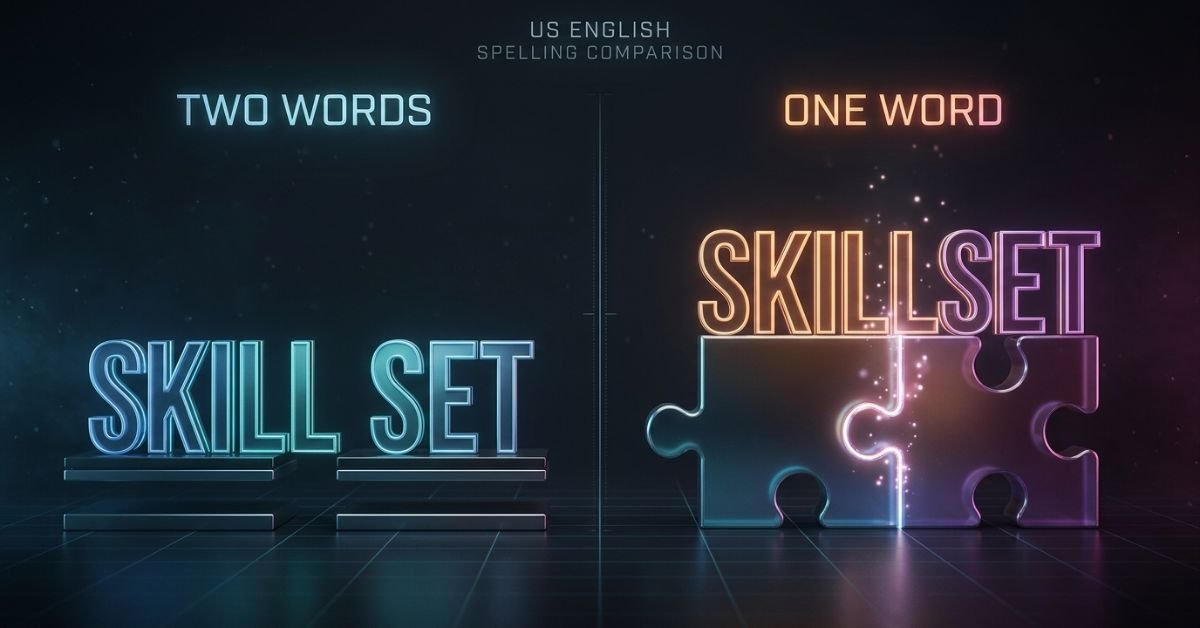
In US English, skill set is a reliable choice for professional and formal writing. You’ll commonly see it in resumes, job descriptions, career advice, and workplace communication.
The one-word form, skillset, also appears in modern writing. However, preferences can vary between companies, editors, and publications. There isn’t a universal rule that every US organization must follow.
If you’re writing for American readers, focus on clarity and consistency. Use the same spelling throughout your document unless you’re quoting a source that uses another form.
For example:
- “The job requires a specific skill set.”
- “I want to improve my technical skill set.”
- “Our training program develops employees’ leadership skill sets.”
These sentences work well in US professional writing.
You should also consider the purpose of your content. A resume needs clear language that recruiters can scan quickly. An article about career development should explain the term naturally without repeating it unnecessarily.
When writing for a US audience, consider these factors
Your spelling choice should support the reader’s needs and match the type of document you’re creating.
Keep these factors in mind:
- Style guide: Check your company’s house style or publication guidelines.
- Professional context: Prefer skill set when you need a conventional spelling.
- Consistency: Use one form throughout resumes, reports, and business writing.
- Readability: Make sure your sentence explains the specific skills involved.
- Audience: Consider whether you’re writing for recruiters, employees, students, or general readers.
- Specificity: Name relevant abilities instead of relying on a broad phrase alone.
For example, rather than writing, “I have a strong skill set,” you could write, “My skill set includes Python, SQL, data analysis, and automated testing.”
The second sentence gives a hiring manager more useful information.
Conversation example:
Recruiter: What makes you a good fit for this role?
Candidate: My skill set includes project management, communication, and Microsoft Excel.
Recruiter: Those skills match several of our preferred qualifications.
This approach works because it connects the phrase to real job skills.
Skill Set vs Skillset in British English
British English readers can understand both skill set and skillset. However, the preferred spelling may vary across dictionaries, publishers, employers, and other writing contexts.
The important point is not to assume that British English always requires one form and US English always requires another. The spelling difference is not a simple rule that separates the two varieties.
If you’re writing for a British audience, check the dictionary or style guide used by your organization. This is especially helpful when preparing reports, academic essays, professional emails, or job advertisements.
For example:
- “The applicant has a useful skill set.”
- “The employee wants to develop a broader skill set.”
- “The training program helps staff improve their technical skill sets.”
The two-word form is a sensible default when you need a conventional spelling and don’t have specific editorial instructions.
In workplace writing, clarity matters just as much as spelling. Explain which abilities you mean, especially when discussing technical expertise, industry knowledge, or professional development.
For example, a software engineer could list programming, cybersecurity, and cloud computing skills. A marketing candidate could mention SEO, content strategy, and email marketing.
These details help readers understand the person’s abilities. They also make your writing more useful than a general statement about someone’s skill set.
Skill Set as a Noun: How to Use It Correctly
The phrase skill set functions as a noun. It names a collection of skills, abilities, or competencies that someone possesses or develops.
You can use it as the subject or object of a sentence. You can also place descriptive words before it, such as technical, professional, strong, or diverse.
Examples:
- “Her skill set includes financial modeling and data analysis.”
- “The course will strengthen your professional skill set.”
- “The employer values a diverse skill set.”
- “His technical skill set includes programming and debugging.”
- “Communication skills are an important part of her skill set.”
Notice that skill set describes the collection, while the words after includes identify individual abilities.
You can use the phrase in business writing, corporate communication, schoolwork, and career discussions. It also works in a resume summary when you explain your relevant experience.
For stronger writing, be specific. Instead of saying, “I have many skills,” identify the abilities that match your target role.
For example, an entry-level web developer might write, “My skill set includes HTML, JavaScript, Git, and basic REST APIs.”
This sentence gives recruiters a clearer picture of the candidate’s qualifications.
Skill set singular vs plural
The singular and plural forms depend on whether you’re talking about one collection of skills or several collections.
Use skill set when referring to one collection. Use skill sets when referring to multiple collections.
Examples:
- Singular: “My skill set includes writing and editing.”
- Singular: “She has developed a strong technical skill set.”
- Plural: “The candidates have different skill sets.”
- Plural: “These training programs build new skill sets.”
- Plural: “Technology companies often seek varied skill sets.”
Remember that skills and skill sets don’t mean exactly the same thing grammatically. Skills refers to individual abilities or multiple abilities. Skill sets refers to separate collections of abilities.
Compare these sentences:
- “I have skills in programming and database management.”
- “My skill set includes programming and database management.”
- “The two candidates have different skill sets.”
All three sentences are correct, but each emphasizes something slightly different.
If you use the one-word form, the corresponding plural is generally written as skillsets. Still, the two-word spelling is a safe choice for formal writing.
The easiest memory trick is simple: one collection is a skill set; multiple collections are skill sets.
Skillset in Sentences
The phrase skill set or skillset describes a collection of skills that someone uses to complete tasks. You can use it when discussing work, education, personal growth, or career development.
The two-word form, skill set, is a reliable choice for formal and professional writing. The one-word form, skillset, has the same general meaning.
Here are some examples:
- My skill set includes writing, editing, and proofreading.
- She developed a strong skill set through practical experience.
- The company needs a candidate with a technical skill set.
- His skill set combines programming and problem-solving.
- This training program will expand your professional skill set.
- Her creative skill set includes graphic design and photography.
Conversation example:
Alex: What skills do you have for this position?
Jamie: My skill set includes SEO, keyword research, and content strategy.
Alex: Those abilities match our marketing needs.
You can also use the phrase in resumes, cover letters, job descriptions, and professional emails. For better results, mention specific abilities instead of making general claims. This helps recruiters understand your experience and qualifications quickly.
Skill Set vs Skills
Although people sometimes use skill set and skills interchangeably, the terms have slightly different meanings. Skills are individual abilities, while a skill set is a collection of related abilities.
For example, writing, editing, and proofreading are separate skills. When you combine them, you can describe them as a writing skill set.
Here’s a simple comparison:
| Term | Meaning | Example |
| Skill | One ability | Writing |
| Skills | Multiple abilities | Writing and editing |
| Skill set | A collection of abilities | A writing and editing skill set |
| Skill sets | Multiple collections | Different skill sets across teams |
Use skills when you want to name specific abilities. Use skill set when discussing a broader combination.
For example, a software engineer might have skills in Python, SQL, debugging, and database management. Together, these abilities form part of their technical skill set.
Conversation example:
Mia: What skills do you have?
Noah: I can use Python and SQL, and I’m good at data analysis.
Mia: So, data analysis and programming are part of your skill set.
Both terms are useful in professional writing. Choose the one that communicates your meaning most clearly.
Common Types of Skill Sets
A skill set can include different abilities depending on your career, interests, and responsibilities. Some people focus on technical knowledge, while others rely on communication, creativity, or leadership.
Understanding these categories can help you identify your strengths. It can also help you choose relevant skills for a resume, LinkedIn profile, or job application.
Common types include:
- Technical skill set
- Soft skill set
- Leadership skill set
- Digital skill set
- Creative skill set
These categories often overlap. For example, a marketing manager may need digital skills, communication skills, and leadership abilities.
Your professional skill set can also change as you gain experience. Training programs, certifications, internships, and daily practice can help you develop new competencies.
Conversation example:
Sara: Which skills should I develop for career growth?
Ryan: Start with the skills your target role requires. Then build on your existing strengths.
You don’t need to master everything at once. Focus on abilities that match your goals and offer practical value in your chosen field.
Technical skill set
A technical skill set includes specialized abilities used to perform technical tasks. These skills often involve software, systems, data, equipment, or industry-specific tools.
Technology companies commonly look for technical skills when hiring software engineers, web developers, and IT professionals. The exact requirements depend on the position and its responsibilities.
Examples of technical skills include:
- Programming with Python or SQL
- Debugging and software testing
- Database management and system design
- Cybersecurity and network administration
- Cloud computing and cloud deployment
- Working with Git and REST APIs
- Automated testing and data analysis
For example, a web developer may need programming, debugging, and database skills. A software engineer may also need system design and experience with automated testing.
Conversation example:
Recruiter: What does your technical skill set include?
Candidate: I use Python, SQL, and Git. I also have experience with REST APIs and software testing.
When describing your technical skill set, name the tools you know and explain how you’ve used them. Practical examples make your abilities easier to evaluate.
Soft skill set
A soft skill set includes personal and interpersonal abilities that help you work effectively with others. These skills influence how you communicate, solve problems, manage time, and respond to change.
Employers value soft skills because most workplaces require teamwork and cooperation. Technical expertise alone may not be enough to handle every workplace challenge.
Common soft skills include:
- Communication skills
- Teamwork and collaboration
- Adaptability
- Time management
- Conflict resolution
- Problem-solving
- Critical thinking
For example, a candidate with strong communication skills can explain ideas clearly. Someone with good time management can organize tasks and meet deadlines.
Conversation example:
Manager: How do you handle a tight deadline?
Employee: I prioritize the most important tasks, manage my time, and communicate early if problems arise.
That answer demonstrates organization and communication. You can develop these abilities through group projects, workplace experience, and regular practice.
When writing your resume, support soft skills with real examples rather than simply listing words like reliable or adaptable.
Leadership skill set
A leadership skill set includes abilities that help someone guide a team, make decisions, and achieve shared goals. These skills are useful for managers, team leaders, project coordinators, and employees preparing for greater responsibility.
Leadership doesn’t always require a formal management title. You can demonstrate leadership by supporting colleagues, organizing projects, or taking responsibility for a problem.
Common leadership skills include:
- Delegation and task planning
- Strategic planning
- Decision-making
- Coaching and mentoring
- Performance management
- Conflict resolution
- Team motivation
For example, a project manager may delegate tasks according to each employee’s strengths. A team leader may coach new employees and help them improve their performance.
Conversation example:
Director: How would you describe your leadership skill set?
Candidate: I have experience coordinating projects, coaching new team members, and making decisions under pressure.
Strong leadership combines communication, accountability, and sound judgment. You can develop these abilities through practical experience, training, and feedback from colleagues.
When applying for leadership roles, explain how you’ve helped a team reach a goal. Specific results make your skill set more convincing.
Digital skill set
A digital skill set includes abilities that help you use digital tools, platforms, and technology effectively. These skills matter in marketing, administration, education, customer service, and many other fields.
Your required digital skills depend on your role. A marketing professional may need analytics and email marketing knowledge, while an office employee may rely on productivity software.
Examples include:
- Google Analytics and SEO tools
- Keyword research and content strategy
- Email marketing platforms
- Microsoft Excel, Word, and PowerPoint
- Google Workspace
- Project management platforms
- Basic data analysis and reporting
For example, a marketing candidate might use Google Analytics to review website performance. An administrative employee might use Microsoft Excel to organize records and prepare reports.
Conversation example:
Hiring manager: Which digital tools can you use?
Candidate: I’m comfortable with Microsoft Office, Google Workspace, and project management platforms. I also have experience with Google Analytics.
A useful digital skill set grows as tools and workplace needs change. Keep learning through practice, tutorials, and relevant certifications.
On your resume, list the platforms you know and describe how you used them in real tasks.
Creative skill set
A creative skill set includes abilities used to develop original ideas, communicate stories, and produce engaging content. These skills are useful in design, advertising, media, publishing, and digital marketing.
Creative work often combines artistic ability with practical thinking. For example, a designer may need to understand visual style while following a client’s budget and project requirements.
Examples of creative skills include:
- Graphic design and illustration
- Photography and video editing
- Writing and storytelling
- Content creation
- Visual communication
- Brainstorming and idea development
- Creative problem-solving
A graphic designer may use illustration software to create campaign visuals. A content creator may combine writing, photography, and video editing to produce social media content.
Conversation example:
Client: What does your creative skill set include?
Designer: I work with graphic design, illustration, and video editing. I also develop visual concepts for marketing campaigns.
When presenting your creative abilities, include examples of completed work. A portfolio can help employers see your style and understand your experience.
You can also mention how your creative skill set supports business goals, such as improving content quality or communicating a brand message clearly.
Skill Set in Resumes and Job Applications
Your resume should show how your skill set matches the role you want. Recruiters and hiring managers often scan applications quickly, so clear and relevant information matters.
Instead of listing every ability you have, focus on the skills mentioned in the job description. Separate required skills from preferred skills and show where your experience meets those needs.
You can include relevant abilities in your resume summary, skills section, and work experience. Your cover letter can explain how you developed those abilities and used them successfully.
Consider including:
- Technical skills relevant to the position
- Communication and teamwork abilities
- Software, platforms, or tools you know
- Industry knowledge and practical experience
- Relevant certifications or training
- Results from internships, projects, or previous jobs
Conversation example:
Recruiter: Why did you include SQL on your resume?
Candidate: The job description asks for data analysis. I’ve used SQL to organize and analyze project data.
That answer connects a specific skill to the employer’s needs.
Make sure your claims are accurate. A strong skill set is not about listing impressive terms; it’s about showing abilities you can actually use.
Better resume examples
A strong resume describes your skill set with specific, relevant details. Broad statements like I have excellent skills don’t explain what you can do.
Compare these examples to see the difference.
Example 1: Entry-level professional
Weak: “I have many computer skills.”
Better: “My skill set includes Microsoft Excel, Word, PowerPoint, and Google Workspace.”
Example 2: Software engineer
Weak: “I have a strong technical skill set.”
Better: “Technical skills include Python, SQL, Git, REST APIs, and automated testing.”
Example 3: Marketing position
Weak: “I am good at digital marketing.”
Better: “My digital skill set includes SEO, keyword research, content strategy, and Google Analytics.”
Example 4: Content writer
Weak: “I can create good content.”
Better: “My professional skill set includes research, writing, editing, proofreading, and SEO content optimization.”
Use the examples as guides, not claims to copy if they don’t reflect your experience.
You should also tailor your LinkedIn profile and cover letter to your target role. Mention relevant skills and support them with projects, work examples, or measurable results when possible.
Skill Set in Job Descriptions
A job description explains the duties, qualifications, and abilities needed for a position. Employers may use skill set to summarize the combination of competencies a successful candidate should bring.
For example, a software engineer may need programming, debugging, and system design skills. A marketing position may require SEO, content strategy, and communication skills.
A clear job description helps candidates understand what the role involves. It also helps recruiters compare applications against the employer’s actual needs.
A job advertisement might describe the expected skill set through several categories:
- Required skills: Abilities candidates must have to perform essential tasks.
- Preferred skills: Additional abilities that may strengthen an application.
- Technical skills: Tools, systems, or methods needed for the job.
- Soft skills: Communication, teamwork, and problem-solving.
- Qualifications: Education, certification, training, or relevant experience.
Conversation example:
Candidate: The advertisement mentions a broad skill set. Which abilities matter most?
Recruiter: Programming and database management are required. Cloud computing experience is preferred.
This distinction helps candidates understand the position and assess their suitability.
Employers should avoid vague descriptions. Listing specific tools, tasks, and experience levels makes recruitment more transparent and helps attract suitable applicants.
Why specificity matters
Specificity makes a job description more useful to candidates and hiring managers. The phrase strong skill set may sound positive, but it doesn’t explain what a person needs to do.
A clearer description names the skills, tools, and level of experience required. This helps candidates assess their qualifications before submitting a job application.
Compare these examples:
- Vague: “The candidate must have a strong technical skill set.”
- Specific: “The candidate must have experience with Python, SQL, database management, and software testing.”
The second example gives applicants a clearer picture of the role.
Specific job requirements also help recruiters evaluate candidates more consistently. They can compare applicants against relevant competencies instead of relying on broad impressions.
When writing a job description, consider these steps:
- Identify the essential tasks.
- List the required skills separately from preferred skills.
- Name relevant software, platforms, or tools.
- Explain the expected experience level.
- Include useful qualifications or certifications.
- Avoid adding skills that aren’t relevant to the position.
Conversation example:
Hiring manager: We need someone with a broad digital skill set.
Recruiter: Should we specify SEO, Google Analytics, email marketing, and content strategy?
Hiring manager: Yes. Those are the abilities the role actually requires.
Clear requirements improve communication and help candidates present the most relevant parts of their skill set.
Skill Set vs Skillset: Common Mistakes
Writers often confuse skill set or skillset because the two forms look different. However, both generally describe a collection of skills, abilities, or competencies.
The main challenge is choosing a spelling that fits your audience and writing style. Avoid assuming that one form is always wrong or that the two forms have different meanings.
Here are common mistakes to avoid:
- Treating skillset as automatically incorrect.
- Assuming skill set and skillset describe different concepts.
- Switching between spellings without a clear reason.
- Using skill set without identifying the actual skills.
- Confusing individual skills with a collection of skills.
For example, writing “I have a strong skill set” is grammatically fine. However, “My skill set includes Python, SQL, and data analysis” gives readers more useful information.
Conversation example:
Editor: Should we change every instance of skillset?
Writer: Let’s check our style guide first and use one spelling consistently.
Good writing depends on accuracy, clarity, and consistency. Once you choose a suitable form, use it throughout your document.
Treating skillset as automatically wrong
One common mistake is assuming that skillset is always incorrect. Although skill set is the more conventional choice in many formal contexts, the one-word form also appears in modern English.
The difference is mainly orthographic. Skill set is an open compound, while skillset is a closed compound. Both generally refer to a collection of abilities.
However, not every dictionary or editorial team treats the forms identically. You should check the relevant dictionary or house style when spelling matters.
For example:
- Conventional form: “She has a valuable skill set.”
- One-word alternative: “She has a valuable skillset.”
Both sentences communicate the same basic idea.
Conversation example:
Writer: Is skillset a spelling mistake?
Editor: Not automatically. Let’s check the dictionary and follow our publication’s style guide.
If you’re writing a resume, report, or academic essay, skill set is a sensible default. The important thing is to use an appropriate spelling rather than correcting the one-word form blindly.
Treating the two forms as different concepts
Another mistake is believing that skill set and skillset describe different abilities. In ordinary usage, both forms generally refer to a collection of skills.
The spelling difference does not automatically change the meaning. A technical skill set might include programming, debugging, and database management, regardless of which spelling you choose.
Consider these examples:
- “My skill set includes writing and editing.”
- “My skillset includes writing and editing.”
Both sentences describe the same combination of abilities.
The context determines what the phrase means. It doesn’t become a different concept simply because the words appear together.
Conversation example:
Mia: Does skillset mean something different from skill set?
Leo: Usually, no. Both refer to a collection of skills.
When writing about career development, focus on the abilities themselves. If you mean communication, leadership, or data analysis, name those skills directly. That gives readers more information than discussing the spelling alone.
Switching spellings randomly
Using skill set in one paragraph and skillset in the next can make an article look inconsistent. Although readers may understand both forms, random changes can distract them.
This issue matters in professional writing, including resumes, business reports, job advertisements, and website articles. A consistent spelling helps your work look polished.
Before you finish a document, check the spelling throughout the text.
- Choose one form.
- Follow your preferred dictionary or house style.
- Check headings, body paragraphs, tables, and captions.
- Keep the same form unless a quotation requires different wording.
- Use the appropriate plural form consistently.
Example of inconsistent writing:
“Our company values your skill set. We also want to develop your skillset.”
More consistent version:
“Our company values your skill set. We also want to develop your skill set.”
Conversation example:
Editor: Why do we use two spellings in this report?
Writer: I missed the difference during editing. I’ll make the wording consistent.
Consistency is an easy way to improve clarity. A quick proofreading check can catch this problem before publication.
Using skill set without naming the skills
The phrase skill set can describe a collection of abilities, but it doesn’t tell readers which abilities you have. Simply claiming to possess a strong skill set may sound vague.
This is especially important when writing a resume, cover letter, LinkedIn profile, or job application. Recruiters need specific information to assess your qualifications.
Compare these examples:
- Vague: “I have an excellent skill set.”
- Clearer: “My skill set includes SEO, keyword research, and content strategy.”
- More detailed: “My skill set includes SEO, keyword research, and content strategy developed through practical marketing projects.”
The final example adds context about how the candidate gained those abilities.
Conversation example:
Recruiter: What makes your skill set suitable for this role?
Candidate: I have experience with Google Analytics, email marketing, and content planning.
When describing your abilities, name relevant skills and support them with examples. This approach makes your writing more specific, credible, and useful.
Confusing skills with skill sets
Skills and skill sets are related, but they emphasize different things. A skill is an individual ability. A skill set is a collection of abilities that someone can use together.
For example, writing is a skill. Editing is another skill. When you combine writing, editing, and proofreading, you can describe them as a writing-related skill set.
Compare these sentences:
- “I have strong communication skills.”
- “My skill set includes communication, teamwork, and problem-solving.”
- “Our employees have different skill sets.”
The first sentence names a particular category of ability. The second describes a collection of abilities, while the third refers to multiple collections.
Conversation example:
Alex: Is SQL a skill set?
Jordan: SQL is a specific technical skill. It can be one part of your technical skill set.
Remember this distinction when preparing professional documents. Use skills to name individual abilities and skill set to describe their combination.
Skill Set vs Skillset Examples
Examples make the spelling difference easier to understand. Both skill set and skillset generally refer to a collection of abilities, so the surrounding sentence usually stays the same.
The two-word form is a reliable choice for formal and professional writing. The one-word form appears in some modern contexts, but you should follow the spelling preferred by your dictionary or style guide.
Here are examples of both forms:
| Skill set | Skillset |
| My skill set includes writing and editing. | My skillset includes writing and editing. |
| She has a strong technical skill set. | She has a strong technical skillset. |
| The course improves your digital skill set. | The course improves your digital skillset. |
| His skill set supports his career goals. | His skillset supports his career goals. |
| We need candidates with varied skill sets. | We need candidates with varied skillsets. |
Notice that the meaning remains essentially the same in each pair.
Conversation example:
Nina: Which spelling should I use in my report?
Omar: I’d use skill set unless our style guide recommends otherwise.
You can use the phrase in discussions about education, career development, job skills, and professional experience. For clearer writing, name the abilities whenever possible.
Skill Set vs Skillset: Side-by-Side Comparison
The main difference between skill set or skillset is how the phrase is written. The two-word form is an open compound, while the one-word form is a closed compound.
Both generally describe a group of skills, abilities, or competencies. The spelling itself does not indicate how experienced or qualified someone is.
Use this comparison as a quick reference.
| Feature | Skill set | Skillset |
| Spelling | Two words | One word |
| Compound type | Open compound | Closed compound |
| Meaning | Collection of skills | Collection of skills |
| Grammatical role | Noun phrase | Noun |
| Example | A technical skill set | A technical skillset |
| Plural form | Skill sets | Skillsets |
| Formal writing | Reliable default | Check the preferred style |
| Best practice | Use consistently | Use consistently |
Conversation example:
Writer: Does the one-word form change the meaning?
Editor: Usually not. The main difference is the spelling.
When writing for a business, school, or publication, check the relevant editorial standards. Dictionaries can also help you confirm preferred usage.
If you don’t have a specific rule to follow, skill set is a practical choice. It communicates the intended meaning clearly and fits many professional contexts.
Skill Set vs Skillset: Plural Forms
The plural form changes depending on whether you use the two-word or one-word spelling.
For the conventional two-word form, add s to set. This gives you skill sets. For the one-word form, the corresponding plural is skillsets.
Both plurals generally refer to multiple collections of skills. They do not mean exactly the same thing as the plural noun skills.
Examples:
- Singular: Each employee has a different skill set.
- Plural: The employees have different skill sets.
- One-word singular: Each candidate has a useful skillset.
- One-word plural: The candidates have different skillsets.
- Skills: The candidates have experience in writing and data analysis.
The choice depends on what you want to describe. Skills identifies abilities, while skill sets emphasizes collections of abilities.
Conversation example:
Manager: Do these candidates have similar skill sets?
Recruiter: No. One has strong technical skills, while the other has more leadership experience.
For professional writing, choose a spelling and maintain it throughout your document. If you use skill set, its plural should normally be skill sets. Avoid mixing skill sets and skillsets without a reason.
A Practical Case Study: Choosing the Right Form
Imagine you’re writing a job advertisement for a technology company. The role requires programming, database management, debugging, and communication skills.
You need to describe these requirements clearly. You also want the advertisement to look professional and consistent.
You could write:
“The ideal candidate has a strong technical skill set that includes Python, SQL, database management, and software testing.”
This sentence uses the conventional two-word form. It also names the specific abilities the employer needs.
Now imagine your company’s house style prefers skillset. You could use the one-word version instead, provided it fits the company’s editorial standards.
Conversation example:
Hiring manager: Should we use skill set or skillset in the advertisement?
Recruiter: Our house style uses skill set, so we should follow that.
Hiring manager: Should we list the specific skills too?
Recruiter: Yes. Candidates need to understand the job requirements.
The lesson is simple: choose the spelling that suits your writing standards, then focus on the content. Specific skills help candidates decide whether they qualify and help recruiters evaluate applications fairly.
Skill Set vs Skillset in Professional Writing
Professional writing values clarity, consistency, and correct usage. When deciding between skill set or skillset, consider your audience, document type, and organization’s style guide.
The two-word form is a reliable option for formal documents. You can use it in business writing, corporate communication, resumes, reports, and professional emails.
The one-word form may appear in company websites, recruitment content, and informal workplace writing. However, preferences can vary, so check the relevant editorial standards when necessary.
Follow these practical guidelines:
- Use one spelling consistently.
- Check your organization’s house style.
- Follow a reliable dictionary when uncertain.
- Name the actual skills when they matter.
- Avoid exaggerated claims about your abilities.
- Use examples to support statements about experience.
Conversation example:
Editor: This report uses both skill set and skillset. Which one should stay?
Writer: Let’s follow our style guide and standardize the wording.
The same principle applies to other compound words, such as tool set and data set. English compounds can follow different spelling patterns, so don’t assume every phrase follows the same rule.
In professional writing, a clear message matters more than making the spelling choice seem complicated.
When Should You Use Skill Set?
Use skill set when you want a conventional spelling that works well in many formal and professional contexts. It is a practical choice for documents where clarity and consistency matter.
You can use it when discussing an individual’s abilities, a team’s strengths, or the requirements of a job.
Common contexts include:
- Resumes and cover letters
- Job descriptions and job advertisements
- Business reports and professional emails
- Academic essays and schoolwork
- Career development articles
- Employee training plans
- Performance reviews
For example, a software engineer might write, “My skill set includes Python, SQL, and automated testing.”
A marketing candidate might write, “My skill set includes SEO, keyword research, and content strategy.”
Conversation example:
Student: Which form should I use in my essay?
Teacher: Skill set is a sensible choice. Check your assignment guidelines if they specify a preferred style.
Choose this form when you want to avoid uncertainty about the one-word alternative. Then keep the spelling consistent and explain the relevant abilities whenever the context requires more detail.
When Should You Use Skillset?
You can use skillset when your organization, publication, or preferred writing style accepts the one-word form. It generally carries the same meaning as skill set.
You may see it in modern online writing, workplace discussions, recruitment content, and company communications. However, its suitability depends on the standards you need to follow.
Before using it, consider these points:
- Does your dictionary recognize the form?
- Does your employer prefer closed compounds?
- Does the publication have a house style?
- Have you used the same spelling throughout the document?
- Will the wording remain clear to your audience?
For example, a company might write, “We’re looking for candidates with a versatile skillset.” The sentence is understandable, but another organization may prefer “a versatile skill set.”
Conversation example:
Content writer: Can I use skillset in this article?
Editor: Yes, if it follows our style guide. Otherwise, use skill set.
The one-word form can be appropriate when it matches established editorial practice. Don’t choose it just because it looks shorter or more modern. Your goal is to communicate clearly and follow the writing standards that apply to your work.
Skill Set vs Skillset: Which Should You Use?
For most formal and professional writing, skill set is the safer default. It is a conventional spelling that works well in resumes, business documents, reports, and job descriptions.
However, skillset is also used, and the two forms generally communicate the same meaning. The best choice depends on the dictionary, style guide, and audience you’re writing for.
Use this quick guide:
- Resume or cover letter: Prefer skill set unless your style guide says otherwise.
- Academic writing: Follow your teacher, institution, or required style guide.
- Business writing: Use the spelling approved by your organization.
- Online articles: Follow the publication’s editorial standards.
- Casual communication: Either may be understood, but consistency still helps.
Conversation example:
Writer: Which spelling is correct for my article?
Editor: Use skill set unless the publication specifically prefers skillset.
Remember that spelling is only one part of good writing. A sentence like “My skill set includes Python, SQL, and data analysis” is more informative than simply saying you have a strong skill set.
Choose a suitable form, apply it consistently, and describe the abilities that matter to your reader.
Skill Set vs Skillset: Easy Memory Trick
Here’s a simple way to remember skill set or skillset: think about whether you’re writing the phrase as two separate words or one combined word.
- Skill set: Two words, with a space between them.
- Skillset: One word, with no space.
- Skill sets: The plural of the two-word form.
- Skillsets: The plural of the one-word form.
You can also use a toolbox analogy. Imagine a toolbox filled with tools for different tasks. Your skill set works in a similar way: it brings together abilities you can use to solve problems or complete work.
For example, a web developer’s skill set might include programming, debugging, and database management. A writer’s skill set might include research, writing, editing, and proofreading.
Conversation example:
Maya: How do I remember which spelling to use?
Leo: Think of skill set as a set of skills. Write it as two words unless your style guide prefers skillset.
The key is not to overthink the spelling difference. Use skill set as your default for formal writing, follow your house style, and keep your choice consistent.
FAQs
1. Is skill set or skillset correct?
Both spellings are used, but skill set is a common choice for formal writing. Check your style guide for the preferred form.
2. What does skill set mean?
A skill set is a collection of abilities, knowledge, and competencies. It helps you complete tasks at work, school, or daily life.
3. Should I use skill set on my resume?
Yes, skill set is a suitable choice for your resume. List specific skills that match the job description and your experience.
4. Is skillset one word?
Yes, skillset is written as one word. However, skill set is a conventional alternative often preferred in professional writing.
5. Is there a difference between skill set and skillset meaning?
No, skill set or skillset generally has the same meaning. The main difference is spelling, not the abilities being described.
Conclusion
Choosing between skill set or skillset is easier when you understand their spelling and usage. Both forms generally describe a collection of skills, abilities, and knowledge. However, skill set is a common choice for formal and professional writing. You can use it in resumes, job descriptions, reports, and business emails. The one-word form, skillset, also appears in modern English. Always check your preferred dictionary or style guide when you feel unsure.
Remember, skill set or skillset usually has the same meaning. The main difference is how you write it. Use skill set as your default when no specific style rule applies. Keep your spelling consistent throughout your article or document. Also, name the skills that matter most. For example, mention writing, programming, communication, or problem-solving. This makes your meaning clear and helps readers understand your abilities.

Jack Harrison is a passionate writer with 4 years of experience exploring names, meanings, origins, symbolism, and cultural significance. He creates clear, engaging, and well-researched content to help readers discover the deeper meanings behind names and words.
