
Ever read a rental ad and wondered if “boarder” means dinner is included? Or worried you’d use the wrong word in a rental agreement?Here’s the short answer. A roomer rents a room only, while a boarder rents a room and also gets daily meals.
That food factor is the whole difference. Keep reading and you’ll see where the words came from, how people use them today, and where writers slip up.
Roomer or Boarder: Quick Answer
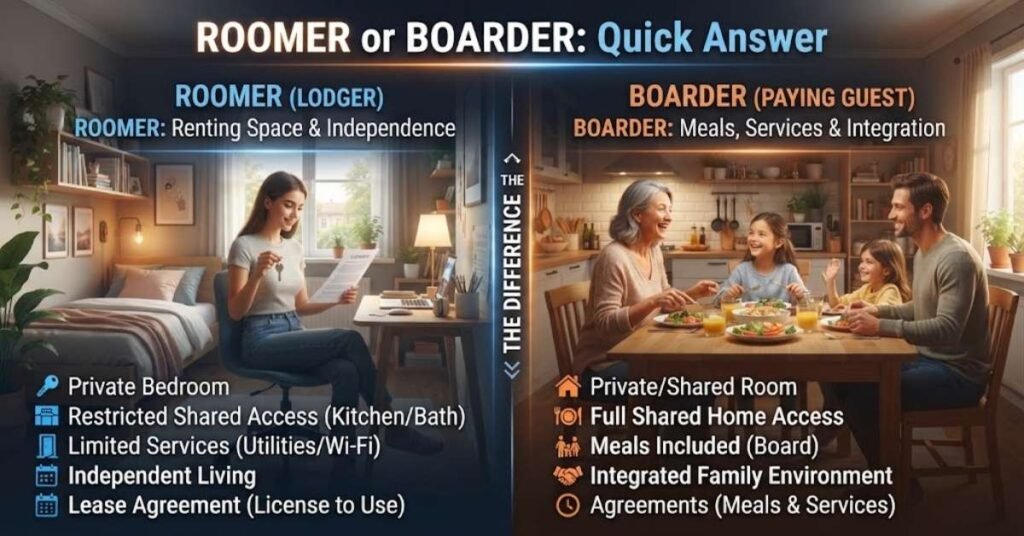
A roomer pays for a place to sleep and nothing more. You buy your own groceries and cook your own food.
A boarder pays for a bedroom plus room and board. The “board” part means meals served by the host, usually full meals at a shared table for meals.
Both live in a private home or shared house owned by someone else. That overlap is why people mix them up.
Examples
Real sentences make this stick faster than definitions. Here’s how each word sounds in the wild:
- Roomer: “The homeowner took in a roomer to cover the heating bill.”
- Roomer: “The rental listing offers a spare room with no kitchen access.”
- Boarder: “Two long-term boarders eat supper with the family every night.”
- Boarder: “The historic inn still keeps three boarders on the top floor.”
Notice the pattern. Whenever food shows up, boarder fits.
The Origin of Roomer or Boarder
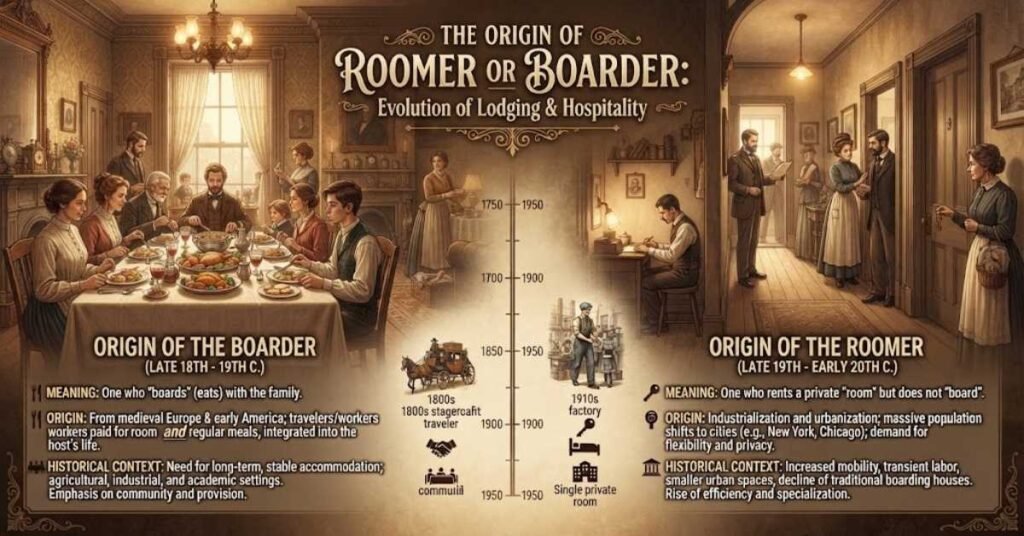
“Board” comes from an Old English word for a plank, which later meant a table. Tables held food, so “board” slowly came to mean meals. A boarder was simply someone who eats meals at your table.
“Roomer” is easier. It’s “room” plus the “-er” ending, meaning a person who occupies a room. The word grew popular in the US when rooming houses filled up with workers who moved to cities.
There’s a fun trap here. “Roomer” sounds exactly like “rumor,” so it’s a classic pair of homophones. Read it aloud in a sentence and you’ll see why the etymology matters for pronunciation too.
British English vs American English Spelling
Here’s a surprise. The spelling of both words is identical in British English and American English. Nobody writes a special UK version of boarder.
What changes is usage frequency. Americans say roomer far more often, while people in the United Kingdom usually say lodger. In Australia and other Commonwealth English regions, boarder and lodger are both common.
The only real spelling wrinkle is the homophone. Americans write “rumor,” and Brits write “rumour.” Roomer stays the same everywhere.
Which Spelling Should You Use?
You don’t have a spelling problem, you have a word choice problem. Your audience and location decide the right term. Let’s break it down by region.
American English
Use roomer for room only, and boarder for room plus meals. Both words are understood across the US. In a rental ad, roomer still feels a little old school but perfectly clear.
British / Commonwealth English
Use lodger for room only, and boarder when meals come with it. A UK reader may pause at roomer or assume you’re American. If you’re writing for UK or Australian readers, lodger is the safer pick.
Global and Professional Writing
When readers come from everywhere, skip the guesswork. Write “room only” or “room plus meals” directly. Then use roomer or boarder as a label after you’ve defined it once.
Common Mistakes with Roomer or Boarder
Most errors come from treating the two words as synonyms. They aren’t. Here are the three slips I see most.
Mistake 1: Using boarder for any renter
A tenant with their own lease and no meals isn’t a boarder. Neither is a renter who pays for a full apartment. Boarder only fits when food comes with the deal.
Mistake 2: Forgetting the food factor
Picture an ad that says “boarder wanted” but never mentions dinner. The reader has to guess, and guessing leads to misunderstandings fast. Always state what’s included: meal service, food included, or neither.
Mistake 3: Confusing boarder with border
A border is a line between countries or the edge of a page. A boarder is a person who lives somewhere and eats there. Try this trick: a boarder has “board” inside the word, and board means meals.
Roomer or Boarder in Everyday Examples
Words behave differently depending on where you write them. Here’s how each one shows up in real communication.
Emails
In a casual email to a landlord, you might write: “I’m looking for a roomer setup with no meals.” Short and clear works best. Add the living arrangements you want in one line so nobody has to ask twice.
News
A local paper might say, “The old farmhouse once had six boarders.” News writers lean on boarder because it carries history and meals in a single word. Roomer appears too, but more often in older or regional stories.
Social Media
Posts are quick and loose. Something like “Renting my spare room, roomer only, no meals” gets the point across in a scroll. Add “room only” in plain words, because not every follower knows the term.
Formal Writing
Contracts need exact terminology. A line like “The Owner shall provide the Boarder with two meals daily” leaves no gap. In formal documents, name what’s included instead of trusting the label alone.
Roomer or Boarder: Google Trends and Usage Data
Search behavior tells a useful story. Boarder pulls far more searches than roomer, and the reason is simple. Boarder also covers school boarding, pet boarding, and even snowboarders.
Roomer gets tangled with “rumor” in search queries. So its search intent splits between housing questions and gossip. People hunting for room rental info usually type “room for rent” rather than either word.
Search numbers shift over time, so I won’t quote figures here. Open Google Trends, enter both words, and filter by your country. Then compare search volume yourself for the freshest picture.
Comparison Table: Roomer vs Boarder
Sometimes a table beats a paragraph. Here’s the quick side by side:
| Feature | Roomer | Boarder |
| Pays for | Room only | Room plus meals |
| Meals | Not included | Included |
| Kitchen use | Often shared or limited | Host cooks |
| Typical setting | Private home, rooming house | Private home, inn, boarding house |
| Common in | US | US, Australia, UK |
| Similar word | Lodger | Lodger |
| Sounds like | Rumor | Border |
| Contract phrase | “Room only” | “Room and board” |
Roomer vs Lodger vs Tenant
Lodger is the flexible cousin. In the UK it can mean either a roomer or a boarder, depending on the deal. That’s why roomer vs lodger questions come up so often.
A tenant is different. A tenant usually holds their own space under a rental contract with real housing agreements behind it. A roomer or boarder usually shares the home with the owner.
Think of it this way. Tenant means your own door and your own lease. Roomer and boarder mean you’re a guest with a bed, and maybe a fork.
Rights of the Roomer and Boarder
Here’s where the words start to matter in court. Legal terminology changes by country and even by state. In many places, someone who shares a home with the owner gets fewer protections than a standard tenant.
That can mean shorter notice periods and simpler exit rules. It can also mean rights of the roomer are set by local housing law instead of a single national rule. Check your local housing authority before you sign anything.
I’m not a lawyer, so treat this as background, not legal writing advice. Put these items in every rental agreement:
- Rent amount and due date
- Whether meals are included, and how many
- House rules for guests and quiet hours
- Notice needed to leave
School Boarding and Pet Boarding
The same idea shows up outside housing. At a boarding school, students live on campus and eat there. That’s a boarder in the classic sense.
Pet boarding works the same way. Pet boarders are animals that stay overnight and get fed and looked after. A dog at a kennel gets a bed, meals, and care, which is room and board in miniature.
Context tells readers which meaning you intend. In a rental ad, boarder means a person with meals, and “pet boarders” usually means animals. When it isn’t obvious, add a clarifying word.
Conclusion
Roomer means room only. Boarder means room plus meals. That single food factor solves most confusion.Use lodger for UK readers and spell out “room and board” when you write contracts. You’ll dodge nearly every mix-up.
Did this clear things up for you? Drop a comment with the trickiest rental ad you’ve seen, and share this guide with anyone who’s renting out a room. I refresh this article regularly, so check back for updates.
FAQs
Is roomer a real word?
Yes, it’s a real English word. It means a person who rents a room in someone else’s home. It’s more common in American English.
Does a boarder always get food?
Yes, meals are the defining trait of a boarder. If there’s no food, the person is a roomer or lodger. Always confirm what’s included before you move in.
Is boarder the same as border?
No. They sound alike but mean different things. A border is a boundary, while a boarder is someone who rents a room and eats meals there.
Which word sounds more formal?
Lodger and boarder read a bit more formal than roomer. Roomer feels casual and American. For contracts, plain phrases like “room and board” beat all three.
Can pets be boarders?
Yes, in the pet boarding sense. Animals stay overnight and get food and care. It’s the same idea as a person paying for room and board.
Is roomer used in legal writing?
Sometimes. Certain US laws and local codes use “roomer” or “roomers.” UK legal writing prefers lodger, so check the rules where you live.
Can one person be both?
Over time, yes. Someone might start as a roomer and later add meals to the deal. From that point, they’re a boarder.

Jack Harrison is a passionate writer with 4 years of experience exploring names, meanings, origins, symbolism, and cultural significance. He creates clear, engaging, and well-researched content to help readers discover the deeper meanings behind names and words.
