
Continuous means something flows without a break, like time or temperature. It can take any value in a range, even tiny fractions.
Discrete means something comes in separate, countable pieces. You can count each unit on its own, like the number of students in a room.
Continuous
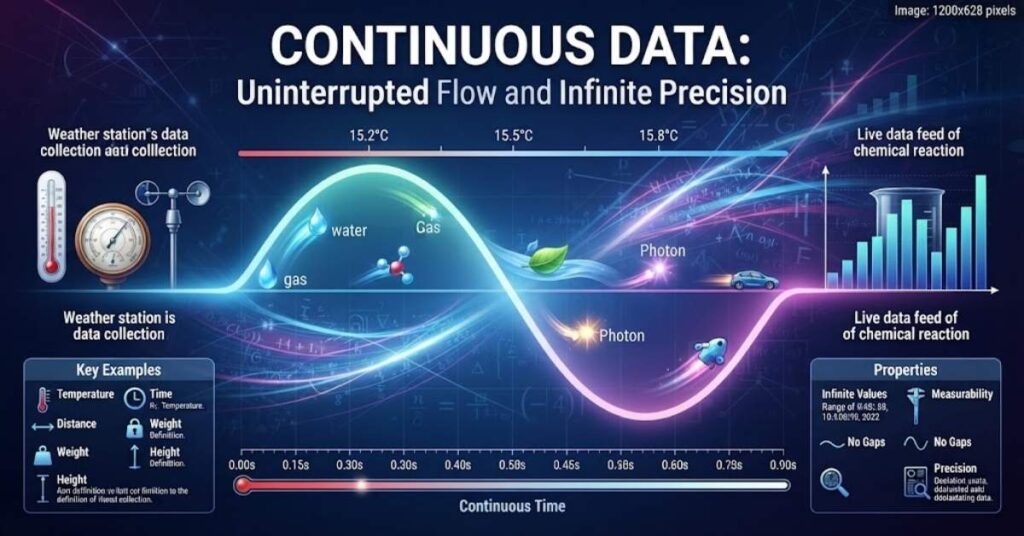
A continuous variable can land anywhere on a scale. Think of height, weight, or time. There’s no gap between one value and the next. You can always slice it thinner. A person’s height might be 170 cm, or 170.4 cm, or 170.42 cm.
Discrete
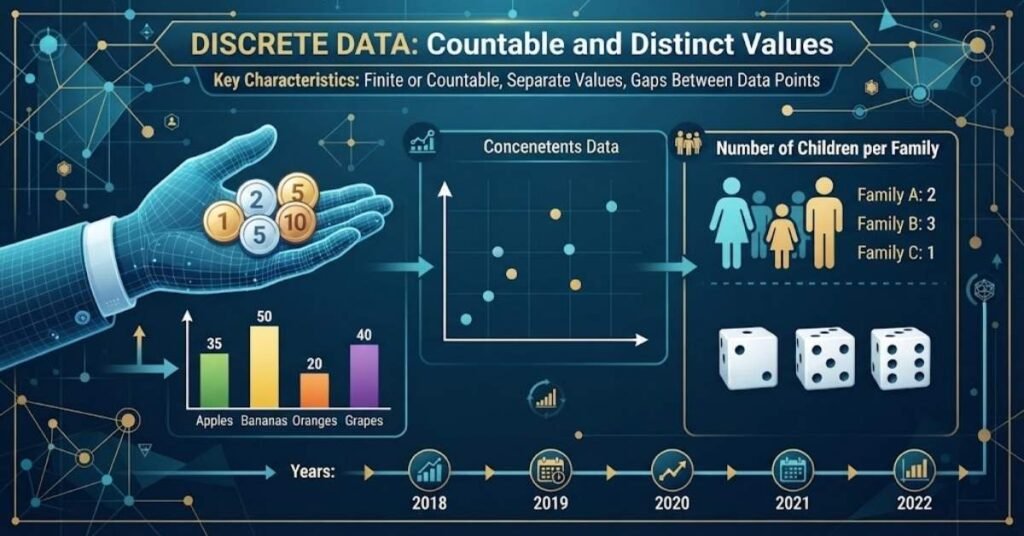
A discrete variable only takes fixed, separate values. The number of cars in a parking lot, the number of pets in a home, or exam scores all fit here. You can’t have 2.5 cars. It’s either 2 or 3, nothing in between.
Simple Rule

Here’s a quick trick to remember it. If you can measure it with a ruler or a clock, it’s probably continuous. If you count it on your fingers, it’s discrete.
The Origin of Continuous or Discrete
The word continuous comes from the Latin continuus, meaning joined together or unbroken. It describes something that keeps going without a pause, like continuous rain on a stormy afternoon.
Discrete traces back to the Latin discretus, which means separate or distinct. It’s about things standing apart from each other, each one its own individual unit.
These two roots explain why the words behave so differently in real use. One is about flow. The other is about separation.
British English vs American English Spelling
Here’s something worth clearing up early. Unlike word pairs with real regional spelling swaps, continuous and discrete don’t change between British and American English.
Both regions spell them the same way. The confusion usually comes from something else entirely, and we’ll get to that in the next section.
So if you searched for a spelling difference, you can relax. The real challenge isn’t British versus American. It’s picking the right word for the right kind of data.
Which Spelling Should You Use?
Since spelling isn’t the issue, the real question becomes usage. Where you use continuous or discrete depends heavily on your field.
Academic Writing
In academic writing, precision matters a lot. Papers on statistics, mathematics, or data science rely on these terms to describe continuous variables and discrete variables with zero ambiguity.
Professors expect exact usage. Mixing them up in a research paper can cost you marks or credibility.
Business and Technology
In business and technology, the terms show up in slightly looser ways. You’ll hear about continuous improvement, continuous monitoring, or continuous updates in software and engineering teams.
Here, continuous often means ongoing effort rather than a strict mathematical range. Discrete shows up too, especially when talking about discrete components in computing or discrete categories in reports.
Global English
Across global English, both words are used consistently everywhere. There’s no dialect that swaps them out for something else.
Writers in technical fields rely on this consistency. It makes technical communication easier across borders and industries.
Common Mistakes with Continuous or Discrete
Even smart writers trip up here sometimes. Let’s look at the most common slip ups so you can dodge them.
Confusing Discrete With Discreet
This one catches almost everyone at some point. Discrete means separate or distinct, while discreet means careful or private.
They sound identical when spoken. But mixing them in writing changes your meaning completely, and spell check won’t always catch it.
Using Continuous for Countable Data
Some writers use continuous when they really mean something you can count. Saying the number of students is continuous doesn’t work, since you can’t have half a student.
That’s a discrete value, plain and simple. Watch for whole numbers. They almost always point to discrete data.
Using Discrete for Smooth Measurements
The opposite mistake happens too. Calling temperature or age discrete ignores how these can shift by tiny fractions.
Age technically flows continuously, even though we round it to whole years in daily conversation. That rounding habit is where a lot of the confusion creeps in.
Forgetting the Main Difference
At the core, it’s really this simple. Continuous flows. Discrete counts.
Keep that one line in your head. It solves almost every mix up before it starts.
Continuous or Discrete in Everyday Examples
You don’t need a stats class to see these words in action. They show up constantly, often without anyone noticing.
Emails
Ever gotten a string of continuous updates from a project manager? That’s the word doing its job, describing something ongoing without a clear stopping point.
On the flip side, an email listing the number of people attending a meeting uses discrete numbers. Five attendees, not five and a half.
News
News reports love continuous coverage during breaking events. You’ll also see references to continuous seismic activity when scientists track earthquakes.
Meanwhile, headlines about the number of cars recalled or the number of books sold use discrete counts. Both words earn their place in journalism daily.
Social Media
Scroll through any app and you’ll spot discrete notifications stacking up in little folders. Each one is separate, countable, and distinct from the next.
Continuous shows up too, especially around continuous effort hashtags or fitness streaks. It’s become a favorite word for describing ongoing habits online.
Formal Writing
Formal writing leans on precise usage more than casual chats do. Reports on population growth often mix both words, since population count is discrete but growth rate can be continuous.
This blend trips up a lot of writers. Reading examples like this helps the distinction stick.
Continuous or Discrete – Google Trends & Usage Data
Search interest for these terms spikes during school exam seasons, especially around statistics courses and mathematics lessons. Students searching for clear explanations drive a lot of that traffic.
Certain regions show heavier search volume too, often tied to universities offering data science training programs. It makes sense. These words are foundational in any stats or research writing course.
Interest also holds steady year round among professionals in research, physics, and discrete mathematics. It’s not just a classroom topic. It’s a working vocabulary for entire industries.
Comparison Table: Continuous vs Discrete
| Feature | Continuous | Discrete |
| Definition | Unbroken, flows smoothly | Separate, countable units |
| Example | Time, temperature, height | Number of students, cars, pets |
| Can be a fraction? | Yes | No |
| Common field | Physics, measurement | Statistics, counting |
| Root word | Latin continuus | Latin discretus |
Continuous vs Discrete Data Examples
Let’s ground this with a few side by side comparisons.
Continuous data examples include height, weight, time, and temperature. Each one can be broken into smaller and smaller fractions without hitting a wall.
Discrete data examples include exam scores, the number of pets, and the number of books on a shelf. These stop at whole numbers. There’s no such thing as half an exam score in most grading systems.
Understanding this split matters a ton for data analysis. Pick the wrong category and your statistical analysis falls apart before it even starts.
Conclusion
So there you have it. Continuous flows without breaks, and discrete counts in separate pieces.The spelling doesn’t shift between British and American English, so you can stop worrying about that part. What actually matters is picking the right word for the right kind of information, whether you’re writing a research paper or just describing your continuous love for pizza.
Got a mix up story of your own? Drop it in the comments below. And if this cleared things up for you, share it with someone still confusing discrete with discreet.
FAQs
1. What is continuous data?
Continuous data can take any value within a range, including fractions. Height and temperature are classic examples.
2. What is discrete data?
Discrete data only takes fixed, countable values. Think of the number of students in a class or exam scores.
3. Is age continuous or discrete?
Technically, age is continuous since it changes every second. We just round it to whole numbers in daily conversation.
4. Is the number of students continuous?
No, it’s discrete. You can’t have half a student sitting in a classroom.
5. Is temperature continuous?
Yes, temperature is continuous. It can shift by tiny fractions of a degree at any moment.
6. Do British and American English differ here?
No, both spell continuous and discrete the same way. The real confusion comes from mixing up discrete with discreet.
7. What is the easiest way to remember the difference?
If you can measure it, it’s usually continuous. If you can count it on your fingers, it’s discrete.

Jack Harrison is a passionate writer with 4 years of experience exploring names, meanings, origins, symbolism, and cultural significance. He creates clear, engaging, and well-researched content to help readers discover the deeper meanings behind names and words.
