
You typed a message in a hurry. Then you paused and stared at one word. Is it “inportant” or “important”? That tiny doubt has probably hit you more than once, especially if you’re texting fast or writing an email before a meeting. You’re not alone, and the good news is this common spelling mistake has a very clear answer.
This article settles the confusion for good. We’ll cover the correct spelling, why so many people slip up, where the word actually comes from, and how to use it properly in emails, schoolwork, business writing, and even social media. By the end, you won’t second guess yourself again.
Inportant or Important – Quick Answer
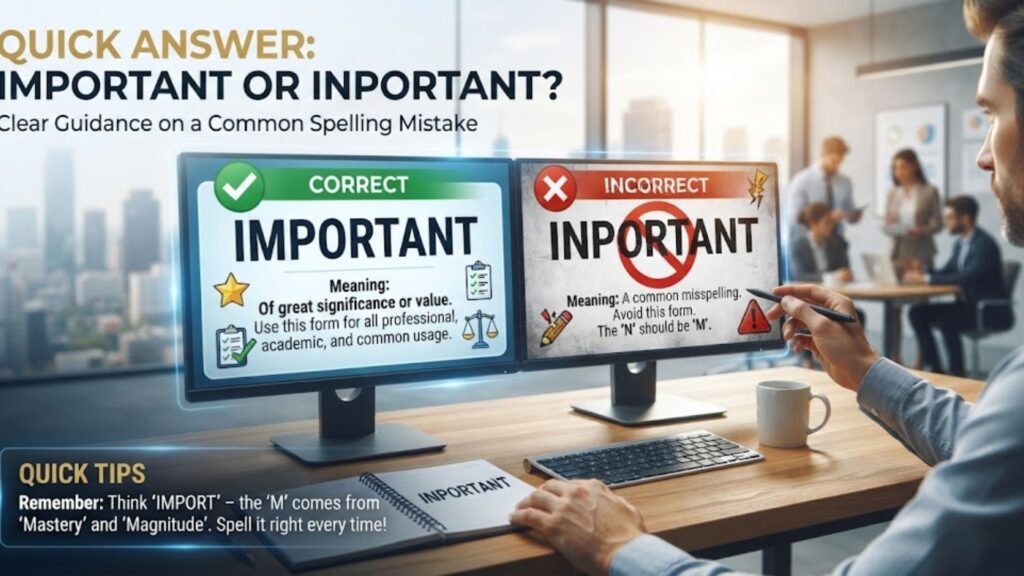
Important is the correct spelling. Inportant is simply an incorrect spelling, and it doesn’t appear in any English dictionary, formal or informal.
The mix up happens because of how the word sounds when spoken quickly. Your mouth blends the “m” and “n” sounds together, and your brain sometimes writes down what it hears instead of what’s actually correct. That’s a classic pronunciation-based spelling error, and honestly, it’s one of the most forgivable typing slips out there.
So if you remember nothing else from this article, remember this. Always write important, never inportant. Every professional document, school paper, and even a casual text should stick to the standard English spelling.
What Does “Important” Mean?
Important means something carries great value, influence, or significance. It describes a person, event, task, or idea that truly matters and deserves your attention.
Grammatically, important is an adjective. It describes nouns, like an important meeting, an important decision, or an important rule you shouldn’t ignore. You’ll rarely see it used any other way in standard writing.
Think about how often this word shows up in daily life. An important message from your boss. An important exam next week. An important announcement on the news. The word carries weight, so getting the spelling right matters just as much as the message itself.
Why Do People Write “Inportant”?
Here’s the honest truth. Nobody sits down and decides to misspell a word on purpose. This mistake almost always comes from sound based spelling confusion, not carelessness.
When you say “important” out loud, your lips barely separate the “m” from the “p” that follows it. That quick blend makes it easy for your brain to substitute an “n” sound instead, since “n” and “m” are cousins in terms of how they’re pronounced. This is called letter confusion, and it’s surprisingly common across many English words, not just this one.
Fast typing adds fuel to the fire too. If you’re rushing through a text or firing off a quick reply, your fingers sometimes follow the sound in your head rather than the actual spelling rule. Add autocorrect lag on mobile devices, and you’ve got the perfect storm for a typographical error slipping through unnoticed.
The Origin of Important
Word history nerds, this section is for you. Important traces back to the Latin word importare, which originally meant “to bring in” or “to carry into.” Over time, its meaning shifted from something physical being brought in to something carrying weight or significance in a more abstract sense.
The word passed through French before landing in English, picking up small spelling adjustments along the way. This journey through Latin origin and French influence on English is actually pretty typical. Tons of English vocabulary took a similar path, borrowing and reshaping words from older languages.
Knowing the etymology doesn’t just satisfy curiosity. It also explains why the “m” sits right where it does. The word never had an “n” in that spot, not in Latin, not in French, and not in English. So “inportant” isn’t a forgotten old spelling either. It’s simply a modern mistake.
British English vs American English
Good news if you were worried about regional differences. British English and American English don’t disagree here. Whether you’re writing from London, New York, Sydney, or anywhere else, important is spelled exactly the same way.
This might surprise people used to seeing spelling shift across regions, like “colour” versus “color” or “organise” versus “organize.” Those differences come from historical spelling reforms in American English, but important was never part of that shake up. It stayed consistent across UK English, US English, and Australian English alike.
So no matter which side of the ocean your reader sits on, you’re safe using important without any regional tweaks. It’s genuinely one of the more reliable words in the English language when it comes to universal spelling.
Which Spelling Should You Use?
Always use important. There’s no professional setting, casual context, or regional variation where “inportant” becomes acceptable. This isn’t a matter of style preference, it’s a matter of correct English word usage.
If you’re an ESL learner or someone who picked up English mostly through speaking rather than reading, this mix up makes complete sense. Sounds mislead us all the time. The fix isn’t about intelligence, it’s about training your eye to catch the pattern.
A simple trick helps here. Break the word into small pieces: im-por-tant. Saying it slowly, syllable by syllable, makes the “m” much easier to spot and remember. Try it a few times and the spelling starts sticking naturally.
Common Mistakes with Inportant or Important
Spelling slips rarely happen for just one reason. A few habits tend to team up and create this particular error, and recognizing them helps you catch the mistake before hitting send.
Writing what you hear
This is the biggest culprit. Writing what you hear works fine for plenty of English words, but “important” isn’t one of the forgiving ones. The spoken blend between “m” and the next sound tricks your ear into skipping the correct letter entirely.
Trusting sound over spelling
Trusting sound over spelling feels natural, especially for fast typists or people typing on a phone keyboard. But English spelling doesn’t always match pronunciation. This word is a perfect example of that mismatch, and it catches even confident writers off guard sometimes.
Ignoring spellcheck warnings
Modern spellcheck tools almost always flag “inportant” with a red underline. Yet plenty of people click past it, assume it’s a false alarm, or simply don’t notice. Ignoring spellcheck warnings is one of the easiest ways this mistake ends up in a final email or published post.
Inportant or Important in Everyday Use
Spelling mistakes don’t just live in isolation, they show up in real situations where they can actually cost you credibility. Here’s where this particular slip tends to appear most often.
Emails
Email writing is probably where this mistake causes the most damage. An important update to your team, an important customer relationship message, or an important announcement to clients all lose a bit of polish if the spelling is off.
A single typo won’t destroy your reputation, but repeated ones chip away at reader trust over time. Professional emails deserve a quick proofread before you hit send, especially when the message itself is genuinely urgent.
School & Education
Students and ESL learners run into this word constantly in essays, assignments, and class discussions. Teachers notice spelling patterns, and getting important wrong repeatedly can quietly affect how your writing is graded.
The fix is simple practice. Write the word a few extra times in your notes, or use it deliberately in a sentence each day until it clicks. Spelling practice like this builds long term writing skills, not just short term fixes.
Work & Business
In business writing, precision matters. An important project update, an important team update, or a note about an important decision should read cleanly, without distracting errors pulling focus from your message.
Workplace communication often moves fast, but that’s exactly why a second glance before sending pays off. Clean writing signals professionalism, and professionalism builds professional reputation over time, one email at a time.
News & Media
News and media outlets deal in important development stories daily, and spelling errors in published content look especially sloppy. Readers notice, and in a world full of content choices, small mistakes can push people toward a competitor’s article instead.
Editors typically catch these slips before publishing, but freelance writers and smaller outlets sometimes miss them. It’s worth double checking any piece before it goes live, particularly headlines carrying words like important announcement or breaking updates.
Social Media
Social media posts move fast, and typos happen constantly. Still, an important social media post, maybe sharing important health information or a serious update, deserves a quick read through before posting.
Once something’s shared online, it often gets copied, screenshotted, or quoted elsewhere. A spelling slip in that context can stick around longer than you’d expect, so a few extra seconds of proofreading genuinely pays off.
How to Remember the Correct Spelling for Good
Here’s a fresh trick that tends to work well. Picture the word import, as in bringing goods into a country. Now just add “ant” to the end: import plus ant equals important. Since “import” already has the correct “m,” this visual association makes the spelling stick almost instantly.
Another approach involves grouping this word with other commonly confused words. Think about mix ups like genius or genious, or donor or donar. Building a small mental list of tricky spellings, and reviewing them occasionally, trains your brain to slow down on words that usually trip people up.
Inportant or Important – Search & Usage Insight
Search engines see this question constantly, which tells you something useful. Plenty of confident, intelligent people still pause on this word, and typing the question into Google search is a completely normal move, not a sign of weak writing skills.
Search intent behind “inportant or important” usually falls into a few buckets: spelling confirmation, quick meaning clarification, or curiosity about pronunciation. Recognizing that this is a frequently misspelled word helps take the pressure off. You’re simply looking something up, the same way anyone checks a word they’re unsure about.
Comparison Table: Inportant vs Important
| Aspect | Inportant | Important |
| Correct spelling | No | Yes |
| Found in dictionaries | No | Yes |
| Grammatically valid | No | Yes (adjective) |
| Common cause | Pronunciation, fast typing | Standard English spelling |
| Acceptable in British English | No | Yes |
| Acceptable in American English | No | Yes |
| Flagged by spellcheck | Yes | No |
| Safe for professional writing | No | Yes |
FAQs
1. Is “inportant” ever correct?
No. Is inportant correct? Never, in any dialect, context, or writing style. It’s always treated as a misspelling of “important.”
2. Why do people spell it incorrectly?
Mostly because of how the word sounds when spoken quickly. The m and n confusion happens naturally in speech, and that carries over into typing for a lot of people.
3. Is the spelling different in British and American English?
No. Unlike some words with regional spelling differences, important stays exactly the same across British English, American English, and every other English variety.
4. Can spellcheck catch this error?
Yes, almost every modern spellcheck tool flags “inportant” instantly. The main issue is people sometimes ignore or dismiss the warning without checking it.
5. Is important a noun or adjective?
It’s an adjective. It describes nouns, such as an important decision or an important rule, rather than naming a person, place, or thing itself.
6. Does important have silent letters?
No, every letter in “important” is pronounced, though the “m” and the following sounds blend closely together in fast speech, which is exactly why the confusion happens.
7. Is this mistake common?
Very. It ranks among the more frequently misspelled words in English, largely because the pronunciation mistake feels so natural to make.
Conclusion
At the end of the day, this comes down to one simple rule. Important is correct, inportant is not, and no context changes that. The confusion makes total sense once you understand it’s rooted in pronunciation, not carelessness or lack of skill.Next time you’re drafting an important message, whether it’s an email, a school assignment, a business update, or a quick social media post, you’ll spell it right without even pausing.
And if you ever catch yourself hesitating again, just remember the import plus ant trick, and you’ll never look back.Got a spelling mix up that still trips you up? Drop it in the comments, chances are someone else struggles with the exact same word.

Jack Harrison is a passionate writer with 4 years of experience exploring names, meanings, origins, symbolism, and cultural significance. He creates clear, engaging, and well-researched content to help readers discover the deeper meanings behind names and words.
