
Ever typed “I have rode a bike since I was six” and then paused, wondering if that sounds off? You’re not alone.
This mix-up trips up native speakers and English learners alike. The good news? Once you get the logic behind it, you’ll never second guess yourself again.
Ridden or Rode – Quick Answer
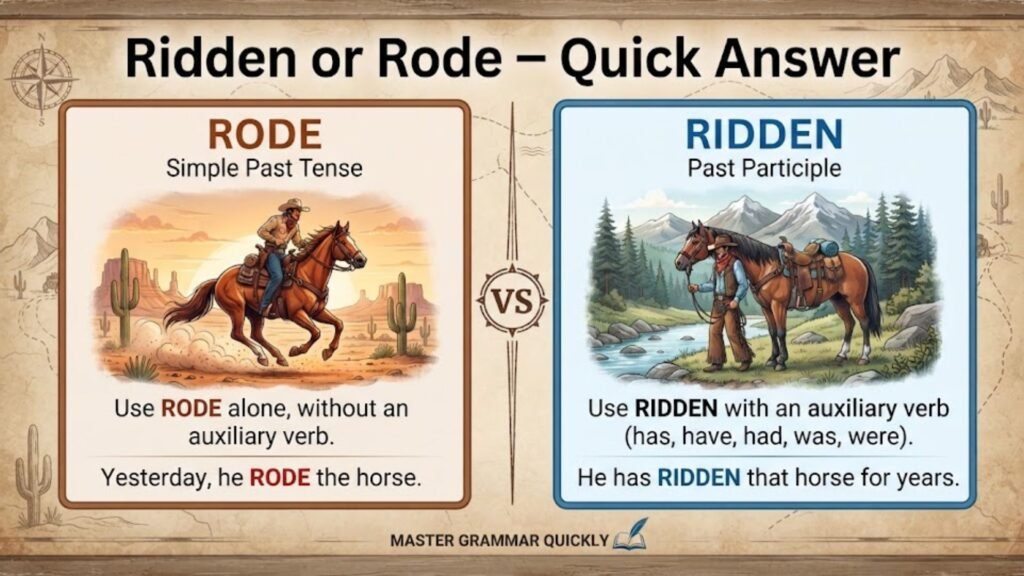
Here’s the short version. Rode is the simple past tense of the verb ride, and you use it alone, no helper needed. Ridden is the past participle, and it always needs a helping verb like have, has, or had standing next to it.
So “I rode my bike yesterday” works fine on its own. But “I ridden my bike yesterday” doesn’t, because ridden can’t stand by itself. It needs backup.
Think of it this way: rode walks alone, ridden always brings a friend. That one image will save you from most mistakes going forward.
The Origin of Ridden or Rode

Ride is one of those stubborn irregular verbs that refuses to follow the normal -ed rule. Most verbs just add -ed to form the past (like walk becomes walked), but ride does its own thing entirely.
This pattern goes way back to Old English, where the verb rīdan already showed vowel change as its way of marking tense. Instead of tacking on an ending, the vowel inside the word shifted, ride to rode to ridden, and that habit stuck around for over a thousand years.
You’ll notice English keeps a handful of verbs like this, think swim, swam, swum or sing, sang, sung. They’re leftovers from an older grammar system, and honestly, they add a bit of texture to the language once you stop fighting them.
British English vs American English Spelling
Good news here, there’s genuinely nothing to worry about. British English and American English spell rode and ridden the exact same way. No hidden trap, no regional twist.
Unlike words such as colour versus color, or realise versus realize, this particular verb pair skipped the whole spelling variation debate. Whether you’re writing for a UK audience, a US audience, or a Commonwealth reader, the forms stay identical.
So if you were bracing yourself for some confusing British English spelling rule, relax. Ride, rode, and ridden work the same across every English-speaking region on the map.
Which Spelling Should You Use?
Since spelling isn’t the issue, the real question becomes grammar, not geography. You pick rode or ridden based on sentence structure, not on which country you’re writing for.
Ask yourself one thing: is there a helping verb nearby? If you spot have, has, or had sitting close to the verb, ridden is your answer. If the sentence stands on its own with no auxiliary support, rode does the job.
This applies the same way in formal writing, professional writing, casual emails, or a quick social media caption. The rule doesn’t shift based on tone or platform, only based on what’s holding the sentence together.
Common Mistakes with Ridden or Rode
Let’s talk about the errors that show up constantly, sometimes even in published writing. The classic one is “I have rode”, which sounds fine in casual speech but breaks the grammar rule the moment you write it down.
Here’s a quick list of frequent tense errors people make:
- Saying “I ridden to school” instead of “I rode to school”
- Writing “She ridden” without any helping verb attached
- Using “He has rode” when it should be “He has ridden”
- Mixing up “They ridden” as a standalone past tense
- Treating rided as a real word (it isn’t, ride skips the -ed rule entirely)
A simple memory tip that works well: if you can swap in “walked,” the sentence needs rode. If you can swap in “have walked,” you need ridden. That little test clears up confusion fast.
Ridden or Rode in Everyday Examples
Grammar rules feel abstract until you see them in action, so let’s ground this in real scenarios you’ll actually run into.
Picture someone telling a story about their weekend: “I rode a bike to the lake on Saturday.” Simple, complete, no helper required. Now imagine the same person reflecting on a longer stretch of time: “I have ridden a bike since I was a kid.” That sentence stretches across years, which is exactly the kind of job present perfect tense handles.
Here are more everyday examples across different contexts:
- Rode a horse through the countryside last summer
- Ridden a horse competitively for over a decade
- Rode the bus to work this morning
- Ridden in races across three different countries
- Rode through the storm without stopping once
- Ridden across the desert during a documentary shoot
Notice the pattern? Rode fits a single, finished moment. Ridden fits ongoing experience, repeated action, or anything connected to a helping verb.
Past Tense vs Past Participle: What’s the Real Difference?
This distinction confuses a lot of people, so let’s break it down without the textbook jargon. Simple past tense describes something that started and ended, cleanly, in the past. It doesn’t need any extra support.
Past participle, on the other hand, teams up with auxiliary verbs to build perfect tenses. That includes present perfect (have/has ridden), past perfect (had ridden), and even passive constructions in some sentences.
Here’s a mental shortcut: simple past finishes the story by itself. Past participle needs a partner to complete the thought. Once that clicks, you’ll spot the right form almost automatically, no more guessing required.
Ridden or Rode – Google Trends & Usage Data
Curious how often people actually search for this? Google Trends shows steady interest in queries like “ridden or rode which is correct” and “past tense of ride,” suggesting this isn’t a rare confusion, it’s a genuinely common one.
Second-language learners search this topic frequently, but so do native speakers, particularly students working on essays or professionals double checking an email before hitting send. Spellcheck tools often miss this error too, since both rode and ridden are technically real words, just used in the wrong context.
That’s actually why this mistake sneaks past so many writers. A spell checker flags misspelled words, not misused grammar, so “I have rode” slides right through undetected unless you catch it yourself.
Comparison Table: Ridden vs Rode
| Feature | Rode | Ridden |
| Grammar role | Simple past tense | Past participle |
| Needs helping verb? | No | Yes (have/has/had) |
| Example sentence | I rode a bike yesterday | I have ridden a bike for years |
| Used for | One finished action | Ongoing or repeated experience |
| Common tense pairing | Past simple | Present perfect, past perfect |
| British vs American spelling | Same | Same |
Keep this table bookmarked if this topic keeps popping up in your writing. A quick glance settles the debate in seconds.
How This Applies to Formal Writing and Everyday Speech
In daily speech, people bend grammar rules constantly, and honestly, nobody’s correcting you mid-conversation. But formal writing, think school work, exams, news writing, or workplace professional communication, holds a stricter standard.
If you’re drafting a report, writing for news articles, or even polishing a personal essay, getting rode and ridden right signals attention to detail. Readers might not consciously notice correct grammar, but they absolutely notice when it’s wrong.
For online writing and social media posts, the bar is a little more relaxed, sure. Still, using the correct form makes your writing feel more polished, and honestly, more trustworthy too.
Similar Irregular Verbs That Follow the Same Pattern
Ride isn’t acting alone here. English has plenty of irregular verbs that shift vowels the same way instead of adding -ed. Recognizing the pattern helps the whole system click into place.
Take a look at a few familiar pairs:
- Used or Use: not the same pattern, but often confused similarly
- Swam or Swum: swim, swam, swum, nearly identical logic to ride
- Would or Will: different category, but frequently searched alongside verb confusion
- Sing, sang, sung
- Drive, drove, driven (this one mirrors ride almost exactly)
Once you notice drive and ride share the same transformation pattern, rode mirrors drove, and ridden mirrors driven, the whole thing starts feeling less random and more like a system you can actually predict.
FAQs
Is “I have rode a bike” correct? No. Since have is a helping verb, it needs ridden, not rode. The correct sentence is “I have ridden a bike.”
Is “I rode a bike yesterday” correct? Yes, completely correct. Yesterday marks a finished moment, and rode stands alone without needing support.
What is the base form of ride? The base form is simply “ride,” as in “I ride my bike every morning.”
Can I say “I ridden to school”? No, that’s incorrect. Ridden always needs a helping verb, so it should be “I rode to school” or “I have ridden to school,” depending on the timeframe you’re describing.
Why do people confuse ridden and rode? Mostly because both sound similar in casual speech, and spellcheck tools don’t catch context based grammar errors. The confusion is common among both native speakers and English learners.
How do I remember the rule for good? Rode stands alone, ridden needs a helper. If you can picture rode walking solo and ridden always paired up with have, has, or had, you’ll rarely get it wrong again.
Conclusion
At the end of the day, this comes down to one simple grammar rule: rode works by itself, ridden always needs a helping verb standing beside it. Once that distinction sits in your head, the confusion basically disappears.
Whether you’re writing a casual text, polishing a professional writing piece, or studying English as a second language, this small fix makes a real difference in how clear and confident your writing sounds.
Got a grammar mix-up you keep running into? Drop it in the comments, chances are, someone else is wrestling with the exact same question.

Jack Harrison is a passionate writer with 4 years of experience exploring names, meanings, origins, symbolism, and cultural significance. He creates clear, engaging, and well-researched content to help readers discover the deeper meanings behind names and words.
