
Have you ever written a word, stared at it, and suddenly thought, “Wait… is that spelled correctly?” You’re not alone. Even a simple word can cause doubt when one extra letter changes how it looks. This often happens in emails, invoices, school assignments, job applications, and everyday messages. One of the most common spelling doubts involves ammount or amount. So, which one should you actually use?
The answer is simple: amount is the correct spelling. Ammount is a common misspelling that adds an unnecessary second “m.” It may look harmless, but it can make your writing seem less polished. The good news? You only need to remember one small rule: amount has one “m.” Once you know that, this spelling confusion becomes easy to avoid. Whether you’re writing for school, work, or social media, choosing the right spelling keeps your message clear and professional.
Amount or Ammount – Quick Answer
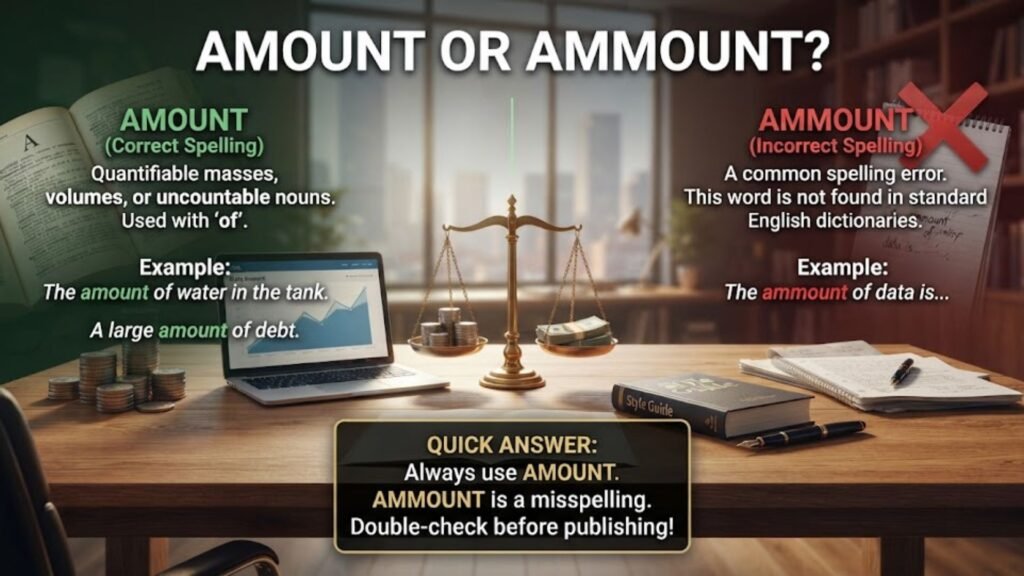
If you’re wondering about ammount or amount, the answer is simple: amount is the correct spelling. Ammount is an incorrect spelling and doesn’t count as a standard English word.
The confusion usually comes from the sound of the word. English has many words containing double letters, such as common and summit. However, amount uses only one m.
Think of it as a small spelling checkpoint:
- ✅ Amount — correct spelling
- ❌ Ammount — incorrect spelling
- Amount — standard English word
- Ammount — common spelling mistake
For example, write:
“Please check the total amount before paying.”
Don’t write:
“Please check the total ammount before paying.”
Whether you’re writing an email, invoice, exam answer, or job application, choose amount.
Ammount or Amount meaning
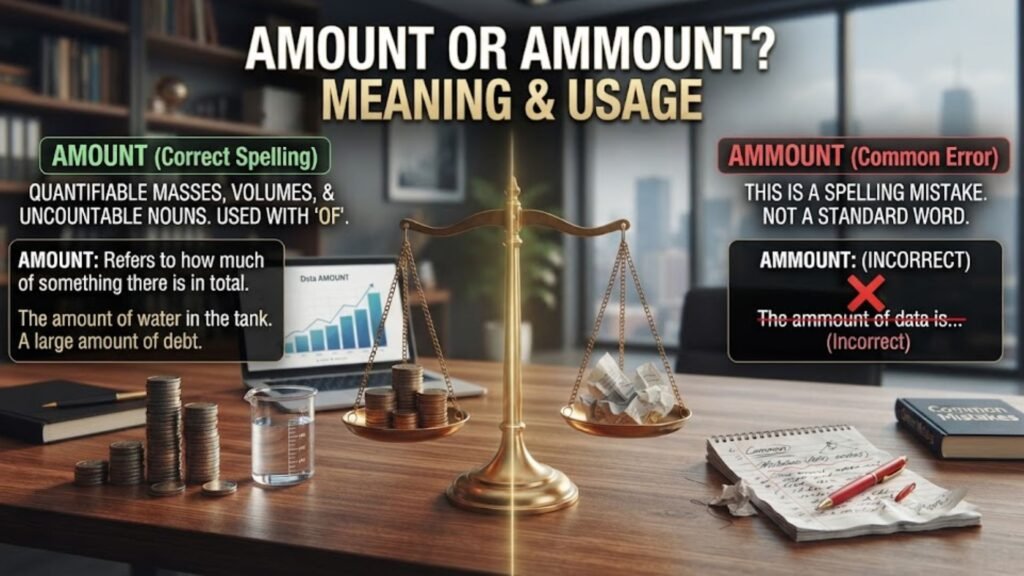
Amount refers to a quantity, total, or sum of something. You commonly see it when discussing money, time, materials, or other quantities.
It can work as both a noun and a verb.
As a noun:
“The payment amount is $250.”
As a verb:
“The repairs amounted to $250.”
Its plural form is amounts. Other correct forms include amounted and amounting.
- Amount — base word
- Amounts — plural form or third-person verb
- Amounted — past-tense verb
- Amounting — -ing form
- Ammount — incorrect spelling
So, when someone searches ammount or amount, they’re usually checking whether that extra m belongs there. It doesn’t.
The Origin of Amount or Ammount
The etymology of amount helps explain why its spelling looks unusual. The word traces back to Old French amonter, meaning roughly “to go up” or “to add up.”
Later, it appeared in Middle English as amounten. Over time, language evolution shaped the word into the modern amount.
The spelling never developed a second m in standard English.
That’s important because English often contains words with double letters. Consider:
- Common
- Summit
- Amount
The first two contain double letters. Amount doesn’t.
A useful memory trick is to picture the word as having a single m between “a” and “ount.” The spelling stays consistent in modern English.
So, ammount isn’t an alternative created through language evolution. It’s simply a spelling mistake that became common enough to appear in searches.
British English vs American English Spelling
Fortunately, you don’t need to memorize two versions here. Amount has the same spelling in both British English and American English.
The same rule applies across Commonwealth countries and for a global audience. No regional spelling change adds another “m.”
For comparison, English does have words such as:
- British English: colour
- American English: color
That difference doesn’t apply to amount.
If you’re writing for a British reader, use amount. If you’re writing for an American reader, use amount. The answer stays exactly the same.
The incorrect form ammount doesn’t become acceptable because of regional preference.
Comparison Table
| Spelling or feature | British English | American English |
| Correct spelling | Amount | Amount |
| Incorrect spelling | Ammount | Ammount |
| Plural form | Amounts | Amounts |
| Past form | Amounted | Amounted |
| -ing form | Amounting | Amounting |
So, unlike colour/color, there’s no British-versus-American spelling issue with amount.
Which Spelling Should You Use?
Use amount whenever you need this word in English. It works across countries, industries, and writing styles.
You might encounter it while preparing an invoice. You could also use it in an exam, business email, or casual conversation.
Here’s the simple rule:
- 🇺🇸 American English: Amount
- 🇬🇧 British English: Amount
- 🌍 Commonwealth countries: Amount
- 🌎 Global audience: Amount
- ❌ Ammount: Never use it
Imagine you’re checking a payment form before submitting it. The box might say “Payment Amount.” That’s the spelling you want.
In conversation, the same rule applies.
Friend: “How much is the total amount?”
You: “The total amount is $75.”
You don’t need a special exception for formal writing either. Amount works perfectly in emails, official documents, exams, and everyday messages.
Common Mistakes with Amount or Ammount
The most common mistake involves adding an unnecessary second m. Writers sometimes hear the word and assume it follows words such as common or summit.
That assumption leads to ammount, but the correct spelling contains only one m.
Watch for these mistakes:
- ❌ Ammount
- ✅ Amount
- ❌ Ammounts
- ✅ Amounts
- ❌ Ammounted
- ✅ Amounted
- ❌ Ammounting
- ✅ Amounting
Another common mistake involves trusting memory instead of checking a dictionary or spellcheck.
For example:
“The ammount seems wrong.”
Better:
“The amount seems wrong.”
When in doubt, remember the simplest rule: amount has one m.
Amount or Ammount in Everyday Examples
You’ll see amount in many everyday situations. It appears in financial records, casual conversations, news reports, and formal writing.
For example:
Emails
“Please confirm the total amount due.”
Invoices
“The invoice shows an outstanding amount of $600.”
Finance
“Enter the payment amount carefully.”
Exams
“Write the correct amount in the answer box.”
Job applications
“Enter your expected salary amount.”
Official documents
“The approved grant amount is $10,000.”
News
“A large amount of rainfall caused flooding.”
Social Media
“That concert generated a huge amount of attention.”
In a conversation, someone might ask:
“What amount did you pay?”
A natural reply would be:
“I paid the full amount yesterday.”
Across these situations, ammount would still be the incorrect spelling.
Amount or Ammount – Google Trends & Usage Data
Search data helps explain why people frequently type ammount or amount into search engines. Many users already suspect that something looks wrong. They simply want confirmation before submitting their writing.
Google Trends can also help illustrate search interest in spelling questions. However, search frequency doesn’t make a misspelling correct.
You’ll still find ammount in searches, websites, comments, and user-generated text. That doesn’t give it dictionary status.
The stronger evidence comes from standard dictionaries and established written usage.
Students may search the term before an exam answer. Professionals might check it before sending business emails or official documents. Non-native English speakers often use search tools to confirm unfamiliar spellings.
When spellcheck flags “ammount,” don’t treat that warning as a regional preference. Check a reliable dictionary instead.
The practical takeaway remains straightforward:
- Search interest doesn’t establish correct spelling.
- Amount is the standard form.
- Ammount remains a spelling error.
Amount or Ammount Comparison Table
A side-by-side comparison makes the ammount or amount question easy to settle. The two forms aren’t competing spellings.
One is the standard English word. The other contains an unnecessary letter.
| Feature | Amount | Ammount |
| Correct spelling | ✅ Yes | ❌ No |
| Standard English word | ✅ Yes | ❌ No |
| Contains one “m” | ✅ Yes | ❌ No |
| Contains double “m” | ❌ No | ✅ Yes |
| Plural form | Amounts | ❌ Ammounts |
| Past form | Amounted | ❌ Ammounted |
| -ing form | Amounting | ❌ Ammounting |
| Used in formal writing | ✅ Yes | ❌ No |
| Used in exams | ✅ Yes | ❌ No |
| Used in business emails | ✅ Yes | ❌ No |
| Used in finance | ✅ Yes | ❌ No |
| Accepted in British English | ✅ Yes | ❌ No |
| Accepted in American English | ✅ Yes | ❌ No |
The easiest rule is still the best one: amount has one m. Once that spelling sticks, ammount or amount becomes an easy choice.
Conclusion
Choosing the correct spelling can make your writing look cleaner and more professional. When you see ammount or amount, remember that amount is the correct word. Ammount is not a standard English spelling. It simply contains one extra “m.” This small mistake is easy to make, especially when typing quickly. Still, it is worth fixing before you send an email, finish an exam, or submit an official document.
The easiest way to remember ammount or amount is to focus on the spelling of amount. Write it with one “m” after the “a.” If you are unsure, use a dictionary or spellcheck. These tools can quickly catch ammount and suggest amount. Keep this simple rule in mind whenever you write. Whether you are a student, professional, or writer, use amount. Avoid ammount. That way, your writing stays clear, correct, and confident.
FAQs
Is amount or ammount correct?
Amount is the correct spelling. Ammount is incorrect. When checking ammount or amount, always choose amount in standard English writing.
Why is ammount incorrect?
Ammount is a common spelling mistake. The correct form is amount, which uses only one m after the first letter.
How can I remember ammount or amount?
Remember that amount has one m. This simple rule helps you avoid the incorrect spelling ammount in everyday writing.
Is amount used in formal writing?
Yes, amount is widely used in formal writing. You can use it confidently in emails, invoices, reports, and official documents.
How do I check ammount or amount?
Use a dictionary or spellcheck when unsure. These tools quickly identify ammount as incorrect and recommend the correct spelling, amount.

Jack Harrison is a passionate writer with 4 years of experience exploring names, meanings, origins, symbolism, and cultural significance. He creates clear, engaging, and well-researched content to help readers discover the deeper meanings behind names and words.
